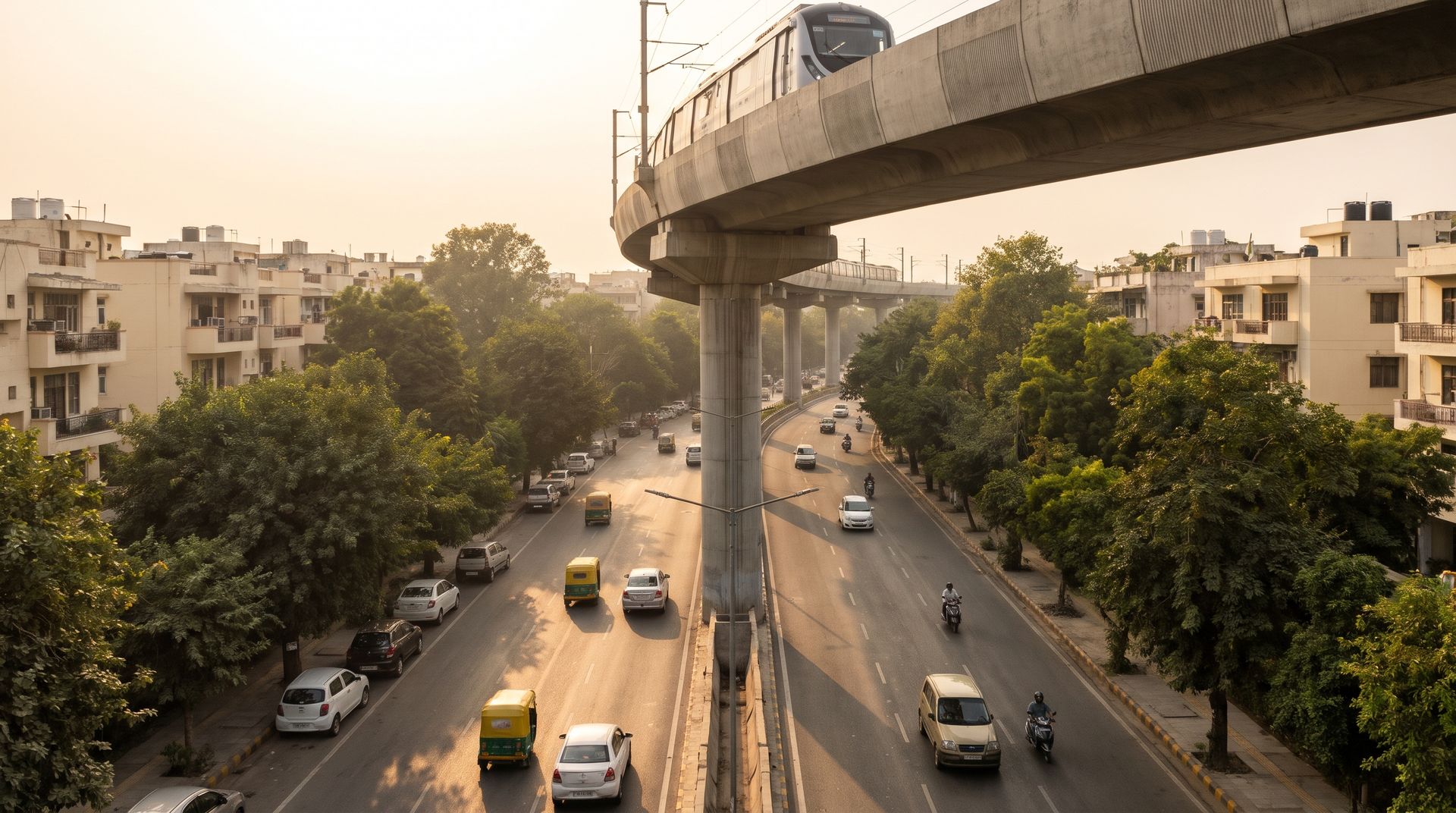
An elevated Delhi Metro viaduct curving above a tree-lined South Delhi arterial road at golden hour
SouthDelhiFloors · The Infrastructure Desk

Delhi Metro Phase 4 and South Delhi Property: Which Colonies Actually Gain

Phase 4 brings South Delhi its first proper east-west metro link, and a rewritten transit-oriented development policy opens everything within 500 metres of a corridor to denser building. Both are real. But the colonies the Golden Line serves are not the ones most buyers picture, and one number in the TOD rules quietly shuts almost every South Delhi plot owner out of the upside.

By the SouthDelhiFloors Research DeskSouth Delhi builder floors11 min read
Will Delhi Metro Phase 4 raise property prices in South Delhi?

In parts of it, yes — but mostly in the outer south, not the established colonies. The Phase 4 line that matters here is the Golden Line, running Delhi Aerocity to Tughlakabad. It serves Mahipalpur, Vasant Kunj, Kishangarh, Chhatarpur, IGNOU, Neb Sarai, Saket G Block, Sangam Vihar and Tughlakabad. The colonies most people mean by South Delhi — Greater Kailash, Defence Colony, Vasant Vihar, Hauz Khas — already sit on the Yellow, Violet, Magenta and Pink lines, so Phase 4 adds convenience rather than a new connection. The bigger change is regulatory: the 2026 transit-oriented development rules allow much denser building within 500 metres of a corridor, with floor area ratio up to 400–500. The catch is a 2,000 sq m minimum plot size — roughly 2,390 sq yards — which a typical 200 to 800 sq yard South Delhi plot cannot meet alone.

Infrastructure announcements move prices through expectation long before they move anyone through a station. It is worth separating what is being built, when it opens, and what the law now permits near it — because those three things have very different timelines.

Dec 2026Target for the Golden Line’s first 8.4 km section, Tughlakabad to Sangam Vihar
500 mTOD influence zone on either side of a metro corridor
2,000 sq mMinimum plot size for TOD — about 2,390 sq yards
207 sq kmArea of Delhi the revised TOD zone is reported to cover

What Phase 4 is actually building in the south

Phase 4 began in 2019. The corridor that touches South Delhi is the Golden Line (Line 10), from Delhi Aerocity to Tughlakabad — the first metro link running east to west across the southern belt, rather than funnelling everyone through the centre.

Published figures differ, and it is worth knowing why. Sources tracking the line as being built describe roughly 23.6 km with 15 stations; others count an approved branch and extension and give around 30 km with 19 stations. Either way, about 19.3 km of it is underground, which is why it has taken as long as it has.

Golden Line stations relevant to South Delhi, in order from Aerocity
Station Why it matters
Delhi Aerocity Interchange with the Airport Express; an RRTS interchange and a bus terminus are planned here
Mahipalpur The airport-side hotel and commercial belt
Vasant Kunj The largest residential catchment on the western half
Kishangarh, Chhatarpur Mandir The farmhouse belt and the Mehrauli side
IGNOU, Neb Sarai The institutional belt south of Saket
Saket G Block Where the branch line splits off; the Saket mall and hospital cluster
Sangam Vihar, Tughlakabad Tughlakabad interchanges with the Violet Line and the railway station

When it opens

As of October 2026 the line is still under construction. DMRC is targeting December 2026 for the first section: Tughlakabad to Sangam Vihar, 8.4 km and four stations, with the rest following in stages. Tunnelling has been progressing steadily — breakthroughs were completed at Chhatarpur Mandir to IGNOU in February 2025, at Vasant Kunj in March 2025 and near Tughlakabad in June 2025.

Treat opening dates as intentions

Metro timelines slip, in Delhi as everywhere. The useful question for a buyer is not when the line opens but whether you would still want the house if it opened three years late. Buy the home; treat the station as an upside, not as the reason.

The colonies that already have metro, and the ones that gain

South Delhi is better served than the Phase 4 coverage suggests. The Yellow Line is the district’s spine, running through INA, AIIMS, Green Park, Hauz Khas, Malviya Nagar and Saket. The Magenta Line crosses the west and centre at IIT Delhi, Hauz Khas, Panchsheel Park, Chirag Delhi, Greater Kailash and Kalkaji Mandir. The Violet Line covers the eastern side through Lajpat Nagar, Moolchand and Kailash Colony, and the Pink Line picks up South Extension and the Ring Road belt.

So for most established colonies, Phase 4 is an improvement in reach rather than a first connection:

  • Genuinely new access: Vasant Kunj, Mahipalpur, Kishangarh, Chhatarpur, Neb Sarai, Sangam Vihar. These are the places where a station is a step change rather than a convenience.
  • Better onward reach, same local access: Saket, and by extension Panchsheel Park, Malviya Nagar and the colonies on that side, which gain a direct run to the airport district without changing lines twice.
  • Little direct change: Greater Kailash, Defence Colony, Vasant Vihar, Hauz Khas Enclave, Anand Niketan, Jor Bagh. Already on the network; the gain is a shorter airport journey, not a new station.

The honest version for a buyer in the core colonies is that Phase 4 is not a reason to pay more. The airport connection is a genuine convenience, and for a household that flies often it is worth something. It is not a price event the way a first station is in an unconnected area.

Mohit Minocha, founder of SouthDelhiFloors, on what new metro lines do and do not do to South Delhi prices
Mohit Minocha, founder of SouthDelhiFloors. A station changes an unconnected area; in a connected one it shortens a journey.

The TOD rules: the part that could actually change what gets built

The bigger story is not the track, it is the planning rule attached to it. Transit-oriented development has existed in Delhi’s master plan since 2015, but the TOD Regulations and Charges notified in 2026 rewrote the terms, and the master plan now treats it as a principal source of new housing.

The TOD framework as reported after the 2026 notification. Confirm the gazette text before relying on any figure.
Provision What is reported
Influence zone 500 metres on either side of a metro corridor; 500 metres around RRTS and railway stations, for operational and proposed corridors alike
Planning area An 800-metre TOD planning area, with the inner 500 metres as the intense development area
Minimum plot Reduced from 8 hectares to 2,000 sq m
FAR Raised to roughly 400–500, against the far lower baseline for a plotted colony
Coverage About 207 sq km of Delhi falls within the influence zones
Use Mixed use and high density, with an affordable-housing component

Why most South Delhi owners cannot use it

The 2,000 sq m minimum is the number that matters, and it is easy to miss. 2,000 sq m is about 2,390 sq yards. A South Delhi builder floor typically stands on a plot of 200 to 800 sq yards. Even the large plots in Vasant Vihar, Maharani Bagh or Neeti Bagh fall well short on their own.

So TOD in a plotted colony is not something an individual owner opts into. It would need several adjoining plots amalgamated under one scheme, which in a freehold colony of separate owners is a slow, consent-heavy exercise. Realistically the early TOD development will be on institutional land, DDA parcels and larger sites — the authority has already identified a set of land parcels along metro corridors for exactly this.

What this means on the ground

If someone tells you a plot is “a TOD plot” and worth a premium because a station is nearby, ask two questions: is it inside a notified influence zone of a notified TOD node, and does the scheme have 2,000 sq m? A single 400-yard plot 300 metres from a station meets the first and fails the second. The master plan’s wider provisions are covered in our MPD 2047 highlights and what it means for South Delhi.

What proximity to a station is actually worth

From what we see in transactions, metro proximity in South Delhi behaves less like a premium and more like a filter. Three patterns:

It widens the tenant pool more than the buyer pool

A walkable station is a strong rental argument, particularly for professional tenants and company leases. Owner-occupier buyers in the premium colonies usually drive, and weigh quiet more heavily. Our rental income guide covers the landlord side.

Too close is its own problem

Directly beside a station entrance you get auto and cab queues, foot traffic and hawkers. The sweet spot is a short walk away, not a shared boundary — the same logic as the market and main-road trade-offs in our corner and park-facing guide.

The expectation arrives years before the train

Asking prices near an announced corridor tend to move on the announcement. Closed deals move much later, if at all. That gap is where buyers overpay, so test any “metro premium” against actual closed deals in the same block.

For a wider view of which colonies sit where, see our South Delhi map, the area-wise pricing page, and the markets map, since station, market and school access tend to move together.

Key takeaways: Phase 4 and South Delhi

  • The Phase 4 corridor that matters here is the Golden Line, Aerocity to Tughlakabad — South Delhi’s first east-west link.
  • First section targeted for December 2026: Tughlakabad to Sangam Vihar, 8.4 km and four stations. The rest follows in stages.
  • Genuinely new access goes to Vasant Kunj, Mahipalpur, Chhatarpur, Neb Sarai and Sangam Vihar, not to the established colonies, which are already on the network.
  • The 2026 TOD rules allow much denser, mixed-use building within 500 metres of a corridor, at a FAR of roughly 400–500.
  • The 2,000 sq m minimum plot — about 2,390 sq yards — puts TOD out of reach for a normal South Delhi plot without amalgamating several.
  • Treat a station as upside, not the reason to buy, and test any metro premium against closed deals rather than asking prices.

Frequently asked questions

What is the Delhi Metro Golden Line?
Line 10 of the Delhi Metro, built under Phase 4, running from Delhi Aerocity to Tughlakabad. It gives South Delhi its first east-west metro link, connecting the Mehrauli-Badarpur belt and Chhatarpur with the airport district. Roughly 19.3 km of it is underground. Published lengths vary between about 23.6 km and 30 km depending on whether an approved extension is counted.
When will the Golden Line open?

DMRC is targeting December 2026 for the first section, Tughlakabad to Sangam Vihar, which is 8.4 km with four stations. The remainder is expected to open in stages afterwards. As of October 2026 the line is still under construction, and metro timelines commonly slip.

Which South Delhi areas get a new metro station in Phase 4?

Mahipalpur, Vasant Kunj, Kishangarh, Chhatarpur Mandir, IGNOU, Neb Sarai, Saket G Block, Sangam Vihar and Tughlakabad, along with Delhi Aerocity at the western end. The established colonies such as Greater Kailash, Defence Colony, Vasant Vihar and Hauz Khas are already served by existing lines.

What is the TOD policy and how close must a property be?

Transit-oriented development allows denser, mixed-use building near transit. The influence zone runs 500 metres on either side of a metro corridor, and 500 metres around RRTS and railway stations, within an 800-metre planning area. It applies only in the influence zones of notified TOD nodes.

Can I use TOD rules on my South Delhi plot?

Almost certainly not on its own. The minimum plot size for a TOD scheme is 2,000 sq m, about 2,390 sq yards, while South Delhi builder floors usually stand on 200 to 800 sq yard plots. Using TOD would require amalgamating several adjoining plots under one scheme, with every owner’s consent.

Does a metro station nearby increase property prices?

It helps most where there was no connection before, and it strengthens rental demand more than owner-occupier demand in premium colonies. Being immediately beside a station entrance can be a drawback because of queues and foot traffic. Asking prices tend to move on the announcement; closed deals move much later, so compare actual transactions.

Which metro lines already serve South Delhi?

The Yellow Line through INA, AIIMS, Green Park, Hauz Khas, Malviya Nagar and Saket; the Magenta Line through IIT Delhi, Hauz Khas, Panchsheel Park, Chirag Delhi, Greater Kailash and Kalkaji Mandir; the Violet Line through Lajpat Nagar, Moolchand and Kailash Colony; and the Pink Line through South Extension and the Ring Road belt.

Should I buy now to get ahead of the metro opening?

Only if the home works for you without the station. Infrastructure timelines slip, and the expectation is often already in the asking price. A useful test is whether you would still be happy with the purchase if the line opened three years later than announced.

Weighing a purchase near a Phase 4 station?

Send us the address. We will tell you whether the station is a real change or already priced in, and what closed deals nearby actually show.

SouthDelhiFloors is a property advisory. Metro timelines and TOD rules change — confirm the current position with DMRC and the DDA before relying on it.

More on buying in South Delhi

Sources: Golden Line route, length and station details from Metro Rail News and Wikipedia, which differ on whether an approved extension is counted; tunnelling milestones from News On AIR and The Tribune; TOD influence zone and definitions from the DDA TOD Regulations; the 2026 TOD notification, the 2,000 sq m minimum, FAR of 400–500 and the 207 sq km figure as reported by The Policy Edge and Business Standard. Opening dates are targets, not commitments. Plot-size and FAR figures are as reported in the press; confirm against the gazette notification before acting.

Share this:

Like this:

Like Loading…

SOUTH DELHI FLOORS

Clean Deals Only · Since 1984

Second-generation consultants for South Delhi’s finest builder floors, farmhouses and independent homes. Four decades of clean, verified transactions.

+91 99990 04511

Enquire Now

Tell us what you are looking for and a senior consultant will get back to you.

    Your Name

    Telephone Number

    Your Email (required)

    Enter Your Message

    © 2026 SouthDelhiFloors LLP · All Rights ReservedClean Deals Only · Since 1984

    Compare Properties

    Compare
    You can only compare 4 properties, any new property added will replace the first one from the comparison.
    Property in South Delhi : Buy Sell Properties, Flats, Homes, Apartments Call SouthDelhiFloors
    Contact
    close slider

      Your Name

      Telephone Number

      Your Email (required)

      Enter Your Message