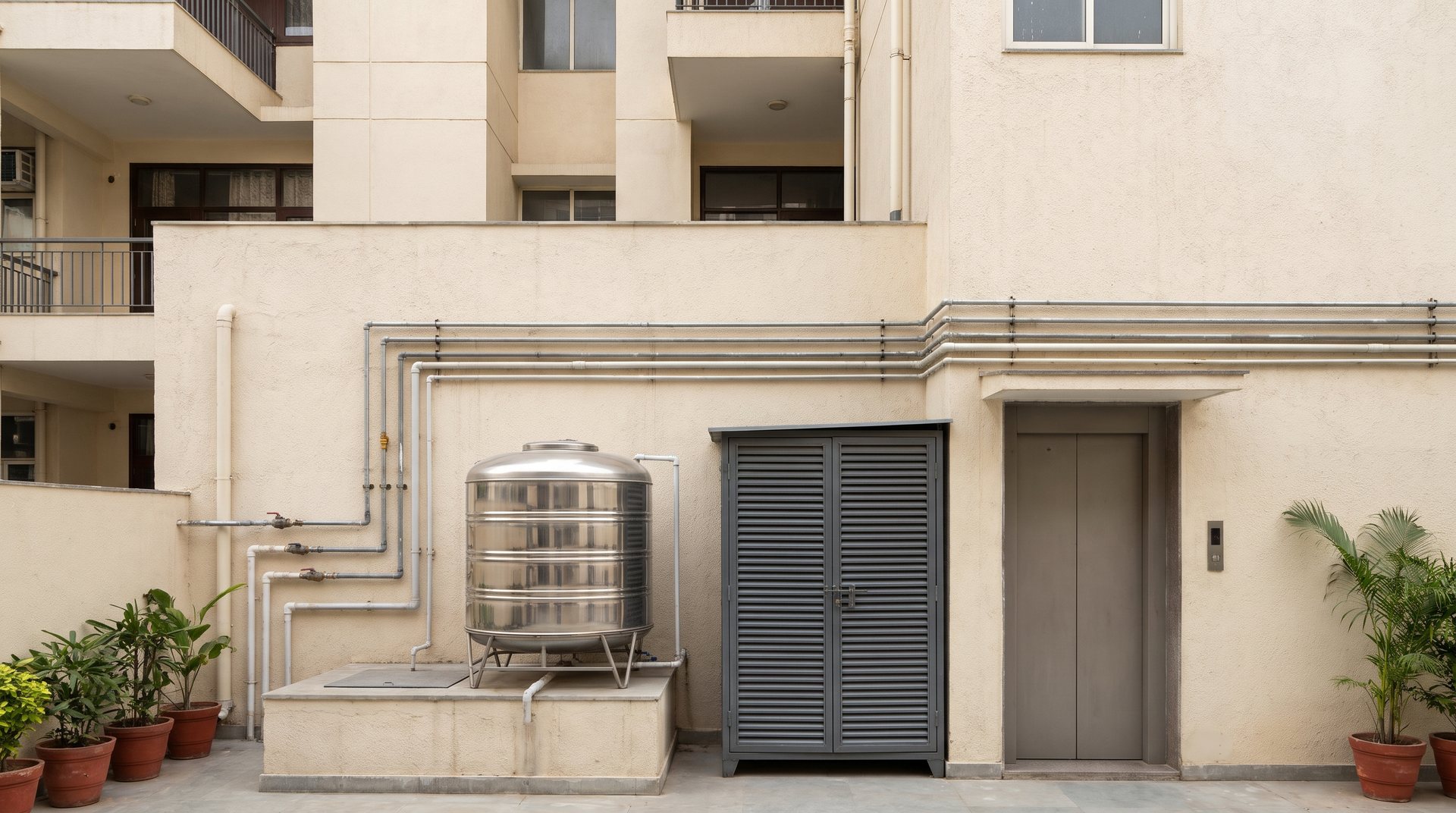
Water: the question is not pressure, it is source
Almost every water complaint in a South Delhi builder floor traces back to one of three things: the building is on a bulk connection and the internal distribution is poor; the building supplements piped supply with a borewell whose legal position nobody has checked; or the floor is at the top of the stack and the pump and tank arrangement was sized for three floors rather than four.
What the Delhi Jal Board actually sanctions
The DJB’s published conditions for a new water and sewer connection are worth reading before you take anyone’s word for it. The ones that matter on a builder floor:
- Individual connections are capped at ten in a property — sanctioned for a single dwelling unit or floor, up to a maximum of ten. The cap was raised from six to ten by a DJB board decision, which is precisely why multi-unit plotted buildings became workable.
- No individual connection where a bulk connection exists or is required under the Board’s policy, which is how group housing and larger complexes are handled.
- No water connection is sanctioned for the basement of any building. If a basement unit is being sold to you as a habitable dwelling with its own supply, that is a question to ask early.
- Nobody may draw water from the Board’s system other than through a sanctioned connection.
So the first thing to establish is simple: is there a connection in the name of your floor, or is the building on a bulk connection with internal sharing? Both are legitimate. They behave very differently when there is a dispute between floors, and they bill very differently.
Borewells: the part people get wrong
Many South Delhi buildings run on a mix of piped supply and groundwater. The legal position is unambiguous and tightening. Under the standard operating procedure of the Government of NCT of Delhi, drawing groundwater through a borewell or tubewell for domestic, commercial, agricultural or industrial use without prior permission of the competent authority is illegal and without authority of law. The competent authority is the Delhi Jal Board for the entire NCT of Delhi, except areas under the New Delhi Municipal Council and the Delhi Cantonment Board. The DJB grants borewell permission after approval of its advisory committee.
Enforcement is real and it is court-driven. In filings before the National Green Tribunal, the DJB reported having identified 19,661 illegal borewells, of which 7,248 had been closed down by district authorities, with later reporting putting the number of identified illegal borewells or sites at 20,625. The division of labour is set out plainly: the DJB identifies, the SDM seals, and the Delhi Pollution Control Committee imposes environmental compensation. Where a borewell is under construction, the drilling rig itself is sealed.
What this means for a buyer
If the building you are buying into relies on a borewell, ask for the DJB permission. If there is none, you are buying into a water supply that can be sealed, and the cost of that falls on the residents, not on the builder who has already sold and left. This is not a theoretical risk in a city that, on Central Ground Water Board figures cited to the NGT, extracted 100.7% of its groundwater in 2024.
Rainwater harvesting is not optional
Rooftop rainwater harvesting has been mandatory in Delhi for plots of 100 square metres and above under the building bye-laws, following a notification dated 28 July 2001, and the requirement sits in Chapter 10 of the Unified Building Bye-laws for Delhi, 2016. Civic agencies are meant to check it before issuing the occupancy-cum-completion certificate. Two things follow for an owner:
- The DJB offers a 10% rebate on water bills for plots of 100 square metres and above with a functional system, and levies a penalty on the water bills of consumers on plots of 500 square metres or more who have not implemented rainwater harvesting.
- Where permission is sought to draw groundwater on a plot larger than 200 square metres, that permission is subject to the owner installing a rainwater harvesting system in the building.
Since 100 square metres is about 120 square yards, essentially every South Delhi builder-floor plot is over the line. On the walkthrough, find the recharge pit. “It’s there somewhere” is the answer you get when it was drawn on the plan and never built.
Ask the seller or builder
- Is this floor on its own DJB connection or a bulk connection for the building? Whose name is it in, and are there arrears?
- Is there a borewell? If so, where is the DJB permission?
- Where are the underground and overhead tanks, what is their capacity, and who cleans them?
- Is there a rainwater harvesting pit, and has it ever been desilted?
- Is there a water softener or treatment unit, and what does it cost to run?
- What happens in June? Ask a neighbour on an upper floor, not the seller.
While you are at it: the DJB runs enforcement drives against water misuse, with teams deployed to fine wastage — washing a car with a running hose and overflowing tanks among the targets. An overflow pipe that discharges onto the street is a snag worth fixing on handover rather than a habit worth inheriting. Our handover snag list covers the plumbing checks in detail.