Farmhouses in Delhi: The 2026 Guide to Belts, Prices and the Legal Reality
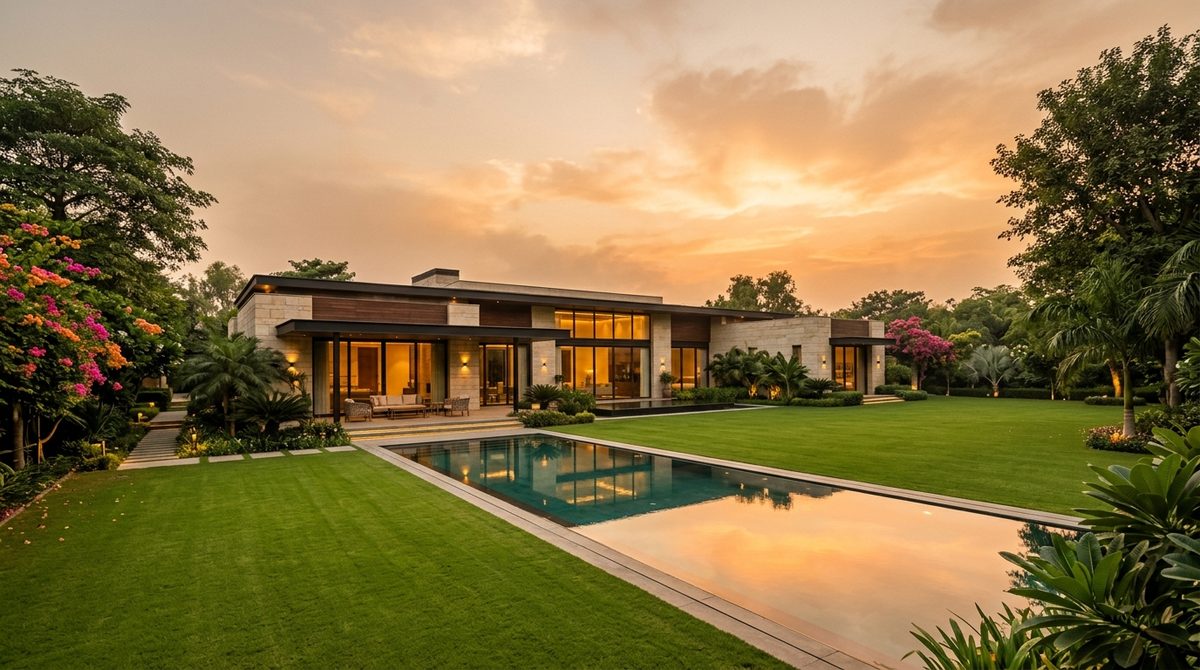
No other Delhi address carries the pull of a farmhouse. Acres of private lawn inside the city, a gulmohar-lined drive, a pool, room to host three hundred people — it sits at the very top of the capital’s property pyramid. It is also the most legally intricate corner of Delhi real estate, where the gap between a sound purchase and a ruinous one lives entirely in documents most buyers never think to ask for.
We have brokered and advised on farmhouses in Delhi for four decades, from our base in Defence Colony. This guide gives you both halves honestly: where the belts are, what they actually cost in 2026 in the unit the market now uses — the square yard — and the land-use and title rules that decide whether an estate is a legal home or a liability waiting to be served notice. Our first job with any farmhouse buyer is not to sell the lawn. It is to check the paperwork behind it.
The short answer
Farmhouses in Delhi cluster in the Chattarpur, Sultanpur, Radhe Mohan Drive, Gadaipur, Ghitorni, Rajokri and Westend Greens belts, plus the well-known Sainik Farms. Land now trades by the square yard, from roughly ₹1 lakh to ₹1.5 lakh per square yard in the prime belts. On a built basis, an accessible outer-belt farmhouse starts near ₹15 crore, while a marquee one-acre estate in DLF Chattarpur starts at ₹80 crore+. The land is usually legal with clean Delhi registry — but the construction on most plots under 2.5 acres is not, and no home loan is available. Diligence is everything.
₹1–1.5 L
Per square yard, prime farmhouse belts
1 acre
= three ~1,650 sq yd farmhouses, the new trend
4,000+
Farmhouses in the Delhi belt today
A horizontally scrollable rail of ten SouthDelhiFloors farmhouse video tours, newest first. Select any tour to play it.
Video Tours · On YouTube
Farmhouse Tours, Walked Room by Room
Estate walkthroughs from across the Delhi belt — the lawns, the drives, the light. Newest first.
Sources are independent news outlets, linked directly. SouthDelhiFloors curates but does not host this reporting.
Where Delhi’s Farmhouses Are
Farmhouses in Delhi run in two broad corridors on the city’s southern edge. The Mehrauli-Gurgaon Road corridor is the dense, established heart — Chattarpur, DLF Chattarpur Farms, Sultanpur and Prakriti Marg, Gadaipur, Radhe Mohan Drive, Ghitorni, Ansal Satbari and Ansal Chattarpur, along with the smaller Chandan Hula and Jonapur pockets set deeper toward Mandi. The NH-8 / airport corridor runs west toward IGI — Westend Greens, Rajokri, Pushpanjali, Bijwasan, Kapashera, Rangpuri and the gated Harcharan Bagh enclave, quieter and minutes from the airport and Gurgaon. Beyond them lie the outer, more accessible pockets toward the Aravalli ridge — Dera Mandi, Asola and Bhati — and the long-established Sainik Farms nearer the city.
The tiers matter more than the map, though. A parcel’s belt tells you its postcode; its exact village, khasra number, land-use classification and “section” status tell you what it is worth and whether you can safely own it. Explore the belts below, then read the pricing and the legal reality that follow.
Interactive map · geographic
The South Delhi Farmhouse Belt, on the Map
Each gold territory is a farmhouse belt, placed by its real position between the airport, Qutub Minar and the Aravalli ridge. Tap any belt for its 2026 desk pricing.
The belts run from the airport-side NH-8 corridor in the west, through the Mehrauli-Gurgaon Road spine, to the Aravalli ridge in the south. Tap a gold territory to see where it sits and what it costs.
Colours mark the tier — from marquee gated estates to the accessible outer edge. Landmarks are shown for orientation only.
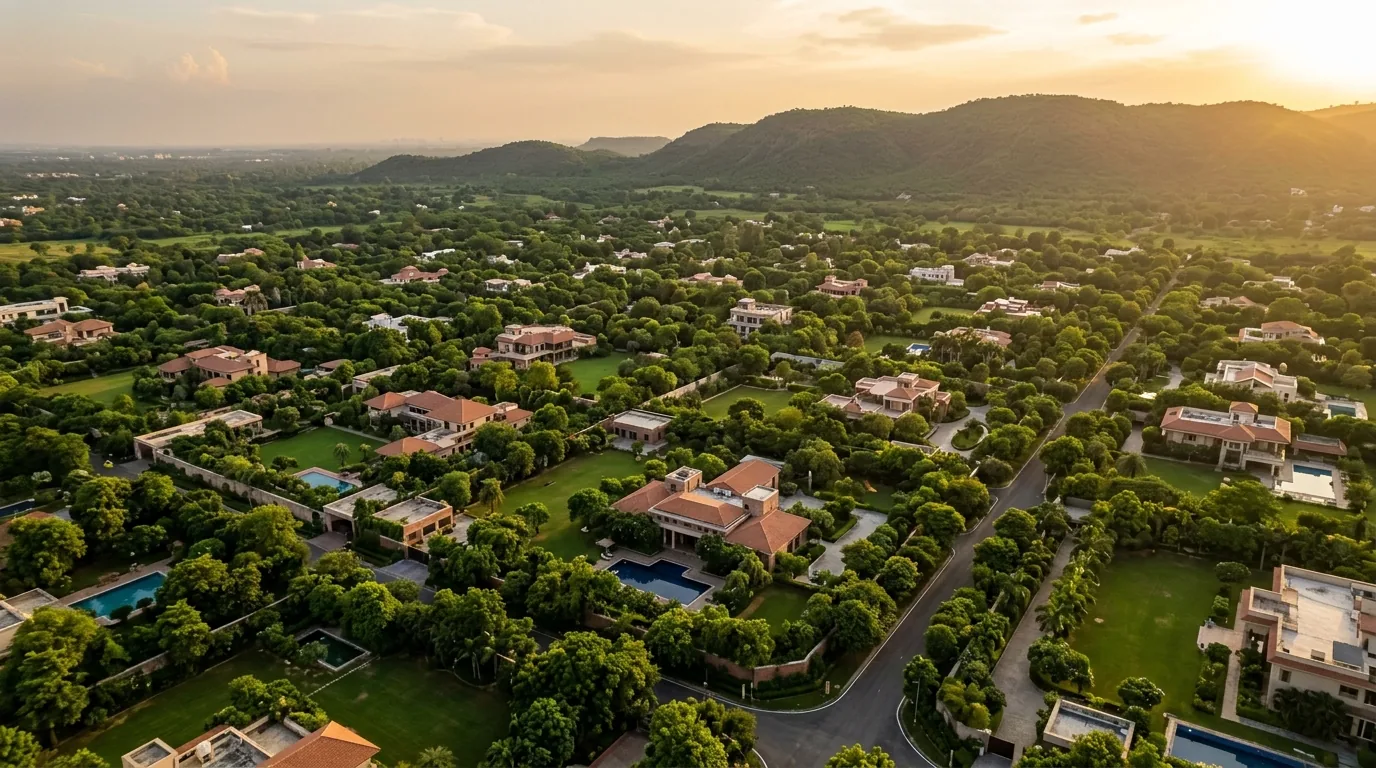
The farmhouse belt from above — walled green estates against the Aravalli ridge.
What Farmhouses in Delhi Cost in 2026
Here is the single most important shift in this market: farmland has become so scarce that nobody serious talks in acres anymore. The live trading unit is the square yard. The dominant trend is a single acre split into three farmhouses of about 1,650 square yards each, every one built out to 10,000+ square feet. That is where the demand is, and it is how you should read every number below.
These are desk figures for farmhouses in Delhi, drawn from live 2026 dealing and presented as ranges. However, property portals understate this segment badly — often by two to three times — so treat any 99acres or MagicBricks headline as a floor, not a fact.
Farmland — the land rate, by belt
Belt
Land rate (per sq yd)
Per acre (≈)
Sultanpur / Prakriti Marg
₹1.40–1.50 lakh
₹70–73 Cr
DLF Chattarpur Farms
₹1.15–1.35 lakh
₹60 Cr+
Westend Greens
₹1.10–1.35 lakh
₹55–65 Cr
Radhe Mohan Drive
₹1.00–1.25 lakh
₹48–60 Cr
Gadaipur, Ghitorni, Satbari
Prime, on request
varies
Dera Mandi, Asola, Bhati (outer)
More accessible
on request
Desk land rates, mid-2026. Sultanpur/Prakriti Marg is the dearest per yard — pricier even than DLF Chattarpur. Radhe Mohan Drive rises the closer a plot sits to the main drive.
Built-up farmhouses — the way buyers now shop
Belt & plot
All-in built price
Dera Mandi — 1,000 sq yd
₹15 Cr+
Sainik Farms — 1,500 sq yd
₹22 Cr+
Dera Mandi — 2,000 sq yd
₹25 Cr+
Sainik Farms — 1,300 sq yd
₹25 Cr+
Sainik Farms — 2,000 sq yd
₹32 Cr+
DLF Chattarpur — 1 acre (4,840 sq yd)
₹80 Cr+
Marquee trophy estates (Westend, DLF, Sultanpur)
₹150–250 Cr+
Desk built-up levels, mid-2026. The outer belts (Dera Mandi) are the accessible entry; the gated marquee estates are the ceiling.
The trend, in one calculation
One acre in DLF Chattarpur is 4,840 square yards, and the land alone starts at ₹60 crore. Split the classic way into three plots of about 1,650 square yards, each carries roughly ₹20 crore of land — before construction. Build 10,000+ square feet on each, and you have three complete farmhouse estates where once there was one field.
That subdivision — one acre into three — is the single strongest trend in the belt right now.
Renting a farmhouse
Not every move into farmhouses in Delhi starts with a purchase. Built-up farmhouse rentals in the belt start at around ₹10 lakh a month, and many buyers rent first to test the lifestyle before committing nine figures of capital. As a live marker, we recently rented a 2,000-square-yard farmhouse near Bandh Road at ₹9 lakh a month. The events and wedding market layers additional income on top for owners who license their lawns.
⚠ Before you buy — read this twice
The land can be legal while the house is not
Most farmhouses in Delhi under 2.5 acres carry unauthorised construction — even where the land itself is legal with a clean Delhi registry. That distinction is the whole game, and it has two hard consequences every buyer must accept before signing:
Check that no "section" is attached to the plot. Verify there is no acquisition notice, attachment or land-acquisition "section" hanging over the exact parcel. This is the first check we run, before we even discuss price.
No home loan is possible. Banks will not finance unauthorised construction, so these are effectively cash or self-funded purchases. Budget accordingly — there is no EMI route here.
None of this makes the segment un-buyable — Delhi's elite own here precisely because they understand it. It makes diligence non-negotiable. The clean parcel with verified papers is the asset; the spectacular house on a "sectioned" plot is a trap.
The Policy Flaw That Explains the Whole Market
The khasra, the title chain and the "section" check — the paperwork that decides a farmhouse purchase.
Why do so many farmhouses carry unauthorised construction? Because the rules are inverted. Under the low-density norms, a 2.5-acre farmhouse plot is sanctioned for only about 6,000 square feet of built area plus a pump room. Nobody pays for 2.5 acres of Delhi land to build a bungalow's worth of house on it — the maths makes no sense.
So the market went the other way. On a sub-acre plot of about 1,650 square yards, owners build 10,000+ square feet — far more usable home, which is exactly what buyers want. That construction is unauthorised, but it is where the value and the demand sit. And with more than 4,000 such farmhouses already standing across the Delhi belt, mass demolition is not a realistic prospect — which is why celebrities, the judiciary, the bureaucracy, industrialists and business houses all hold farmhouses here despite the paper status. This is weak enforcement and practical reality, not legal safety — which is precisely why the "section" check and the no-loan rule above still bind. Understand the risk; do not assume it away.
Why Demand Keeps Rising
To begin with, the biggest disruptor was COVID. After the lockdowns, buyers re-valued space — and above all open space — and so farmhouse prices rose multifold in the years since. What was once a weekend indulgence became a serious primary-residence option.
Meanwhile, the sharpest competition in South Delhi today is no longer farmhouse versus farmhouse. It is the 1,000–1,200 square yard builder floor, duplex or penthouse in a prime colony versus the farmhouse at a similar ticket. The farmhouse is further out — call it thirty minutes of extra drive through traffic — but the living is different in kind: clutter-free, private, unhurried. Picture the mornings and evenings on your own estate rather than a shared lift lobby.
In addition, two things have quietly tilted that contest toward the farmhouse. Quick-commerce has erased the old "the markets are too far" objection — Zepto and Blinkit deliver groceries to a Chattarpur estate in minutes. And the mindset has shifted from weekend home to everyday home. Layer on the long-running anticipation premium — the government has repeatedly signalled a policy change that would allow legal construction on a single acre, and although it has never actually been notified after years of waiting, prices keep climbing on the expectation of regularisation.
The Legal Framework for Farmhouses in Delhi
In official planning language, most properties once called "farmhouses" are now Low Density Residential Area (LDRA) plots, governed by the Master Plan for Delhi. The framework is specific, and the gazette history matters:
The minimum plot was cut from 2.5 acres to 1 acre by DDA notification S.O. 1199(E) dated 10 May 2013 — the single most important farmhouse-policy change of the modern era.
23 villages were declared Low Density Residential Area in the urban extension by notification S.O. 1744(E) dated 18 June 2013.
Maximum height rose from 6 metres to 12 metres, and permissible built-up area was raised to roughly 10,000 square feet — though estates in practice report 7,000 to 20,000 square feet.
The belt is designated low-density for a reason: groundwater is severely depleted and civic load is deliberately kept light, which is why intensive residential density is discouraged here.
As for the current plan, the operative document remains the Master Plan for Delhi 2021, with modifications carried to 2022. The draft Master Plan for Delhi 2041 — which proposes a roughly one-acre (4,000 sq m) farmhouse minimum and more generous legal construction — has been discussed for years but, after some 33,000 public objections, remains a draft and was not notified as of 2026. Do not let any broker present a "2041" allowance as current law. You can verify the plans on the DDA master plans portal.
The Diligence Checklist
Before any of the farmhouses in Delhi changes hands, we work through the following. Because skipping any one of them is how buyers lose money in this belt, we treat none of these checks as optional.
The "section" check — confirm no acquisition notice, attachment or land-acquisition section is attached to the exact plot.
Khasra number and land-use classification — verify the parcel's precise khasra and whether it is LDRA, green belt, agricultural or notified otherwise.
Clean 30-year title chain with a registered Delhi sale deed — never buy on a general power of attorney.
Ridge and forest status — parcels near the Aravalli ridge or the Asola-Bhatti sanctuary carry forest and green-belt restrictions.
Sanctioned plans versus what stands — understand exactly how much of the construction is authorised.
Groundwater and borewell legality — extraction is regulated; unauthorised borewells carry risk.
Access and road width — confirm legal access and the status of the approach road.
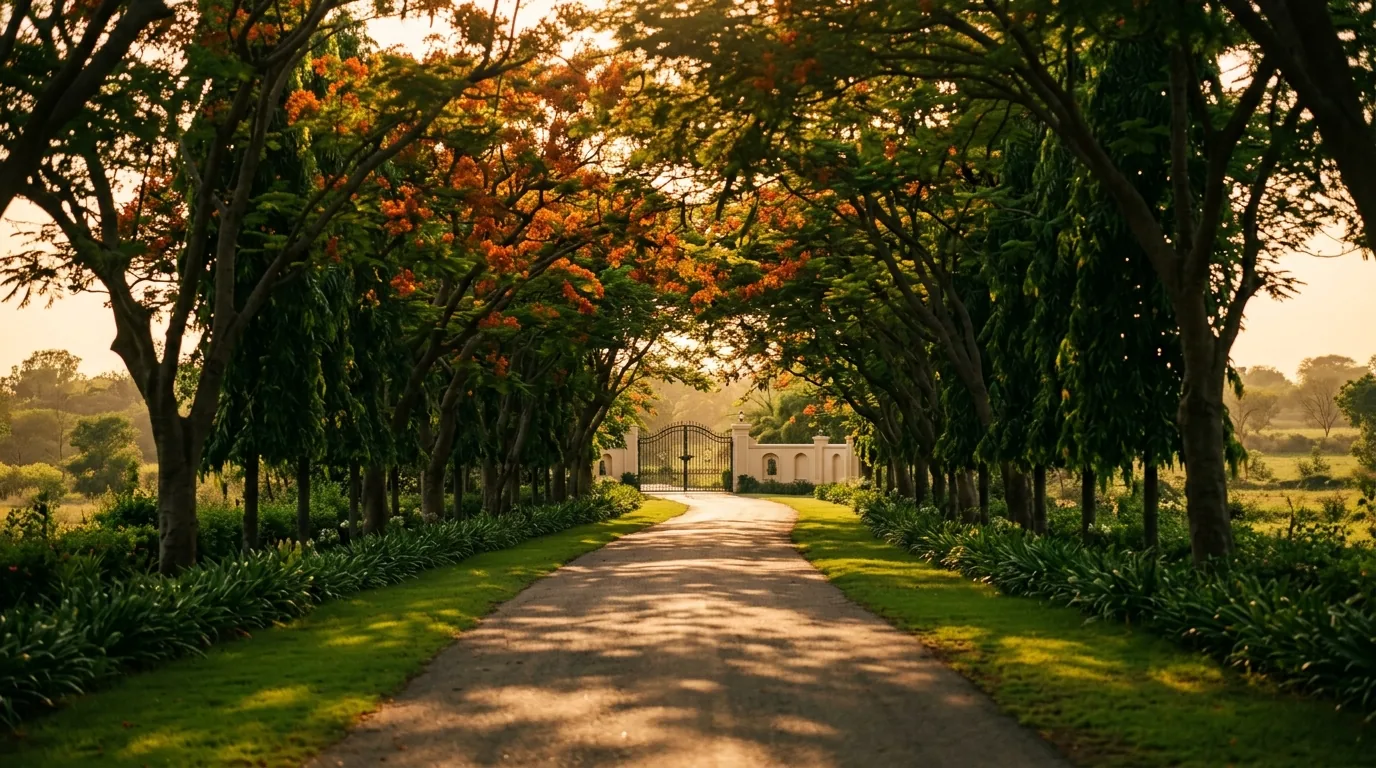
The gulmohar-lined private drive — the signature arrival of a Delhi farmhouse.
Running a Farmhouse, and the Events Market
Remember, too, that a farmhouse is a running estate, not just a purchase. Typically, water comes from borewells — confirm the arrangement and its legality. In turn, power means a substantial sanctioned load plus a generator or, increasingly, solar backup. Beyond that, landscaping, security and staff across an acre-plus plot are a real, ongoing commitment a colony floor never demands. Budget the running estate, not just the sticker price.
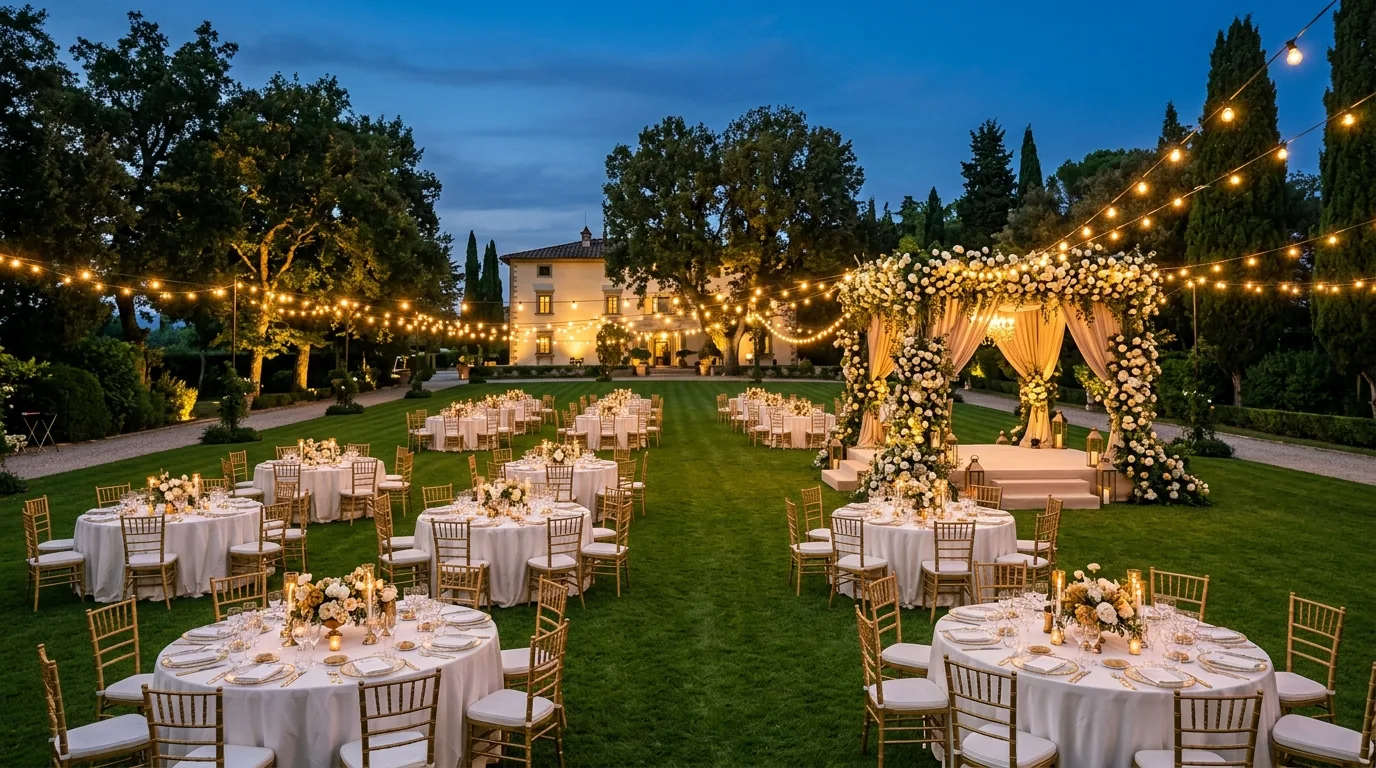
The event lawn — the income engine and social draw of the Delhi farmhouse.
For many owners, the lawns are also an income engine. Delhi's wedding and events market prizes farmhouse venues, and a well-located estate can earn meaningfully across the season — though event use brings its own licensing, noise and neighbour considerations worth confirming before you bank on that income.
Farmhouse or Prime Builder Floor?
For instance, at a similar budget you can hold a large builder floor in GK or Defence Colony, or a farmhouse in the belt. The floor gives you a central address, a deep and liquid resale market, cleaner title mechanics and full home-loan eligibility. The farmhouse gives you acres, privacy, event capacity and a lifestyle no colony can match — at the cost of liquidity, loan access and regulatory simplicity. If you want to compare the colony side directly, read our guides to builder floors in South Delhi, property in Defence Colony and property in Vasant Vihar.
Can NRIs Buy a Farmhouse in Delhi?
Generally, no. Under FEMA, NRIs and OCIs may freely buy residential and commercial property in India but are prohibited from purchasing agricultural land, plantation property or farmhouses. An NRI can inherit a farmhouse but cannot ordinarily buy one. Given that most Delhi farmhouse land is agricultural in classification, this is a genuine barrier — our NRI guide to buying property in South Delhi covers the residential routes that remain open, and the structures worth taking advice on.
"With a farmhouse, the lawn sells itself — so our job is the opposite. We check the khasra, the title chain and whether a section is attached before we let a client fall for the pool. In this belt, the clean parcel is the asset. The spectacular house on the wrong paper is a decade of litigation."
— Mohit Minocha, Founder, SouthDelhiFloors
Frequently Asked Questions
How much does a farmhouse in Delhi cost in 2026?
Land in the prime belts runs roughly ₹1 lakh to ₹1.5 lakh per square yard — Sultanpur and Prakriti Marg at the top around ₹1.4–1.5 lakh, DLF Chattarpur at ₹60 crore-plus per acre. On a built basis, accessible outer-belt farmhouses in Dera Mandi start near ₹15 crore for 1,000 square yards, while a marquee one-acre estate in DLF Chattarpur starts at ₹80 crore-plus, and trophy estates reach ₹150–250 crore-plus.
Why are most Delhi farmhouses called "illegal"?
The land is usually legal with a clean Delhi registry, but the construction on most plots under 2.5 acres exceeds what is sanctioned. The low-density rules permit only about 6,000 square feet on 2.5 acres, so owners build far more on smaller plots — unauthorised, but where the value sits. Always verify that no "section" or acquisition notice is attached to the plot, and note that no home loan is available.
What is the minimum plot size for a farmhouse in Delhi?
DDA reduced the minimum from 2.5 acres to 1 acre via notification S.O. 1199(E) dated 10 May 2013. In gated estates such as DLF Chattarpur, a strong RWA enforces that one-acre minimum strictly. In the looser outer belts, smaller sub-acre "mini farm" plots do trade — but their farmhouse and LDRA status must be verified.
Can I get a home loan on a Delhi farmhouse?
No. Banks will not finance unauthorised construction, which covers most Delhi farmhouses under 2.5 acres. These are effectively cash or self-funded purchases, so buyers should budget the full price without relying on an EMI route.
Which are the best farmhouse belts in Delhi?
The best farmhouses in Delhi cluster in a handful of belts. The marquee gated belts are DLF Chattarpur Farms, Westend Greens and Sultanpur/Prakriti Marg. Radhe Mohan Drive, Gadaipur, Ghitorni and Ansal Satbari are prime. Rajokri, Pushpanjali and Bijwasan sit airport-side off NH-8. Dera Mandi, Asola and Bhati are the accessible outer edge, and Sainik Farms is the well-known older colony where some plots now carry Delhi registry.
Can NRIs buy a farmhouse in Delhi?
Generally no. Under FEMA, NRIs and OCIs cannot buy agricultural land, plantation property or farmhouses in India, though they may inherit one. Since most farmhouse land is agricultural in classification, NRIs are usually barred from purchase and should take specific advice.
What does it cost to rent a farmhouse in Delhi?
Built-up farmhouse rentals start at around ₹10 lakh a month. As a recent live example, we rented a 2,000-square-yard farmhouse near Bandh Road at ₹9 lakh a month. Rentals let buyers test the lifestyle before a large capital commitment.
Is the Master Plan for Delhi 2041 in force?
No. The Master Plan for Delhi 2021, with modifications to 2022, remains the operative plan. The draft 2041 plan — which proposes a roughly one-acre farmhouse minimum and more legal construction — was still a draft and not notified as of 2026, despite years of discussion and around 33,000 public objections.
Key Takeaways
Farmhouses in Delhi now trade by the square yard — ₹1–1.5 lakh in the prime belts — and the trend is one acre split into three ~1,650 sq yd farmhouses.
Built farmhouses run from ~₹15 crore in the outer belts to ₹80 crore+ for a marquee DLF Chattarpur acre, and ₹150–250 crore+ for trophy estates.
The land is usually legal with clean Delhi registry, but construction under 2.5 acres is mostly unauthorised — check for a "section" and expect no home loan.
The minimum plot is 1 acre (S.O. 1199(E), 2013); MPD-2021 is operative and the 2041 draft is not yet notified.
Post-COVID demand, quick-commerce and the shift to primary-residence living keep prices rising — as does anticipation of a policy change that has never quite arrived.
Considering a farmhouse? Let us check the paper first.
Tell us the belt and budget, and we will run the land-use, khasra and "section" checks before you fall for the lawn — then tell you plainly whether an estate is a sound buy or a future dispute. Four decades in South Delhi, headquartered in Defence Colony, and clean deals only.