In this article:
- How to Read South Delhi
- Cluster 1: The Diplomatic West — Vasant Vihar, Shanti Niketan, Anand Niketan, Westend
- Cluster 2: The Heritage Core — Jor Bagh, Golf Links, Sunder Nagar
- Cluster 3: The Classic Middle — Greater Kailash, Defence Colony, Hauz Khas, Green Park, Gulmohar Park, Panchsheel Park, Neeti Bagh, Anand Lok, SDA
- Cluster 4: The Eastern Belt — Friends Colony East & West, Maharani Bagh, New Friends Colony, East of Kailash, Kailash Colony
- Cluster 5: The Value Ring — Chittaranjan Park, South Extension, Lajpat Nagar, Saket, Malviya Nagar
- The Comparison at a Glance
- Choosing Between Them: A Working Framework
- The Infrastructure That Ties It Together
- If You Are Undecided: Rent There First
- Frequently Asked Questions
- Key Takeaways
Ask ten Delhiites for the best colony in South Delhi and you will get ten confident, contradictory answers — usually the colony they grew up in. The truth is that “best” depends on what you are optimising for: a diplomat’s quiet, a joint family’s space, walkability to a market, proximity to a particular school, or pure capital appreciation. All of these exist in South Delhi, just not in the same pin code.
This guide organises the major colonies into five clusters, with indicative current price levels and a plain reading of who each area suits. It reflects what we see across live transactions from our Defence Colony office, not a portal’s algorithm. One market note before we start: recent data showed luxury floor prices across South Delhi rising as much as 32% year on year, with the so-called Category B colonies (GK, Defence Colony, Gulmohar Park and their peers) appreciating faster than the pricier Category A addresses. Value is currently migrating outward from the most famous postcodes.
How to Read South Delhi
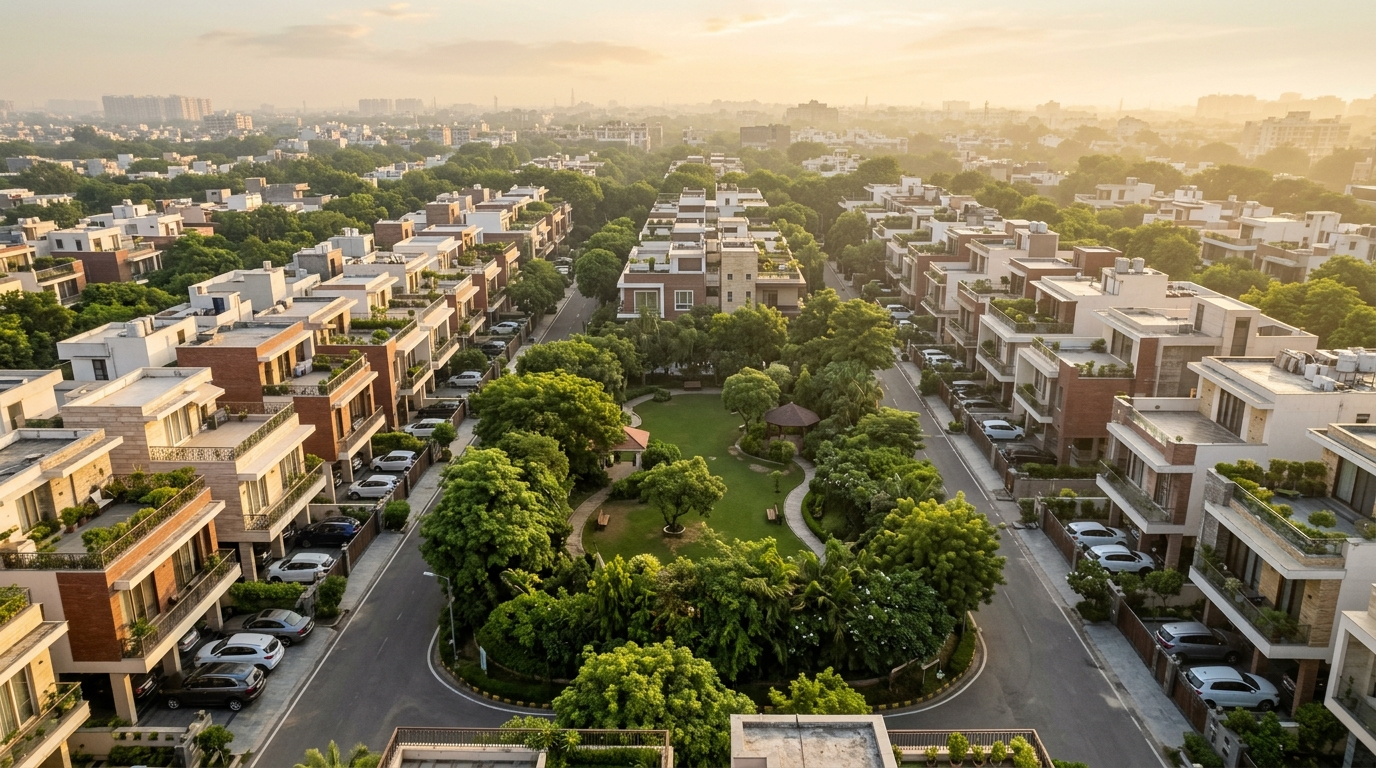
The city’s revenue department groups every colony into categories A through H for circle-rate purposes, and the market broadly respects the same hierarchy. Category A is the diplomatic and heritage belt; Category B is the large middle of premium plotted colonies; the value ring beyond offers South Delhi addresses at half the price. Plot sizes matter as much as category: a colony laid out on 400–800 square yard plots feels and prices very differently from one on 150–250 square yard plots, even a kilometre apart.
Cluster 1: The Diplomatic West — Vasant Vihar, Shanti Niketan, Anand Niketan, Westend
These four Category A colonies sit between Chanakyapuri’s embassies and the airport corridor, on large plots with wide, genuinely quiet streets. Vasant Vihar is the flagship: a new 4 BHK floor on a 400 sq yd plot starts around ₹18 crore, and floors on the larger plots go well past ₹40 crore. Anand Niketan and Shanti Niketan are smaller, calmer and increasingly favoured by expatriates and institutional redevelopment capital; Westend offers similar low-density privacy.
Who it suits: Buyers who want maximum privacy and airport access, families with children at the international and legacy schools nearby, and NRIs who value a quiet, secure street over market buzz. It is the least “Delhi” part of South Delhi, in the best sense.
Cluster 2: The Heritage Core — Jor Bagh, Golf Links, Sunder Nagar
Bordering Lutyens’ Delhi and Lodhi Garden, these are the capital’s true trophy addresses. Inventory is bungalows and a small number of ultra-premium floors; transactions are few and rarely advertised. Pricing starts where other colonies end — full houses here trade well into nine figures, and even floor opportunities typically begin above ₹25 crore. Buyers here are purchasing history and scarcity, not yield.
Who it suits: Legacy buyers, family offices and anyone for whom the address is the asset. If you have to ask about price per square foot, this cluster will frustrate you; value here is negotiated, not listed.
Cluster 3: The Classic Middle — Greater Kailash, Defence Colony, Hauz Khas, Green Park, Gulmohar Park, Panchsheel Park, Neeti Bagh, Anand Lok, SDA
This is the beating heart of the South Delhi market and where most of our transactions happen. GK-1 and GK-2 combine strong housing stock with the M-Block and N-Block markets — arguably the best colony retail in India. Defence Colony adds a restaurant scene and a central location between Lodhi Road and the Ring Road. Hauz Khas Enclave has quietly become one of the strongest performers, with new 4 BHK floors on 500 sq yd from around ₹20 crore after prices rose roughly 30% in a year. Panchsheel Park stands out within this cluster for its larger plots and greener streets, with new 4 BHK floors on 500 sq yd from about ₹18 crore. Gulmohar Park, Neeti Bagh and Anand Lok offer smaller, extremely liveable colonies with professional and media pedigrees; SDA gives IIT-adjacent calm at the cluster’s most accessible pricing.
Indicative current levels: new floors start around ₹6.5–9.5 crore for a 3 BHK on 200–217 sq yd and ₹9–13 crore for a 4 BHK on 300 sq yd across these colonies, with 500 sq yd floors from ₹16–21 crore.
Who it suits: Families who want walkable markets, established schools, metro access and liquid resale. This cluster also led the recent appreciation cycle, which makes it the pragmatic investor’s default.
Cluster 4: The Eastern Belt — Friends Colony East & West, Maharani Bagh, New Friends Colony, East of Kailash, Kailash Colony
Across the Ring Road towards Mathura Road, the Friends Colony–Maharani Bagh belt offers some of South Delhi’s largest plots (500–1,000+ square yards) at prices below the diplomatic west, which is exactly why old business families have anchored here for generations. Friends Colony and Maharani Bagh are Category A; New Friends Colony mixes grand homes with institutional presence. East of Kailash and Kailash Colony are the belt’s more compact, better-connected cousins — Kailash Colony’s Violet Line metro station makes it one of the most conveniently located premium colonies in the city.
Who it suits: Joint families needing genuine space, buyers who want an A-category land holding without Vasant Vihar pricing, and anyone working towards Noida or the Faridabad corridor.
Cluster 5: The Value Ring — Chittaranjan Park, South Extension, Lajpat Nagar, Saket, Malviya Nagar
Calling these “value” is relative — a good floor in South Extension or CR Park still runs several crores — but this ring delivers a South Delhi life at roughly half the classic-middle pricing. CR Park has a genuine community culture and excellent food; South Extension pairs its homes with marquee retail; Saket brings mall, hospital and court infrastructure plus the coming Golden Line metro interchange, which materially improves its long-term case; Lajpat Nagar and Malviya Nagar offer the entry points. Rental yields in this ring are among South Delhi’s healthiest, which matters to investors.
Who it suits: First-time South Delhi buyers, professionals prioritising metro connectivity, and yield-focused investors.
The Comparison at a Glance
| Cluster | Category | Recent floor pricing | Best for |
|---|---|---|---|
| Diplomatic West | A | ₹9–40+ Cr | Privacy, airport, expat life |
| Heritage Core | A | ₹25 Cr upwards | Trophy addresses, legacy capital |
| Classic Middle | Mostly B | ₹6.5–28 Cr | Families, liquidity, appreciation |
| Eastern Belt | A / B mix | ₹6–24+ Cr | Large plots, joint families |
| Value Ring | C–D | ₹5.5–8 Cr | Entry buyers, rental yield |
Choosing Between Them: A Working Framework
- Fix the budget honestly, including 6–8% for stamp duty, transfer duty and registration. The budget usually chooses the cluster before you do.
- Decide what daily life looks like. School runs, a clinic or office nearby, parents living with you, how often you fly — each answer eliminates colonies.
- Prioritise block over colony. A park-facing floor on a wide internal road in a B-category colony beats a compromised plot in an A-category one, for living and for resale.
- Check the specific street at 9 am and 8 pm. Parking pressure, through-traffic and market spillover are street-level realities no listing mentions.
- If investing, follow the redevelopment. Colonies with ageing stock and active builder interest — much of the classic middle right now — are where the next cycle’s gains sit.
SouthDelhiFloors insight: The most common regret we hear is not “wrong colony” but “right colony, wrong plot” — a floor bought on a congested lane because it was ₹1 crore cheaper. Streets do not renovate. Buy the street first, the floor second.
The Infrastructure That Ties It Together
Three metro lines do the heavy lifting for these colonies. The Magenta Line runs the GK–Panchsheel–Hauz Khas–Vasant Vihar arc towards the airport side; the Violet Line serves Kailash Colony, Nehru Place and the eastern belt’s edge; the Yellow Line anchors Green Park, Hauz Khas and the Saket–Malviya Nagar ring, with the Golden Line’s Saket interchange adding a new southern spoke. If a daily metro commute matters, shortlist within a ten-minute walk of a station — it also widens your future tenant pool. For car-first households, the Outer and Inner Ring Roads remain the true arteries; a colony’s access points onto them shape daily life more than its metro distance.
Hospitals cluster conveniently: AIIMS and Safdarjung at the top of the Yellow Line arc, Max Saket serving the southern ring, Moolchand and Fortis CG Road covering the GK–Defence Colony belt, Indraprastha Apollo within reach of the eastern belt. Schools are the one factor that regularly overrides colony preference — families organise around a specific school run, and paying somewhat more to be fifteen minutes closer is usually money well spent.
If You Are Undecided: Rent There First
For buyers new to South Delhi — returning NRIs especially — a year’s rental in the shortlisted colony is the cheapest diligence available. At 2–3% gross yields, renting a ₹12 crore floor costs ₹2.5–3 lakh a month while your capital stays liquid, and you learn things no site visit reveals: the parking situation at Diwali, the lane that waterlogs in July, whether the market’s evening noise reaches the bedroom. Several of the best purchases we have closed followed exactly this route — by the time we negotiated, the buyer knew the block better than the seller did.
Frequently Asked Questions
Which is the most expensive residential area in South Delhi?
The heritage core around Lutyens’ Delhi — Jor Bagh, Golf Links, Sunder Nagar — commands the highest values, with bungalows trading well into nine figures. Among floor colonies, Westend and Shanti Niketan carry the highest price per square yard of plot, and a new 4 BHK in Vasant Vihar starts around ₹18 crore on 400 sq yd.
Which South Delhi colonies are best for families with school-going children?
The classic middle — GK, Defence Colony, Hauz Khas, Green Park, Gulmohar Park — puts you within a short drive of most of Delhi’s established schools while offering parks and colony markets. Vasant Vihar suits families using the international schools on the airport corridor.
Where do property prices appreciate fastest in South Delhi?
In the current cycle, Category B colonies are leading: Recent data showed 23–32% year-on-year growth in colonies like GK, Defence Colony, Gulmohar Park and Hauz Khas Enclave, against 14–22% in Category A addresses.
Is Saket a good place to buy?
For connectivity-led buyers, yes. Saket combines hospital, retail and court infrastructure with an upcoming Golden Line metro interchange, at roughly half classic-middle prices, and its rental market is consistently strong.
What is the difference between Category A and Category B colonies?
The categories come from Delhi’s circle-rate classification. Category A colonies (Vasant Vihar, Anand Niketan, Friends Colony, Maharani Bagh and peers) carry the highest government valuations and market prices; Category B covers the broad premium middle such as GK, Defence Colony and Green Park.
Which colony has the best market and restaurant scene?
GK’s M-Block and N-Block markets and Defence Colony’s market are the standouts, with Hauz Khas Village and Khan Market (for the heritage core) close behind. If café-walkability is a priority, shortlist GK-1, GK-2 and Defence Colony.
Are there gated societies or condominiums in South Delhi?
Very few — South Delhi is overwhelmingly plotted colonies with builder floors. Rare exceptions exist, but buyers wanting full condominium amenities usually have to trade the South Delhi address for Gurgaon.
How much do I need to buy into South Delhi at the entry level?
Realistically, ₹3–5 crore opens the value ring (CR Park, Lajpat Nagar, Malviya Nagar, parts of Saket); ₹9 crore and above opens the classic middle; ₹18 crore and above opens the diplomatic west.
Which areas suit NRIs best?
NRIs typically favour Vasant Vihar, Anand Niketan and Westend for security and airport access, or their family’s original colony in the classic middle. Freehold builder floors in any of these are fully open to NRI purchase.
Should I buy in an A-category colony for better appreciation?
Not automatically. A-category colonies preserve wealth exceptionally well, but the current cycle’s growth is concentrated in B-category colonies where entry prices are lower and redevelopment is most active. Match the category to your goal: preservation versus growth.
Key Takeaways
- South Delhi is five distinct markets, not one: diplomatic west, heritage core, classic middle, eastern belt and value ring.
- The recent cycle’s appreciation leaders are the B-category colonies — GK, Defence Colony, Hauz Khas Enclave — not the priciest addresses.
- Budget bands: ₹3–8 crore for the value ring, ₹9–18 crore for the classic middle, ₹18 crore upwards for Category A.
- Inside any colony, the block and street decide livability and resale more than the colony name does.
- Buy the street first; the floor can be renovated, the lane cannot.
Locality Guides Live
South Delhi, colony by colony
Explore More on SouthDelhiFloors
- Property rates in South Delhi: floor prices by colony
- Areas in South Delhi: every colony, mapped
- Browse Top Locations
- Lutyens Bungalow Zone
- Builder Floors in South Delhi
- Farmhouses in Delhi
- Boutique Residential
- Builder Floors in South Delhi: The Complete Guide
- Property in Defence Colony: Prices, Blocks and Buying Guide
- Property in Vasant Vihar: Prices, Blocks and Buying Guide
- Greater Kailash 1 Property Guide
- Property in Greater Kailash 2: Prices, Blocks and Buying Guide
- Circle Rate vs Market Rate in Delhi
- Stamp Duty and Registration Charges in Delhi
- Builder Floor vs Apartment: Which to Buy?
- NRI Guide to Buying Property in South Delhi
- Contact Us
Talk to SouthDelhiFloors. Tell us your budget, family stage and the two or three things you refuse to compromise on — we will send you a shortlist of colonies and current floors that fit, usually within a day.
Call / WhatsApp +91 99990 04511 · contact@southdelhifloors.com · Defence Colony–based consultants, four decades in South Delhi real estate.