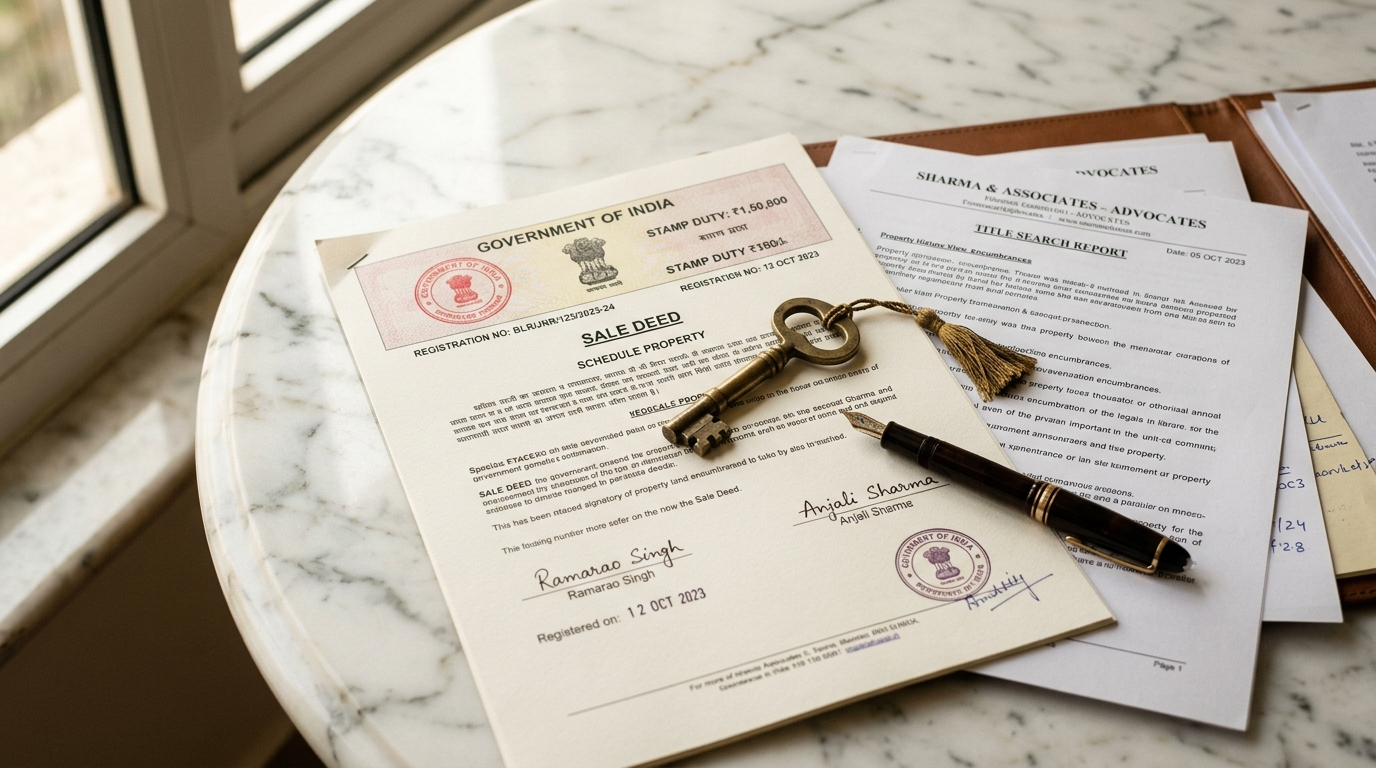
01What is a Title Search Report?+
A verification of the property’s ownership chain — typically 12 to 30 years — through Sub-Registrar records and Delhi’s online registration system, flagging encumbrances, prior transfers and litigation signals. We prepare one on every transaction we close; it is included in
our standard fee, not an extra.
02Which documents prove a clean title?+
The unbroken chain of registered title deeds, mutation in municipal records, property tax receipts, the sanctioned building plan, lender NOC or loan closure if previously mortgaged, and confirmation that no encumbrance or litigation attaches. Any single missing link is a question; the answers must come before the Agreement to Sell, not after.
03What is the difference between freehold and leasehold?+
Freehold is absolute ownership of land and building. Leasehold means the land vests with an authority such as DDA or L&DO and you hold rights under a lease — with restrictions on transfer unless converted. Most South Delhi plotted-colony properties are freehold or long since converted; where leasehold survives, conversion charges and process enter the deal math.
04Are GPA (power of attorney) sales valid?+
No. The Supreme Court settled this in 2011 (Suraj Lamp): sale through GPA, agreement to sell or will does not transfer ownership. A registered Sale Deed is the only instrument that conveys title. If a seller offers “GPA property” at a discount, the discount is the price of not actually owning it.
05What is mutation — and is it proof of ownership?+
Mutation updates the municipal (MCD) record to show the new owner for property-tax purposes. It is an important post-registration step and useful evidence, but it is not conclusive proof of title — the registered Sale Deed is. Do both: register the deed, then mutate promptly. We handle the sequence on every closing.
07How do I check for encumbrances on a Delhi property?+
Three layers: a Sub-Registrar records search of the title chain, Delhi’s online registration records, and a CERSAI search for registered bank mortgages. Delhi has no single certificate like some states issue, which is exactly why a professional title search — not a portal screenshot — is the standard of care here.
08The seller has a running home loan — can I still buy?+
Yes, through a structured payoff: the lender states the foreclosure figure, part of your payment retires the loan directly, the bank releases the original documents and its lien, and the Sale Deed follows. Done in the right sequence — often with the bank in the loop throughout — it is routine; done casually, it is how buyers fund someone else’s loan.
09What if the property has unauthorised construction?+
Treat deviations from the sanctioned plan as a priced risk, not a footnote. Deviations can invite sealing or demolition action and complicate resale and lending. Compare the sanctioned plan with what physically stands, understand what is compoundable, and either price the risk explicitly or walk away. “Everyone does it” is not a legal opinion.
10Do I need my own lawyer if you provide legal assistance?+
Your call — both work. Basic legal assistance and the Title Search Report are included in our fee; a complete due-diligence or customised legal work is scoped and priced for your approval first, as set out on
the charges page. If you prefer your own counsel, we coordinate with them seamlessly.
11What does full due diligence cover beyond title?+
Statutory dues and property tax status, seller identity and capacity, validity of any Power of Attorney, corporate approvals if a company is selling, litigation searches, tenancy or possession claims, and tax clearances where applicable. Title answers “who owns it”; due diligence answers “what else travels with it.”
12Are Delhi’s digital land records enough on their own?+
They are a powerful screening layer — registration records are searchable online and improving every year — but originals still get physically verified, certified copies still get pulled, and chains still get read end to end. Digital first, paper always: that combination is what “Clean Deals Only” looks like in practice.
13Is probate required for a will in Delhi?+
Generally not mandatory for wills executed in Delhi — unlike the Presidency-town jurisdictions where it is. In practice, though, a probate, succession documentation or NOCs from other legal heirs materially strengthen the chain, and a careful buyer’s counsel will often insist on them. Plan for that before listing an inherited property.
14Sale deed vs conveyance deed — what’s the difference?+
Conveyance is the umbrella term for any instrument that transfers title; a Sale Deed is a conveyance for a sale. In Delhi chains you will often also meet a “Conveyance Deed” as the specific document by which DDA or L&DO converted a leasehold allotment to freehold. A clean file frequently contains both — the conversion, then the sales.
15What is lis pendens?+
The doctrine that a property transferred while litigation over it is pending remains subject to the outcome of that case — the buyer inherits the result. It is why litigation searches are a standard layer of our due diligence, and why a suspiciously motivated seller mid-dispute is a deal to walk away from, whatever the discount.
16Does a Power of Attorney need to be registered?+
For executing and registering property documents, yes — Sub-Registrars require a duly stamped, registered POA, and for NRIs one executed abroad must be consularised or apostilled and then adjudicated in India before use. A casual notarised general POA is not an instrument you can close a South Delhi deal on.