Locality Guide · South Delhi
One of Delhi’s most iconic planned colonies — lettered blocks E, W, M, N, S and R around the famous M-block market, a big colony park and the Archana theatre, minutes from Kailash Colony metro.
Property in Greater Kailash I trades at roughly ₹32,000–35,000 per square foot for builder floors — putting a typical 4 BHK floor between ₹9 and ₹16 crore, with smaller or older resale floors starting below that.
We have spent four decades closing floor transactions across South Delhi from our base in Defence Colony, and in a colony as large and varied as GK I the gap between a good buy and an expensive one is rarely the finish. It is the block, the plot and the paperwork. This guide lays out what property in Greater Kailash I actually costs, how its blocks differ, what it rents for, and the checks that protect a buyer before a single rupee moves.
GK I is one of the most liquid luxury markets in South Delhi — more stock trades here than in most colonies — but the range is wide. A market-facing M-block address and a quiet inner N-block street are very different buys at very different prices. Knowing which block and which frontage fits your brief is where the value is won.
At a glance
Indicative levels for new or near-new construction. Actual pricing swings with block, plot size, floor and frontage. Values reflect the SouthDelhiFloors pricing table for Greater Kailash and recent market data, and should be confirmed against the specific floor.
This is the minimum registration value of the land, not its market price — for a built property you add the cost of construction. See Delhi circle rates in full →
How it formed
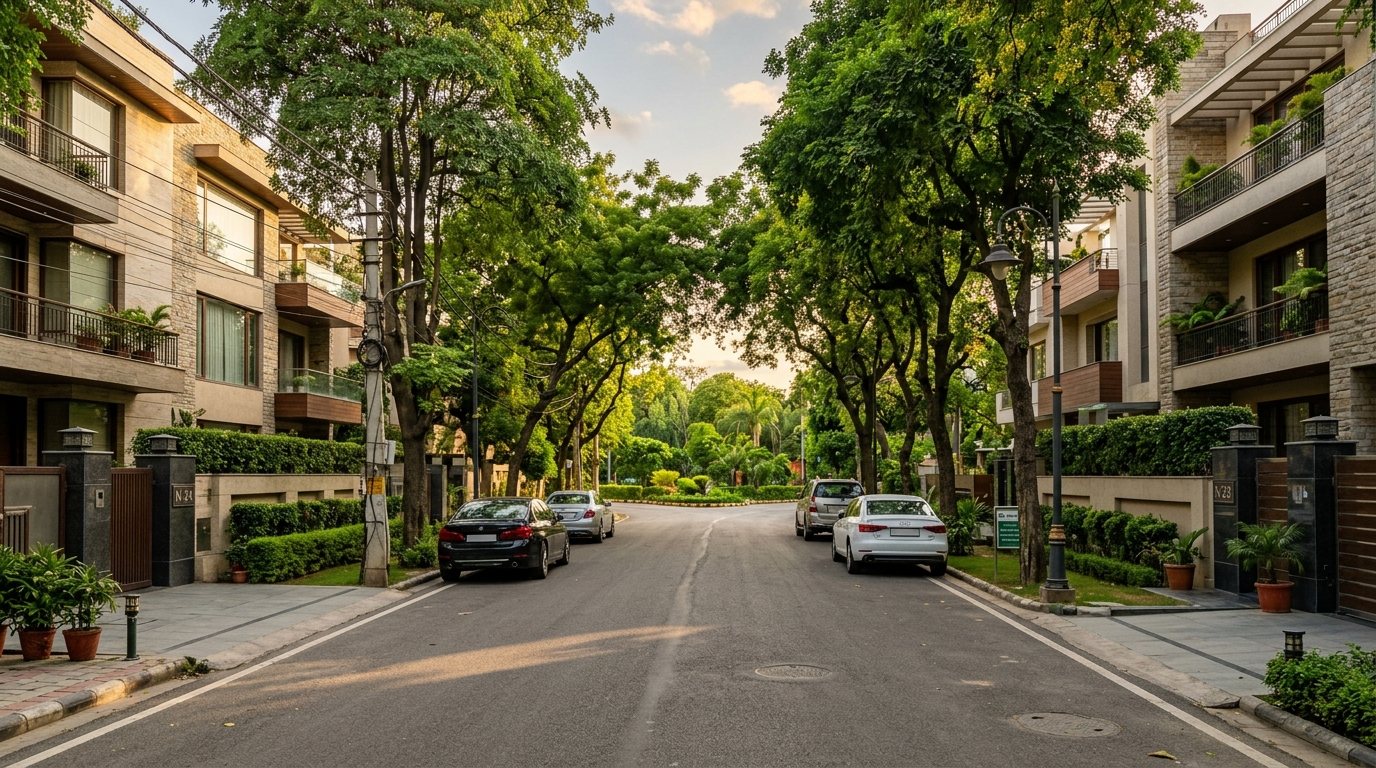
Greater Kailash I is one of Delhi’s best-known planned colonies, laid out from the 1960s as a grid of lettered blocks — E, W, M, N, S and R — around a large central park and the M-block market, which grew into one of the city’s most famous shopping and dining destinations. It sits between the Outer Ring Road, Kailash Colony and Chirag Delhi, with Greater Kailash Enclave and GK 2 alongside.
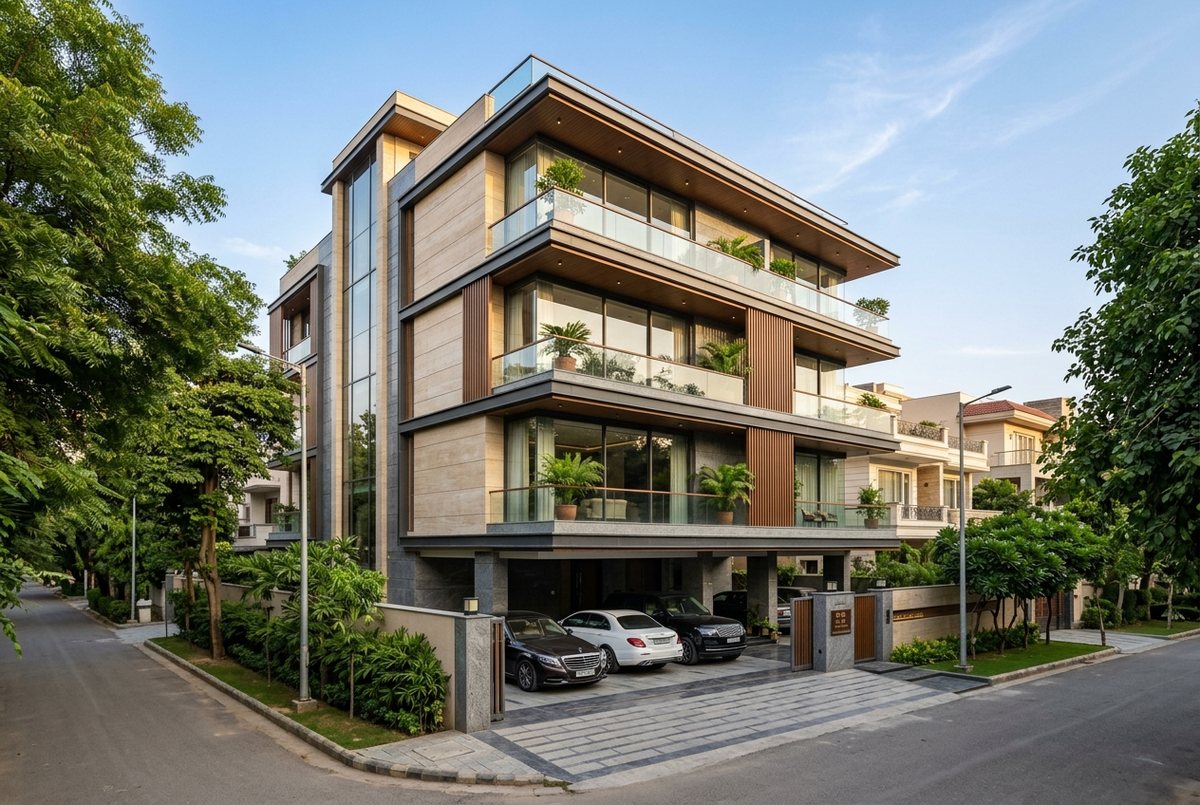
As across South Delhi, the original plots have redeveloped one at a time into stilt-plus-four builder floors — several homes on each old address — so with no vacant land and no apartment towers, new supply is entirely redevelopment-driven. A rare combination of a marquee market, a big park, its own cinema and deep, established demand keeps GK I both prestigious and unusually liquid.
A typical stilt-plus-four redevelopment — several floors on one plot.
Where value lives
Greater Kailash I is best read block by block. The M-block and the Central Market are the prime, central and most liquid part of the colony, ringed by sought-after residential streets and the Archana theatre. The N and W blocks hold classic leafy builder-floor streets away from the market bustle. The E-block and the streets toward Kailash Colony are well-connected, with the colony schools close by. The A, B and S blocks run along the big colony park to the east — green frontage and among the most prized addresses. Plots run from about 200 to 500 square yards, so block and frontage move price more than fittings do.
Which block suits you is the whole question in GK I — a market-facing floor, a park-facing floor and a quiet inner-street floor are three different lives at three different prices. The finer nuances — which streets are quietest, which titles are cleanest, which floors face green — are exactly what we walk clients through before they shortlist. Tap the map below to see how the colony is laid out.
Each gold quarter groups the blocks of GK I — the M-block market at the heart, the residential blocks around it, and the big colony park to the east — wrapped by the Outer Ring Road, Kailash Colony and the road to Kalka Ji. Tap a quarter for its character. Schematic overlay — not to scale.
Colours group the blocks; plot size, block and frontage move price more than finish. Landmarks and boundary roads are for orientation; the overlay is schematic, not to scale.
Ask us about this area →Three ways to buy
The cleanest option. You inspect the finished product and get fresh construction with a builder warranty. You pay the top rate — toward ₹35,000 per sq ft, more for a park- or market-facing plot — for it.
Typically 15–30% cheaper per sq ft, which is why sound resale floors here start well below new build. The land share is identical, so the discount sits on structure and fittings — often the best value in the colony.
Milestone-linked payments and a modest price edge, against completion risk. Most single-plot redevelopments fall below Delhi’s RERA thresholds — your protection is the builder’s record and your agreement.
Daily life
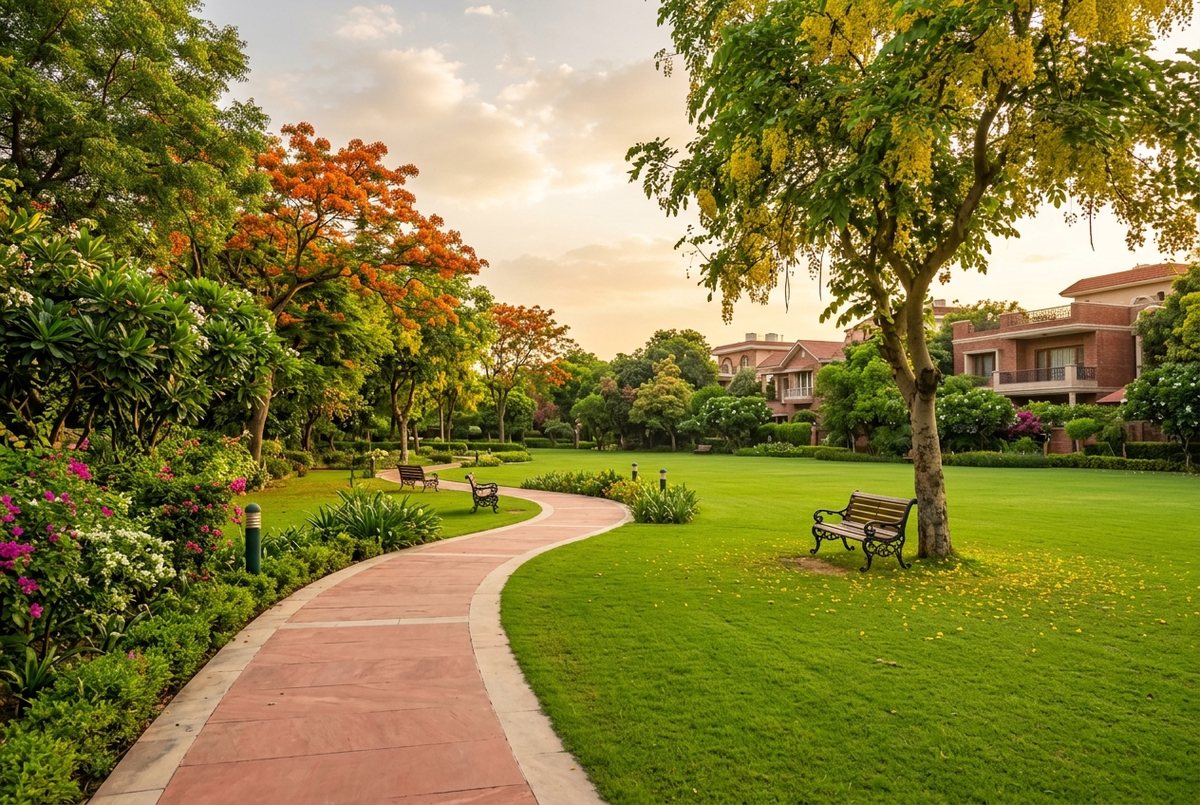
The appeal of GK I is that everything is on the doorstep. The M-block market is a destination in its own right — flagship stores, restaurants and cafes — with the N-block market and Central Market covering everyday needs, the Archana theatre for cinema, and a large colony park for the morning-walk crowd. Several schools sit inside or beside the colony.
Connectivity is a big part of the draw. Kailash Colony on the Delhi Metro Violet Line is minutes away, with Chirag Delhi and the Outer Ring Road giving fast access to Nehru Place, Saket, the airport and Noida. Max and Fortis hospitals are within a short drive. The honest trade-offs: the market blocks are busy and parking-tight, and the Ring Road slows at peak hours — which is exactly why the quiet inner streets command their own premium.
What it earns
Rents in GK I are strong and steady because demand is deep and varied — corporate leases, business families, and professionals who want a central, connected address with a market and metro on hand. A typical 4 BHK floor lets for roughly ₹2–4.5 lakh a month depending on block, floor and finish, with large or market-facing floors higher. As across land-heavy South Delhi, gross yields are modest — on the order of 2% — because buyers pay for land, location and liquidity, not cashflow.
The money mechanics
Greater Kailash I is circle-rate Category B: land is valued at ₹2,45,520 per square metre under the rates still in force, with construction valued separately. Market values run several times that figure, and because Delhi charges stamp duty on the higher of transaction value or circle value, in GK I duty is effectively paid on the actual deal price. On a ₹12 crore floor registered in a male buyer’s name, budget roughly ₹72 lakh stamp duty (6%), ₹12 lakh registration (1%), and 1% TDS deducted against the seller’s PAN. Registering in a female family member’s name brings stamp duty to 4% — a legitimate ₹24 lakh saving at this ticket. Banks typically fund 65–75% of a floor at this size, so plan your equity accordingly.
See also: Stamp duty & registration charges in Delhi · Circle rate vs market rate · Home loan for a builder floor
Protect yourself
In GK I, the problems that surface years later almost always trace to a thin or unregistered collaboration agreement from the plot’s redevelopment — or to a floor near the market being sold with unresolved commercial use. Trace the full chain — original allottee, collaborating builder, and every floor sold since — confirm the exact block, plot and permitted use, and price the land share, not the finish.
What typically trades
GK I is liquid, and the best floors still move quickly — often off-market. These are indicative configurations and price bands, not live listings; the always-current list lives on our Greater Kailash page, and we hold quiet floors matched to serious buyers.
Around 2,000–2,500 sq ft, stilt parking, lift and servant room — the GK I workhorse.₹9–13 Cr
Around 3,000–3,800 sq ft on the larger plots — often park-facing or on a wide block road.₹14–22 Cr
Corporate and business-family leases on the better blocks.₹2–4.5 L/mo
How it compares
The two are South Delhi’s most iconic Category B colonies, and a buyer at this level should look at both. Defence Colony is tighter, more uniform and arguably more exclusive — a single prestigious address with its own famous market and a strong sense of order. Greater Kailash I is larger, livelier and more liquid, with lettered blocks, a bigger park, its own cinema and a deeper flow of stock, so there is usually more to choose from and a wider price range. Choose Defence Colony for a more exclusive, uniform address; choose GK I for choice, liquidity and a market-and-metro lifestyle. If a specific floor fits your brief better in one that week, the floor usually wins — the colony-level difference is smaller than the plot-level one.
Compare: Property in Defence Colony Guide → · Property in Gulmohar Park Guide →
The medium term
Three things underpin the case. Supply is structurally scarce — a fully-built colony with no vacant land, redevelopment-only — while demand stays deep and national, which is why GK I is one of the most liquid luxury markets in the city. Category B colonies led the last surge, and GK I’s builder-floor values have risen strongly as buyers priced land and location over finish. And the fundamentals of daily life — a marquee market, a big park, a cinema, schools and a metro on hand — are exactly what keeps a colony desirable decade after decade. None of this guarantees any single year’s return, but scarce, liquid, well-located land is a strong floor under value.
Good to know
In short
Locality Guides Live
Talk to SouthDelhiFloors
Tell us your brief and we will shortlist the Greater Kailash I floors worth your time — the right block, including the quiet off-market ones — walk them with you in a single afternoon, and give you an honest read on price and paperwork before you commit.
Defence Colony–based consultants · Four decades in South Delhi real estate
SOUTH DELHI FLOORS
Clean Deals Only · Since 1984
Second-generation consultants for South Delhi’s finest builder floors, farmhouses and independent homes. Four decades of clean, verified transactions.
+91 99990 04511Explore
Prime Localities
Enquire Now
Tell us what you are looking for and a senior consultant will get back to you.
Owning a home is a keystone of wealth… both financial affluence and emotional security.
Please enter the 6-digit OTP sent to your email.
Time remaining: 05:00