View from inside a South Delhi home through a sealed window at a hazy winter morning outside
SouthDelhiFloors · The Ownership Desk

Air Pollution and Your South Delhi Home

Delhi’s winter air changes three practical things for a homeowner: when you are allowed to renovate, what your house can actually do about the air, and which features of a floor are worth paying for. The restrictions are not weather. They are a published schedule with stated thresholds, and that means you can plan around them — which most buyers only learn after a fit-out has been stopped.

By the SouthDelhiFloors Research DeskSouth Delhi builder floors13 min read
The one thing a buyer needs to know

You cannot assume you will be allowed to run a dusty renovation through a Delhi winter. Two separate sets of rules bite. The Graded Response Action Plan is triggered by air quality: when Stage III is in force, there are strict restrictions on dust-generating construction and demolition across NCR, and under the Commission for Air Quality Management’s schedule, Stage II already asks that dust-generating construction be avoided in the months of October to January. Separately, Delhi’s own Winter Action Plan has in recent years prohibited dust-generating demolition and outdoor civil construction over a fixed window from 1 November to 31 January — irrespective of the day’s AQI — with exceptions for essential public infrastructure.

If you are buying in September with a plan to strip out and refit by December, that plan needs rethinking before you negotiate, not after.

4GRAP stages, keyed to Delhi’s AQI
401–450The ‘Severe’ AQI band at which Stage III construction curbs bite
Oct–JanMonths in which the CAQM schedule asks that dust-generating construction be avoided
~10%How much lower indoor PM2.5 was in high-income Delhi homes than in low-income ones, in a Delhi study

How GRAP actually works

The Graded Response Action Plan for NCR is written and revised by the Commission for Air Quality Management in NCR and Adjoining Areas, a statutory body under the CAQM Act, 2021, which replaced the earlier EPCA. Its Sub-Committee on GRAP invokes and revokes stages. Four things about its mechanics matter to a resident:

  • It is keyed to Delhi’s AQI, in four stages. The bands are published and do not move.
  • It can be invoked in advance. Actions under a stage can be triggered ahead of the AQI actually reaching that level, on IMD and IITM forecasts, where the higher levels are likely to be sustained — and if an episodic event breaches a threshold, that stage applies.
  • It is cumulative. When a higher stage is invoked, the measures of the lower stages continue to apply.
  • The schedule gets revised. The Commission has repeatedly moved measures to lower stages so that they bite earlier, and the revised schedule runs to dozens of actions across the four stages with a Citizens’ Charter attached. Whatever you read about GRAP, check the current schedule on the CAQM site.
Stage I
Poor
AQI 201–300

Baseline enforcement of existing dust, waste and emission norms.

Stage II
Very Poor
AQI 301–400

Tighter dust and traffic controls. The schedule asks that dust-generating construction be avoided October to January.

Stage III
Severe
AQI 401–450

Strict restrictions on dust-generating construction and demolition; vehicular restrictions.

Stage IV
Severe+
AQI above 450

Stricter construction curbs and the tightest vehicle entry restrictions.

What a Stage III construction restriction actually stops

This is the detail that matters, and it is more specific than “construction ban”. When the Commission has invoked Stage III, the restriction has been enforced on the dust-generating categories in particular: earthwork for excavation and filling including boring and drilling works, piling works, and all demolition works. Construction activity other than those categories, being relatively less polluting, has been permitted to continue subject to strict compliance with the Construction and Demolition Waste Management Rules, dust prevention norms and the Commission’s directions. Exceptions have been made for projects such as metro, railways, airports, hospitals and linear public projects.

Read against a builder-floor fit-out, that is a precise and inconvenient list. Demolition — knocking out a wall, pulling up a floor, breaking a bathroom — is exactly what gets stopped. Finishing work, which is the quiet half of a renovation, has generally been allowed to continue with dust controls.

The renovation calendar, in one line

Do the breaking in the warm months and the finishing in the cold ones. Plan a South Delhi fit-out so that demolition, chasing walls, floor removal and any excavation are finished before the end of October, leaving plaster, paint, joinery, electricals and installation for the winter. That one sequencing decision is worth more than any clause you will negotiate, and it costs nothing to make.

Delhi’s own winter plan, on top of GRAP

The Delhi government also publishes a seasonal Winter Action Plan, typically announced in October and running to the end of February. In recent years it has carried measures that apply on dates rather than on AQI, which is the part people miss. The recent plan included a prohibition on dust-generating demolition and outdoor civil construction from 1 November to 31 January except for essential public infrastructure; a bar on non-BS-VI vehicles registered outside Delhi entering the city over the same window, with electric, CNG and essential-service vehicles exempt; doubled parking charges at authorised parking facilities from 1 November to the end of February, excluding DMRC parking; a 50% work-from-home requirement for government and private offices; and a “no PUC, no fuel” rule enforced at petrol pumps fitted with number-plate recognition.

The specifics change from one winter to the next and are announced each autumn, so treat the shape as reliable and the detail as something to confirm. Two of these have direct consequences for a household: the construction window, and the out-of-state car. If your second car is registered in Haryana or UP and is not BS-VI, it may be a car you cannot drive into the city for three months of the year.

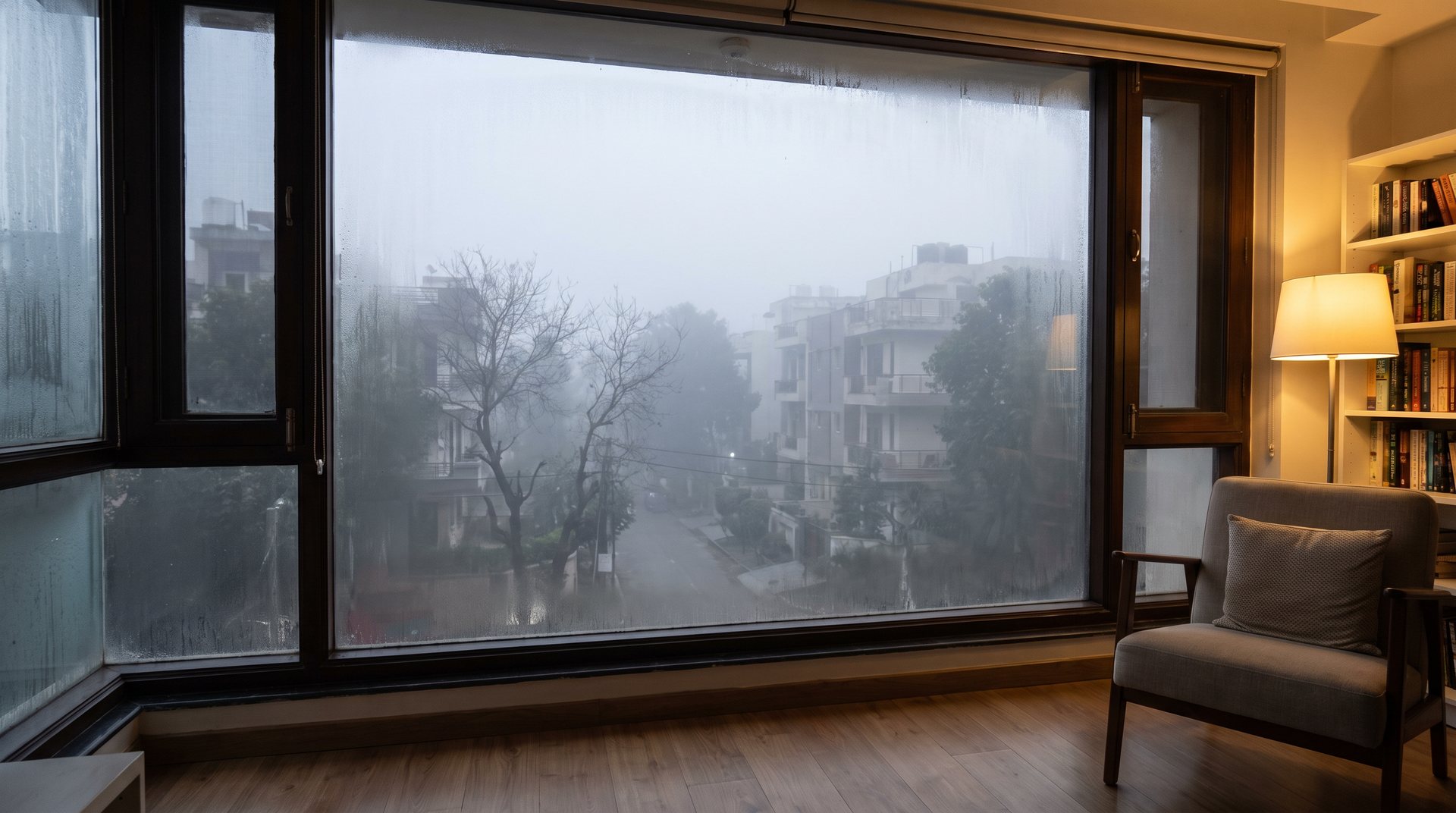
What your house can and cannot do about the air

Here the honest answer is less flattering to real estate than buyers would like. The most useful Delhi evidence comes from a study of thousands of households across socio-economic strata by the Energy Policy Institute at the University of Chicago, which measured indoor rather than ambient air. Its findings:

  • Winter indoor PM2.5 was extremely high in every stratum — mean concentrations around 23 times the WHO limit of 10 micrograms per cubic metre used in the study in low-income households and around 29 times in high-income households.
  • Indoor levels in better-off homes were only about 10% lower than in disadvantaged ones, despite greater ownership of air purifiers.
  • Indoor levels were substantially higher than the nearest government monitor reported — so the AQI on your phone is not a reading of your living room.
  • Indoor PM2.5 spiked in the mornings and evenings, when households were most likely to be cooking.
  • Households given real-time indoor readings saw a modest decline, around 8.6%, in indoor PM2.5.

Two conclusions follow, and both run against the marketing. First, buying a larger or more expensive home in South Delhi does not by itself buy you cleaner indoor air. Second, the biggest single lever in your own home is not the colony or the floor — it is the kitchen extract, because cooking is when your own air gets worst.

What is worth doing, in order of effect

Make the kitchen exhaust actually work

A chimney that vents outdoors, sized to the hob, used every time, with the duct run checked rather than assumed. Our handover snag list includes the specific check: confirm the duct goes outside and does not terminate in a shaft or a false ceiling.

Seal the envelope

Dust in a South Delhi flat arrives through window gaskets, door undercuts, unsealed AC sleeve penetrations and exhaust fans with no backdraught shutter. Sealing is cheap, permanent and more effective per rupee than another purifier. It is also the one thing you can only do properly during a renovation, so do it then.

Then buy purifiers — sized, per room, filters changed

Purifiers do work, and the published field evidence shows meaningful reductions in closed rooms. It also shows diminishing returns as outdoor pollution rises: a recirculating unit cannot outrun infiltration on the worst days. Size by room, run them closed, and put the money into filter replacement rather than a second machine.

Measure your own air

An inexpensive indoor monitor changes behaviour, which is what the Delhi study found. It will also tell you something no listing will: whether the flat you are about to buy holds its air.

Deal with the sources inside

Incense, candles, mosquito coils, a kitchen with no extract, and dry-sweeping a marble floor all raise indoor particulate. None of these is a property problem, and all of them are cheaper to fix than a purifier.

Mohit Minocha of SouthDelhiFloors, on how Delhi air quality rules affect buying and renovating a South Delhi home
Mohit Minocha, founder of SouthDelhiFloors. The cheapest air-quality upgrade in any South Delhi flat is a kitchen chimney that actually vents outside.

Does any of this move price in South Delhi?

Being straight about this: we have no credible evidence that air quality prices colonies against each other within South Delhi. The differences in measured air quality across South Delhi monitoring stations are small relative to the differences in price, and buyers do not shop by AQI. What air pollution does influence is which features of a floor buyers pay up for, and that is visible in the market.

Features that attract a premium partly for air-quality reasons, and what to actually check.
Feature Why buyers want it What to check
Park-facing position Open frontage, mature trees, no traffic queue at the window. A genuine quality-of-life premium that we see in closed deals. Whether the park is maintained, and whether the frontage is actually open or faces a service lane. Our guide to corner, park-facing and main-road floors sets out what each position is worth.
Set back from a main road Traffic is a source you cannot filter away, and road dust is the dominant nuisance in a ground or first-floor flat. Stand at the window in the evening peak. Then look at the sills.
Good windows Sealed, well-gasketted glazing is the single most effective piece of air-quality hardware in a house, and it also fixes noise. Slide every panel; check the gasket seats all round and the mesh is tensioned. Dust will find a bad seal long before rain does.
Proper kitchen extract The one source inside the house that dominates your own exposure. Run the chimney and confirm the duct goes outside.
Top floor with terrace Less road dust at height, plus outdoor space. Commands a premium for both reasons. Terrace rights are a document question, not a view question — see our note on terrace, stilt and basement rights.
Covered or stilt parking A car that does not sit under three months of settling dust, and a place to put an EV charger. Allocation in the documents, and whether the lift reaches the parking level — our guide to water, power backup and lifts covers that.
One more thing that has become a property question

Generator backup. The Commission for Air Quality Management has directed a revised schedule for regulated operation of diesel generator sets across all sectors in NCR, residential included, built around conversion to dual fuel and retro-fitment of emission control devices; without those, the Commission has stated that use is not permitted anywhere in NCR, and operation is restricted further while GRAP is in force. A building that sells you “DG backup” should be able to say what its compliance position is.

Checking the air where you are actually buying

You can do this yourself, before a second visit, and it takes ten minutes:

Find the nearest monitoring station

The Central Pollution Control Board’s network has several stations across South Delhi and central Delhi. Use the CPCB dashboard or the SAMEER app to find the one closest to the colony and look at its history, not today’s number.

Look at the pattern, not the day

Any single reading tells you about the weather. The useful comparison is the seasonal shape and how the station behaves in November against the city average.

Check what is upwind and nearby

A major arterial road, a flyover construction site, a landfill, a bus depot or an industrial pocket matters more than the colony’s reputation. Look at the satellite view, not the brochure.

Visit at the worst time

A winter evening, with the windows closed. Ask what the flat smells like and how much dust is on the sills. It is the single most informative visit you will make, and almost nobody makes it.

Check the current GRAP stage before you plan work

The stage in force is published on the CAQM website, and AQI is on the SAMEER app. Before you commit to a fit-out schedule, check both and read the current Winter Action Plan notification.

Key takeaways: air pollution and your South Delhi home

  • GRAP has four stages keyed to Delhi’s AQI: Poor (201–300), Very Poor (301–400), Severe (401–450) and Severe+ (above 450). It is cumulative and can be invoked on a forecast.
  • Stage III restrictions have targeted excavation, boring and drilling, piling and all demolition, with less dust-generating construction allowed to continue under dust controls.
  • Delhi’s seasonal Winter Action Plan has separately barred dust-generating demolition and outdoor civil construction over a fixed 1 November to 31 January window, regardless of the day’s AQI.
  • So: do the breaking before the end of October and the finishing through winter.
  • A Delhi study found winter indoor PM2.5 at roughly 23 to 29 times the 10 microgram WHO limit it used, with better-off homes only about 10% lower than poorer ones. A bigger house does not buy clean air.
  • In order of effect: kitchen extract, sealing the envelope, then sized purifiers with filters actually changed.
  • Air quality does not visibly price colonies against each other, but it does drive the premium on park-facing frontage, set-back position, good windows and covered parking.

Frequently asked questions

Can I renovate my South Delhi flat in winter?

Partly. Dust-generating work is what gets restricted. Under GRAP Stage III the restrictions have targeted excavation and filling including boring and drilling, piling, and all demolition works, while less dust-generating construction has been permitted subject to dust-control and waste-management compliance. Delhi’s seasonal Winter Action Plan has separately prohibited dust-generating demolition and outdoor civil construction over a fixed November-to-January window irrespective of AQI. Plan demolition before the end of October and keep finishing work for winter, and check the current notification before you start.

What are the four GRAP stages and their AQI levels?

Stage I is ‘Poor’ at Delhi AQI 201 to 300, Stage II ‘Very Poor’ at 301 to 400, Stage III ‘Severe’ at 401 to 450 and Stage IV ‘Severe+’ above 450. The measures are cumulative, so a higher stage adds to rather than replaces the lower ones, and a stage can be invoked ahead of the AQI actually reaching that band on the basis of IMD and IITM forecasts.

Who decides when GRAP restrictions apply?

The Commission for Air Quality Management in NCR and Adjoining Areas, a statutory body set up under the CAQM Act, 2021, which replaced the earlier EPCA. Its Sub-Committee on GRAP invokes and revokes the stages, and the Commission writes and revises the schedule of measures under each stage.

Does a more expensive South Delhi home have cleaner indoor air?

Not by much, on the Delhi evidence. A study of thousands of Delhi households by the Energy Policy Institute at the University of Chicago found winter indoor PM2.5 in high-income homes only around 10 per cent lower than in low-income homes, despite greater ownership of air purifiers, with mean concentrations in both strata many times the WHO limit used in the study. What makes a difference inside a home is the kitchen extract, the sealing of the envelope and correctly sized purifiers that are actually run with the windows closed.

Do air purifiers work in Delhi?

Yes, in a closed room, with meaningful reductions reported in field studies. But the published Delhi work also shows diminishing returns as outdoor pollution rises: a recirculating unit cannot outrun the rate at which outdoor particulate infiltrates a leaky room. Which is why sealing the room is the step that makes the purifier work, rather than an alternative to it.

Which South Delhi colony has the best air?

We would not claim to know, and we are sceptical of anyone who does. Differences between South Delhi monitoring stations are small set against the city-wide winter pattern, and a colony’s average tells you little about a particular flat. What is checkable about a specific property is its distance from an arterial road, its frontage, the quality of its windows and whether its kitchen vents outside.

Will my out-of-Delhi car be affected in winter?

It may be. Delhi’s recent Winter Action Plan barred vehicles registered outside Delhi that do not meet BS-VI emission standards from entering the city over a November-to-January window, with electric, CNG and essential-service vehicles exempt, and doubled parking charges at authorised parking facilities to the end of February, excluding Delhi Metro facilities. These are announced each autumn and the detail changes, so check the current notification.

Should air quality change which floor I buy?

It is one input among several. A higher floor set back from a main road will see less road dust than a first floor on an arterial, and a park-facing frontage is pleasanter on every count. But the premium you pay for position in South Delhi is driven by light, outlook, noise and parking at least as much as by air, and a well-sealed flat in an ordinary position will usually hold its air better than a leaky one in a good position.

Planning a purchase and a fit-out in the same season?

Tell us when you want to move in and we will tell you what the winter calendar does to the plan — before you negotiate.

SouthDelhiFloors is a property advisory. This is general information and not health, legal or engineering advice. Air-quality rules in Delhi-NCR change frequently; confirm the current position with CAQM and the Delhi government before acting.

More on South Delhi homes

Sources: the Commission for Air Quality Management’s published GRAP schedule for the four stages, their AQI bands, the forecast-based and cumulative mechanics and the October-to-January dust guidance; the Press Information Bureau release on the invocation of GRAP Stage III for the specific construction and demolition categories restricted and the permitted exceptions; the PIB release on the revised GRAP schedule for the movement of measures to lower stages; reporting of Delhi’s Winter Action Plan measures in Business Today and Outlook India; and the Energy Policy Institute at the University of Chicago on indoor air quality in Delhi homes for the indoor PM2.5 findings, the high-income versus low-income comparison and the effect of real-time information. The diminishing-returns finding on purifier use is from published field work in Delhi. Winter Action Plan measures are announced seasonally and the GRAP schedule has been revised more than once; the dates and detail above describe recent plans rather than a permanent rule, and the current notification governs. The renovation-sequencing advice is our own.

Share this:

Like this:

Like Loading…

SOUTH DELHI FLOORS

Clean Deals Only · Since 1984

Second-generation consultants for South Delhi’s finest builder floors, farmhouses and independent homes. Four decades of clean, verified transactions.

+91 99990 04511

Enquire Now

Tell us what you are looking for and a senior consultant will get back to you.

    Your Name

    Telephone Number

    Your Email (required)

    Enter Your Message

    © 2026 SouthDelhiFloors LLP · All Rights ReservedClean Deals Only · Since 1984

    Compare Properties

    Compare
    You can only compare 4 properties, any new property added will replace the first one from the comparison.
    Property in South Delhi : Buy Sell Properties, Flats, Homes, Apartments Call SouthDelhiFloors
    Contact
    close slider

      Your Name

      Telephone Number

      Your Email (required)

      Enter Your Message