
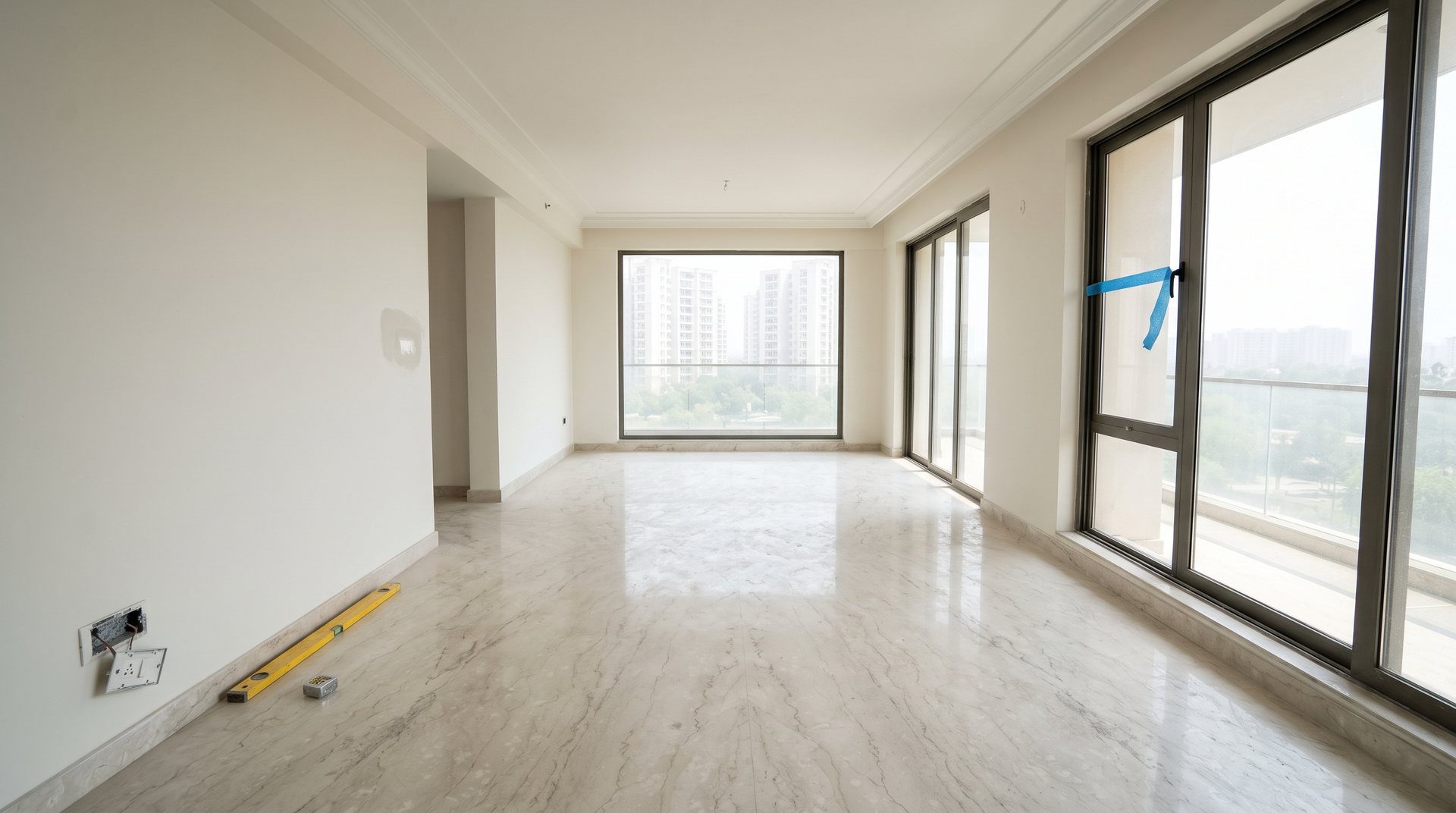
















An empty newly finished builder floor apartment interior in South Delhi awaiting handover, with marble flooring and bare walls
SouthDelhiFloors · The Ownership Desk

The Builder Floor Handover Snag List

On most South Delhi builder floors there is no RERA registration, no five-year builder warranty and no municipal inspector who ever walked the site — because the plot is under 500 square metres and the plan was signed off by the builder’s own architect. The snag list you make before you release the final payment is the only warranty you get. Here is what to check, room by room, and how to hold the retention.

By the SouthDelhiFloors Research DeskSouth Delhi builder floors12 min read
Why does a snag list matter more on a South Delhi builder floor than on a flat in a tower?

Because the statutory safety net that covers a tower almost never covers your floor. Under Section 3(2)(a) of the Real Estate (Regulation and Development) Act, 2016, a project does not need RERA registration below certain thresholds, which is why so many Delhi builder floors sit outside the register. Delhi RERA has narrowed the loophole — by its clarification order, registration is mandatory if the plot exceeds 500 square metres regardless of unit count, and also where the number of units crosses eight on any plot size — but 500 square metres is about 598 square yards, and most South Delhi builder-floor plots are smaller than that. No registration means no Section 14(3) five-year defect liability to fall back on, and no RERA complaint to file.

Layer on how the plan was approved. Under the Unified Building Bye-laws for Delhi, 2016, plots up to 105 square metres need no sanction of building plans at all, and residential plots from 105 to 500 square metres are treated as low risk, with the architect or engineer empowered to issue the building permit. The professional who certifies the building is appointed and paid by the builder. Your own walkthrough is the inspection.

598 sq ydRoughly the plot size at which the 500 sq m RERA threshold bites
105 sq mPlot size up to which no building-plan sanction is needed in Delhi
5 yearsRERA defect liability — but only on a registered project
30 daysTime a promoter has to rectify a notified defect under Section 14(3)

None of this means South Delhi builder floors are badly built. Plenty are built better than the towers, by builders who have worked the same four colonies for twenty years and cannot afford a bad reputation. It means the accountability is commercial rather than statutory: it sits in your sale agreement, in the money you have not yet paid, and in the quality of the list you put in front of the builder on handover day.

Before the walkthrough: the paperwork half of the snag list

Half the defects that cost real money are not visible. Ask for these in writing, and treat a refusal as information:

Documents to collect at or before handover. What you can get varies with the colony and the vintage of the construction.
Document Why it matters
Sanctioned building plan The only way to know whether what was built matches what was approved. A deviation can surface years later as a notice.
Completion-cum-occupancy certificate Confirms the construction was formally closed. Delhi simplified this process in 2016; the absence of a certificate is worth a direct question.
Architect’s structural and supervision certificates On a low-risk plot these are the certification. Get the architect’s name, registration and the certificates themselves.
Electrical load sanction and meter details Whether the sanctioned load actually supports air conditioning in every room, and whose name the meter is in.
Water and sewer connection papers The Delhi Jal Board connection for the building, and any borewell — see our note on the full cost of buying in Delhi for what these add.
Lift paperwork and warranty Make, model, installation date, warranty terms and the AMC. The lift is the single most expensive thing in the common area.
Equipment warranty file Water pump, inverter or generator, geysers, chimney, ACs, water treatment. Original invoices, not photocopies.
Mutation and no-dues Property tax position, electricity and water dues, and any colony maintenance arrears. Our guide to RWAs explains how far a maintenance demand can actually be enforced.
The clause that does the work

Before you sign anything, ask that the agreement name a retention amount held against the snag list, with a date by which the snags are to be cleared and a joint sign-off releasing it. This is ordinary practice in commercial fit-outs and entirely negotiable on a floor. A builder who agrees is telling you something; so is one who refuses.

The walkthrough, room by room

Go in daylight. Carry a phone torch, a phone charger, a spirit level app, a small mirror, a marble or a ball bearing, and a roll of masking tape to mark each snag as you find it. Photograph everything with the tape visible. Then do it again at night, with every light on.

Structure, walls and ceilings

What to look for

  • Cracks — hairline shrinkage cracks in plaster are common and cosmetic. Cracks that run diagonally from a window or door corner, cracks wider than a visiting card, or any crack along a beam-column junction are a different question and deserve a structural engineer before you pay.
  • Damp patches and efflorescence — the white powdery bloom on plaster means water is moving through the wall. Check shared walls, the wall behind every bathroom, and the ceiling under any terrace or balcony above.
  • Ceiling and wall level — sight along each wall from a corner. Waves and bulges in plaster will show up through paint and will show up more under wall lights.
  • Paint finish — look at an angle, not straight on. Roller marks, patch repairs in a different sheen and missed cut-ins around switches are easy to get fixed now and impossible later.
Floors

What to look for

  • Hollow tiles — tap every tile with a coin or a knuckle. A hollow ring means the bed is not full and the tile will crack or lift. This is the single most common snag and the most commonly waved away.
  • Level and lippage — run a hand across each joint. A tile edge standing above its neighbour is a trip and a chip.
  • Marble joints and staining — on Italian or Indian marble, check joint width consistency, and look for rust spots or patch polishing where the fitter has filled a chip.
  • Skirting — gaps at the wall, uneven heights, mitres that do not meet at corners.
Bathrooms and plumbing

What to look for

  • Drainage slope — pour a bucket of water across the floor. If it pools anywhere, or runs away from the drain, the screed is wrong and the fix is disruptive. Do this in every bathroom and every balcony.
  • Pressure on the top floor — open the shower and a basin tap together on the highest floor and watch the flow. A weak top floor usually means a pump or a tank height problem, not a tap problem.
  • Hot water — run every geyser. Time how long hot water takes to arrive at the furthest outlet. Check there is no cross-connection making the cold tap run warm.
  • Leaks under everything — use the mirror and torch under every basin, behind every WC and inside every vanity. Dry today is not the test; run each outlet for two minutes and look again.
  • Flush and seals — flush every WC twice. Check the cistern refills quietly and the pan is sealed to the floor. Push the WC gently; it should not rock.
  • Traps and smell — every floor drain should have a water seal. A sewer smell in a brand new bathroom is a trap or a vent problem and will not go away on its own.
  • Exposed shut-offs — find the isolation valves for each bathroom and the main stopcock for the floor. If there is no accessible shut-off, ask for one now.
Electrical

What to look for

  • Every point, tested — take a phone charger and a small lamp. Test every socket, every switch and every switch-to-fitting pairing. Mark the dead ones.
  • The distribution board — circuits should be labelled, and there should be an earth-leakage device. Trip it and confirm it actually cuts the circuits it claims to.
  • Earthing — ask where the earth pit is, when it was last watered and whether it was tested. On a builder floor this is frequently the weakest link in the whole installation.
  • AC points and loads — confirm there is a dedicated circuit for each air conditioner, and that the sanctioned load covers running them together with a geyser and a kitchen.
  • Inverter or generator circuits — establish exactly which points are on backup. “Full backup” often means lights and fans only. Our guide to water, power backup and lifts goes into what the different arrangements really deliver.
  • Data, TV and doorbell — test them. Conduits that were pulled but never terminated are a standard snag.
Doors, windows and joinery

What to look for

  • Every door, opened and closed slowly — it should not swing on its own, should latch without being lifted, and should clear the floor consistently. A door that drops is a hinge or a frame out of plumb.
  • Window alignment and seals — slide every panel. Check the gasket seats all round, the drainage weep holes are clear, and the mesh is tensioned. In South Delhi the test that matters is dust, and dust finds a bad seal faster than rain does.
  • Glass — look for scratches, chips at the edges and any pane where the spacer in double glazing has fogged.
  • Locks and keys — every lock operated with every key, and a written count of how many sets exist. Change the main door cylinder after possession as a matter of course.
  • Wardrobes and kitchen units — open and close every shutter and drawer, check soft-close actually closes soft, look at the edge banding, and check the carcass is fixed to the wall.
Kitchen

What to look for

  • Counter — joints, overhang support, and the cut-out edges around the sink and hob. Press down near the sink cut-out; a counter that flexes there will crack there.
  • Sink and waste — fill the sink and release it in one go. Watch for a slow drain and for leaks at the trap under load.
  • Chimney and exhaust — run the chimney. Confirm the duct actually goes outside and is not simply terminating in a shaft or a false ceiling.
  • Gas — the piped connection or the cylinder cabinet, with ventilation.
Terrace, balconies and the common area

What to look for

  • Waterproofing and slope — the bucket test again, on every balcony and on the terrace if it is yours. Check the parapet-to-slab junction, which is where terrace waterproofing usually fails first.
  • Railing height and gaps — push the railing firmly. Check the fixings into the slab, not just the look of it.
  • What is actually yours — terrace rights, stilt and basement parking are allocated in the documents, not by who gets there first. Our guide to terrace, stilt and basement rights sets out how that works, and it is far easier to settle before you pay than after.
  • Lift — ride it to every floor. Check levelling at each stop, door timing, the emergency alarm, the phone or intercom, and whether there is an automatic rescue device for a power cut.
  • Stairs, lobby and lighting — the parts nobody inspects, and the parts a visitor sees first.
  • Water tanks and pump — look inside the tanks. Check the covers seal, the overflow is piped away, and the pump has a dry-run cut-out.
Mohit Minocha of SouthDelhiFloors, on inspecting a builder floor before taking possession
Mohit Minocha, founder of SouthDelhiFloors. The bucket of water in the bathroom has settled more arguments than any clause ever has.

How to run handover day so the list actually gets fixed

Do not do it alone, and do not do it at the end

Take a civil contractor or an architect with you, paid by the hour. They will find in twenty minutes what you will miss entirely, and their presence changes the conversation. Book the walkthrough a week before the final payment is due, not on the day.

Write the list on site, numbered, with photographs

One row per snag: location, what is wrong, what the fix is. Numbered rows are harder to argue with than a paragraph. Masking tape in the photo proves where each one was.

Separate must-fix from cosmetic, openly

Hand over one list in two parts. Being explicit that half the items are cosmetic earns you credibility on the half that is not, and the structural and waterproofing items are the ones you should refuse to compromise on.

Get a date against each row, signed

Both parties sign the list with a target date per item. This single page is what you will rely on if the conversation turns difficult in month three.

Hold the retention until the joint re-inspection

Re-walk the list with the same person. Sign off item by item. Release the retention when the list closes, not before.

Keep the file

The signed list, the photographs, the warranty invoices, the architect’s certificates and the correspondence go in one place. Three years later, when a bathroom floor lifts, this file is the difference between a conversation and a dispute.

If the builder has already gone

Where there is no registered project and no warranty, your remedies sit elsewhere: the terms of the sale agreement, and a consumer complaint where there is a deficiency in what was promised and paid for. Both get much harder without contemporaneous evidence, which is the real reason to photograph everything on day one. For anything serious, take a lawyer’s view on your own documents rather than a general rule.

Key takeaways: the handover snag list

  • Most South Delhi builder floors fall outside RERA registration, so there is no Section 14(3) five-year defect liability and no RERA complaint route.
  • Delhi RERA requires registration where the plot exceeds 500 square metres (about 598 sq yd) regardless of unit count, and where units cross eight on any plot size. Check the register if your plot is near that line.
  • On plots up to 105 square metres no plan sanction is needed, and from 105 to 500 square metres the builder’s own architect issues the permit. Your walkthrough is the inspection.
  • Collect the sanctioned plan, completion-cum-occupancy certificate, architect’s certificates, load sanction, lift papers and warranty invoices — the paperwork half of the snag list.
  • The tests that find the most: tap every tile, bucket-test every floor drain, run every outlet for two minutes, test every socket, trip the earth-leakage device.
  • Negotiate a retention held against the signed snag list, with dates and a joint sign-off. Money not yet paid is the only leverage that reliably works.

Frequently asked questions

Does RERA cover a South Delhi builder floor?

Usually not. Section 3(2)(a) of the RERA Act sets registration thresholds that most Delhi builder-floor projects fall under. Delhi RERA has clarified that registration is mandatory where the plot exceeds 500 square metres regardless of how many units are built, and where the number of units crosses eight on any plot size. Since 500 square metres is roughly 598 square yards, a typical South Delhi plot is below the line. Check the Delhi RERA register if your plot is near or above it.

So is there any builder warranty on an unregistered builder floor?

Not a statutory one. The five-year defect liability in Section 14(3) of the RERA Act applies to a registered project. On an unregistered floor your protection is whatever the sale agreement says, plus the equipment warranties, plus a consumer remedy where something promised and paid for was not delivered. That is exactly why the snag list and the retention matter.

Who inspected the construction of my builder floor?

On a plot up to 105 square metres, no building-plan sanction is required in Delhi at all. On residential plots from 105 to 500 square metres, the Unified Building Bye-laws treat the building as low risk and empower the architect or engineer to issue the building permit, with professional liability on them. That professional is appointed by the builder. There is generally no municipal site inspection of the kind people assume.

What is the single most useful test on a walkthrough?

Water. Pour a bucket across every bathroom and balcony floor and watch where it goes. Slope and waterproofing failures are the most expensive thing to fix after you move in, the hardest to argue about later, and the easiest to prove with a thirty-second video on the day.

How much should be held back as retention?

There is no standard figure and it is purely a matter of negotiation, usually settled as a lump sum tied to the size of the snag list rather than a percentage. What matters more than the amount is that it is written into the agreement with a date and a joint sign-off, so releasing it is an event rather than an argument.

Should I take a professional to the handover?

Yes. A civil contractor or architect on an hourly fee is among the cheapest money you will spend on the purchase, and they will find things an owner cannot. They also shift the dynamic: a builder answers a contractor’s question about screed slope differently from a buyer’s.

Are hairline cracks in a new floor a problem?

Fine shrinkage cracks in plaster are normal as a building dries and are cosmetic. What is not routine: diagonal cracks running from the corners of doors and windows, cracks you can fit a card into, cracks at beam-column junctions, or any crack that is growing. Those need a structural engineer’s eye before you release the balance.

Do I need a completion-cum-occupancy certificate?

Ask for it. Delhi simplified the process for obtaining a completion-cum-occupancy certificate under the 2016 bye-laws, reducing the documents required. Where one has not been obtained, you want to know why before you pay, because unresolved deviations from the sanctioned plan travel with the property rather than with the builder.

Taking possession of a floor and want a second pair of eyes?

We walk handovers in these colonies regularly and know which snags builders fix without argument and which they will try to leave with you.

SouthDelhiFloors is a property advisory, not a law firm or a structural consultancy. This is general information. Engage a qualified professional for the inspection and a lawyer for your documents.

More on taking over a South Delhi floor

Sources: Section 3(2)(a) and Section 14(3) of the Real Estate (Regulation and Development) Act, 2016; the Delhi RERA clarification order on registration thresholds, as reported by Business Standard and Outlook Money; the Press Information Bureau release on the Unified Building Bye-laws for Delhi, 2016 for the 105 sq m SARAL exemption, the low-risk classification for 105–500 sq m residential plots and the simplified completion-cum-occupancy procedure. The 500 sq m to 598 sq yd conversion is ours. The room-by-room checks are our own practice on handover walkthroughs, not a statutory standard, and they are not a substitute for a qualified inspection.

Share this:

Like this:

Like Loading…

SOUTH DELHI FLOORS

Clean Deals Only · Since 1984

Second-generation consultants for South Delhi’s finest builder floors, farmhouses and independent homes. Four decades of clean, verified transactions.

+91 99990 04511

Enquire Now

Tell us what you are looking for and a senior consultant will get back to you.

    Your Name

    Telephone Number

    Your Email (required)

    Enter Your Message

    © 2026 SouthDelhiFloors LLP · All Rights ReservedClean Deals Only · Since 1984

    Compare Properties

    Compare
    You can only compare 4 properties, any new property added will replace the first one from the comparison.
    Property in South Delhi : Buy Sell Properties, Flats, Homes, Apartments Call SouthDelhiFloors
    Contact
    close slider

      Your Name

      Telephone Number

      Your Email (required)

      Enter Your Message