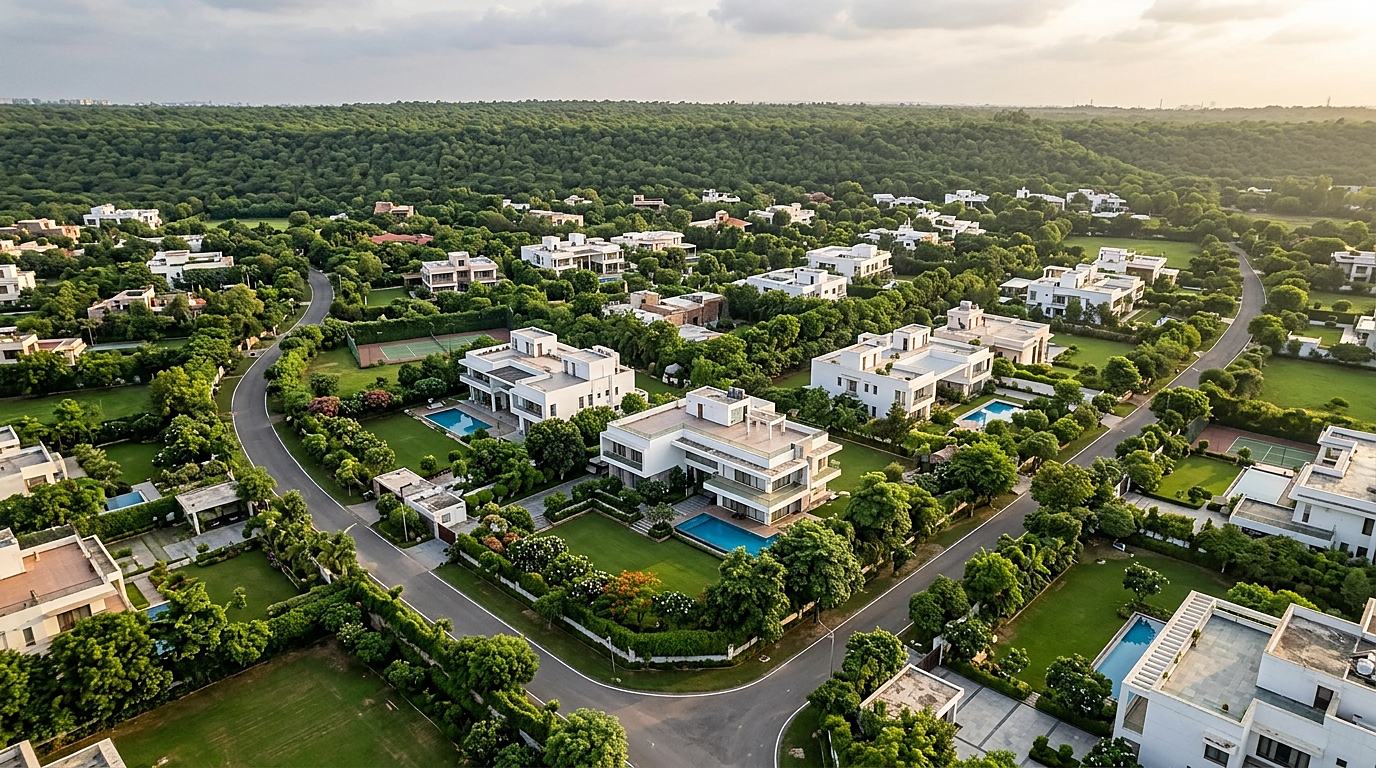
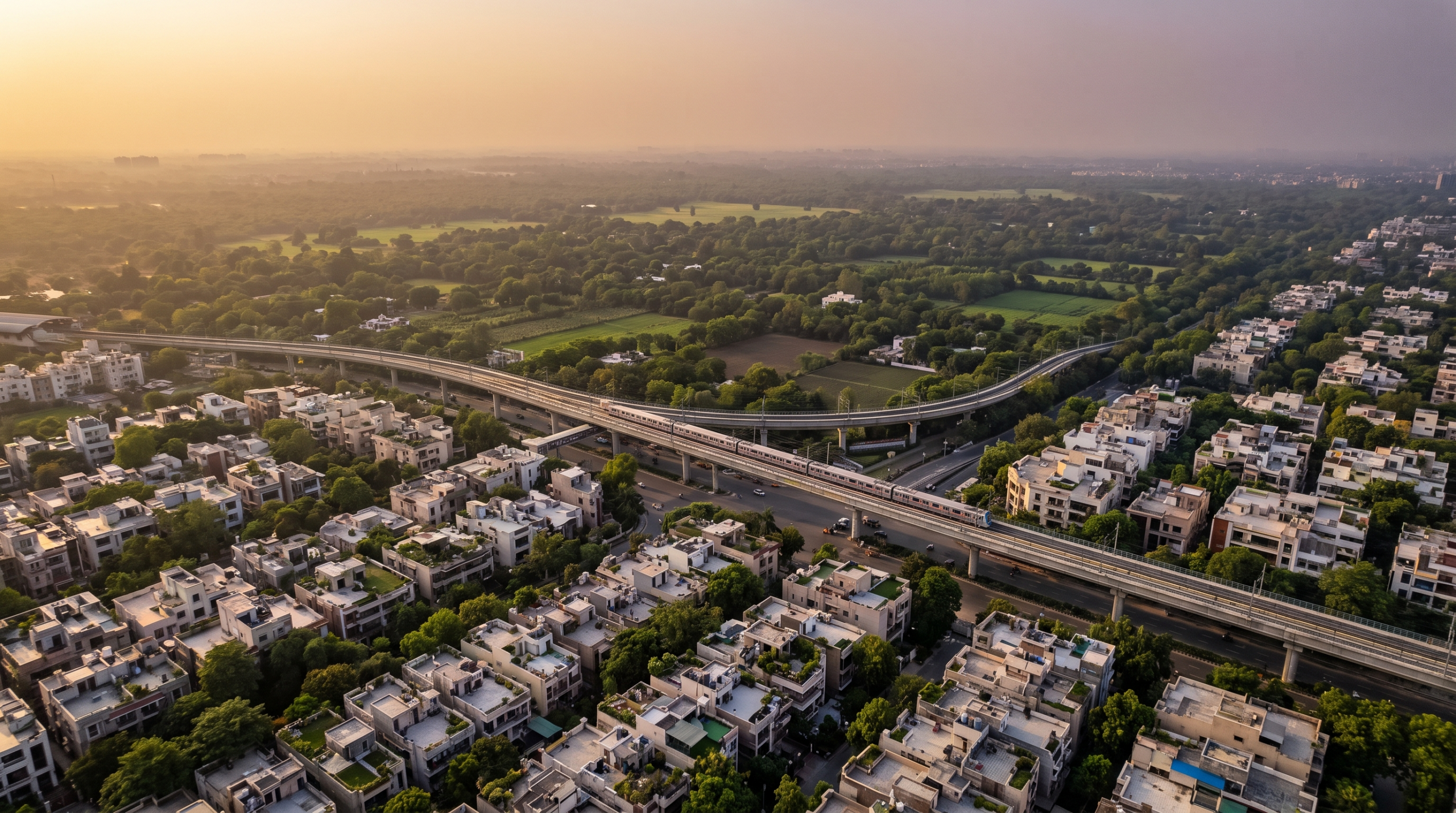
MPD 2047 highlights — aerial view of Delhi at golden dusk with South Delhi colonies, a metro corridor and the farmhouse belt
SouthDelhiFloors · The Policy Desk

MPD 2047 Highlights: What Became Law on 20 August

A week after our first read, the gazette landed. Delhi’s master plan is no longer a proposal — it is law. Here are the MPD 2047 highlights that now govern property in the capital, number by number, and the one place where the notified text quietly rewrote the draft everyone had priced in.

By the SouthDelhiFloors Research Desk
Updated August 2026
10 min read
MPD 2047 highlights — what is actually in force now?

The Ministry of Housing and Urban Affairs notified the Master Plan for Delhi–2047 in the Gazette of India on 20 August 2026, under Section 11-A of the Delhi Development Act, 1957 — and the plan came into force on publication. It plans for a Delhi of roughly 3.2 crore people by 2047 and about 40 lakh additional homes, delivered through colony redevelopment, transit-oriented development, land pooling and slum rehabilitation. For South Delhi, the plotted-colony arithmetic — stilt + 4, the FAR table, ground coverage — carries forward untouched in everything published so far. The genuine surprise sits in the farmhouse belt, where the notified text is reported to have dropped the draft’s Green Development Area grades and set a far larger reference plot. Our 13 August analysis ended with “plans announce, gazettes reprice”; the gazette has now repriced, and the full text sits on the DDA’s MPD-2047 page.

Some housekeeping on the timeline, because it moved fast: the DDA Authority approved the plan on 12 August; eight days later, Union Housing Minister Manohar Lal Khattar unveiled the notified plan alongside Lt Governor Taranjit Singh Sandhu and Chief Minister Rekha Gupta. A document drafted for 2041, put out for objections in June 2021 and worked through some 33,000 responses, finally replaced MPD-2021 — the plan that had governed every sanction in this city since February 2007. What follows is what the new one says, and what each provision means for money.

20 AugGazette notification under Section 11-A — the plan is in force from publication
40 lakhAdditional homes targeted by 2047 across redevelopment, TOD and land pooling
3.2 crProjected population by 2047 — the number the whole plan is built around
~695 kmMetro network after the planned 279 km expansion over today’s ~416 km

MPD 2047 highlights: how the 40-lakh housing math adds up

The plan estimates Delhi’s housing requirement at roughly 40 lakh dwelling units, on an average household of 4.5 people — and, for the first time, publishes the channels it expects to deliver them through. Two planning approaches run in parallel: area-based redevelopment in the built city, and road-network-led greenfield development on the periphery. Here is where the homes are supposed to come from:

The delivery channels behind the 40-lakh target, as published at notification
Channel The provision Reported scale
Colony redevelopment Minimum area for redeveloping group housing, DDA housing and government colonies cut from 40,000 sq m to 3,000 sq m; RWA-led redevelopment explicitly encouraged ~7 lakh additional units
Transit-oriented development Affordable housing concentrated in TOD zones along metro corridors, with density moved next to stations ~18 lakh homes
Land pooling Roughly 200 sq km earmarked for pooling-led expansion, developed infrastructure-first — 30-metre-plus roads before buildings — on a planned 600-km road grid ~12 lakh homes, as reported
JJ cluster rehabilitation In-situ rehabilitation of eligible jhuggi-jhopri clusters, subject to planning and statutory conditions Benefits 17 lakh+ residents
Rental & workers’ housing 50% FAR incentive for affordable rental housing; +15% FAR for workers’ housing on industrial plots of 5,000 sq m and above; reported preference for small-format units of 25–60 sq m carpet area Volume drivers across channels

Around the housing core sit the rest of the headline items: the metro network growing by about 279 km to roughly 695 km, a 138-hectare education hub at Narela, a Yamuna restoration framework, selected 24-hour city zones — and, unusually for a Delhi master plan, a built-in discipline of five-yearly reviews with a dedicated monitoring unit inside the DDA. The minister also told reporters that building-height curbs would be eased outside sensitive zones, with the specifics left to the regulations.

The number that matters most in South Delhi

It is not 40 lakh. It is 3,000 sq m. Under MPD-2021, society redevelopment effectively demanded a 40,000 sq m assembly — ten acres of aligned owners, which is why it almost never happened. At 3,000 sq m, a single society block clears the bar. South Delhi’s ageing DDA flats and group-housing pockets have just moved from “impossible to redevelop” to “a resolution and a developer away” — and the minister explicitly invited RWAs to lead. Plotted colonies are a different animal; this clause is about the society stock around them.

What did not change: plotted colonies and the stilt + 4 world

Nothing in the notified plan’s published summaries, the ministry’s briefing or the coverage since touches the plotted-colony FAR table, ground coverage, height norms or the stilt + 4 regime. Your sanction file continues to run on the existing development-control machinery — already faster since 12 August, when four NOCs (pollution, factories, Jal Board, forest) were de-linked from building permits — until superseding regulations and zonal plans are notified. The plot versus floor maths and the construction cost stack you would run today are unchanged by the gazette.

The supply picture is unchanged too, and that is the quiet story for colony owners. The plan’s growth machinery — the 200 sq km of land pooling, the 600-km road grid, Narela’s education hub — points north and west. Not one square yard of new plotted supply lands in South Delhi. What the plan does add inside South Delhi is vertical: society redevelopment at the 3,000 sq m threshold and TOD density at the metro edges. Both press on the commercial fringes and the society stock long before they touch a colony’s core, because amalgamating fragmented plots with multiple floor owners remains structurally hard. The scarcity premium under colony land was reinforced by this gazette, not diluted.

Mohit Minocha of SouthDelhiFloors outside a four-storey South Delhi builder floor — reading the notified MPD 2047 against colony building norms
Same street, same FAR table — the gazette left the plotted colonies alone. Founder Mohit Minocha on reading law before headlines.

The draft sold hope. The gazette assigns homework: text, road width, title — then we talk price.

Mohit MinochaFounder, SouthDelhiFloors

The farmhouse surprise: the gazette did not print the draft

On 12 August, the DDA-approved draft carried the Green Development Area framework our first analysis mapped: green uses from 600 sq m, farmhouses from 4,000 sq m, institutions from 10,000 sq m across the LDRA belt — Chattarpur, Devli, Sultanpur. We warned then that every figure was provisional until the final text appeared. It appeared on 20 August, and the reported text is materially different.

Low-density norms: the 12 August draft versus the 20 August gazette, as reported
Item DDA-approved draft (12 Aug) Notified gazette (20 Aug), as reported
Farmhouse threshold 4,000 sq m (about an acre), Grade 2, with a GRIHA green-rating condition The one-acre farmhouse norm finds no mention; a 10,000 sq m (2.5-acre) reference plot anchors the framework
Road access Access-road conditions attached to each grade 18-metre internal roads and 45-metre master trunk rights of way for low-density areas
Smaller plots Green uses permitted from 600 sq m Plots below 2.5 acres reported to receive the full FAR entitlement of a 2.5-acre plot — a vertical-development framework, per the minister’s remarks, rather than a farmhouse one
Legal status Provisional, pending notification Operative — but zonal plans and development-code regulations will set the ground rules

The sharpest reading so far comes from India Sotheby’s International Realty, whose managing director Amit Goyal noted that the acre-scale farmhouse permission in the approved draft is absent from the gazette — and that a 10,000 sq m minimum combined with an 18-metre road requirement would, in his reading, leave around 95% of Delhi’s existing farmhouse development non-conforming. Most of the belt’s built stock sits on parcels near the one-acre mark, served by village roads far narrower than 18 metres. No official reason for the change has been published.

Before you panic — or celebrate

Three cautions. First, the farmhouse reading rests on early reporting of a dense gazette text; the operative detail will live in the zonal plans and regulations that follow, and clarifications from the DDA are entirely possible. Second, a new master plan does not demolish anything by itself — the status of existing structures runs through regularisation and enforcement policy, not through a definition changing on paper. Third, this cuts both ways: the same clause that unsettles a one-acre farmhouse rewards land assembly — the 2.5-acre reference and full-FAR entitlement make consolidated belt parcels on wide roads more valuable, not less. Do not sell into the scariest headline, and do not buy “gazette-discounted” land on the most optimistic one. Read the text first.

Chattarpur farmhouse belt aerial — the low-density geography where the notified MPD 2047 diverges most from the draft
The Chattarpur–Sultanpur belt: where the notified MPD-2047 diverges most sharply from the draft it replaced.

What buyers, owners and builders should do now

Colony buyers: nothing about your deal changed

The plan is law, but your file runs on regulations — the FAR table, sanction process and under-construction risks are exactly where they were, minus four NOCs. Buy on block, title and land share, as always.

Belt landowners: two facts now decide value

Plot size against the 2.5-acre reference, and the width of the road that serves you. Get the actual gazette text for your village, wait for the zonal plan, and treat both distress-selling and bargain-hunting on headlines as the same mistake.

Society residents: the 3,000 sq m door just opened

If your block or society assembles 3,000 sq m, redevelopment is a realistic conversation for the first time. Convene the RWA, establish the members’ position early, and let developers compete for you — not the other way around.

Everyone: four things reprice from here

The zonal plans, the development-code regulations, any DDA clarification on the low-density framework, and the first TOD notifications along South Delhi’s metro corridors. Those documents move prices. Launch-event headlines already have.

Key takeaways

  • MPD-2047 was gazette-notified on 20 August 2026 under Section 11-A of the DD Act and is in force — the era of MPD-2021, notified in 2007, is over on paper; regulations and zonal plans will operationalise it.
  • The housing math: ~40 lakh homes via redevelopment (~7 lakh at the new 3,000 sq m threshold), TOD (~18 lakh), land pooling (~200 sq km, ~12 lakh reported) and JJ rehabilitation benefiting 17 lakh+ residents.
  • Plotted South Delhi is untouched in everything published: same FAR, same stilt + 4, faster sanctions after the NOC de-linking — and zero new plotted supply anywhere in the plan, which reinforces colony scarcity.
  • The 3,000 sq m redevelopment threshold is the sleeper clause for South Delhi: ageing DDA and group-housing societies become redevelopable at single-block scale, with RWA-led redevelopment invited.
  • The farmhouse framework reportedly hardened: the draft’s 4,000 sq m norm is absent from the gazette, replaced by a 10,000 sq m reference and 18-metre roads — a reading that favours assembled parcels and demands verification before any belt transaction.

Frequently asked questions

Is MPD-2047 in force now?
Yes. The Ministry of Housing and Urban Affairs notified it in the Gazette of India on 20 August 2026 under Section 11-A of the Delhi Development Act, 1957, and it came into force on publication. Zonal plans and development-code regulations will now operationalise its policies.
What are the main highlights of MPD 2047?
About 40 lakh homes for a projected 3.2 crore population: ~7 lakh via colony redevelopment at a new 3,000 sq m threshold, ~18 lakh in TOD zones along metro corridors, roughly 12 lakh via ~200 sq km of land pooling, JJ rehabilitation benefiting 17 lakh+ residents, FAR incentives for rental and workers’ housing, a metro network growing toward ~695 km, 24-hour city zones and a five-yearly review discipline.
Does MPD-2047 change builder floor or FAR rules in South Delhi?
Nothing published changes plotted-colony norms — stilt + 4, FAR, ground coverage and heights carry forward, with sanctions already faster since four NOCs were de-linked from building permits. Any plot-level change would come through the regulations, which we are tracking.
What happened to the Green Development Area policy?
As reported, the GDA grades in the DDA-approved draft — 600, 4,000 and 10,000 sq m — do not appear in the notified gazette. The reported low-density framework instead uses a 10,000 sq m (2.5-acre) reference plot, 18-metre internal roads and full-FAR entitlement extended to smaller carved-out plots. The full text and zonal plans will settle the detail.
Are existing farmhouses now illegal?
No such order exists. A plan change does not by itself alter the status of built structures — that runs through regularisation and enforcement policy. The 95% non-conforming figure is one industry expert’s reading of the reported norms, not a government determination. Verify the text before transacting; do not act on headlines.
What is the 3,000 sq m redevelopment rule?
The minimum area for redeveloping group housing, DDA housing and government colonies drops from 40,000 sq m to 3,000 sq m — expected to enable around 7 lakh additional units. It puts single-society redevelopment within reach, and RWA-led redevelopment has been explicitly encouraged.
Does MPD-2047 add housing supply in South Delhi colonies?
No. New plotted supply sits in the land-pooling belts to the north and west. Inside South Delhi, the plan’s supply story is vertical — society redevelopment and TOD density near metro stations — which leaves the plotted-colony scarcity premium intact.
When do the new rules actually apply to my building file?
The plan is in force, but day-to-day sanctioning runs on development-control regulations and zonal plans. Until superseding regulations are notified, the existing machinery governs your file — the practical change already live is the faster permit after the NOC de-linking. Track DDA notifications from here.

Belt acreage, a society flat, or a colony floor?

The gazette moved the ground under each one differently. Tell us what you hold or what you’re hunting — we’ll read your exact position against the notified text before you buy, sell or sit tight.

SouthDelhiFloors is a property advisory. Regulations and zonal plans are still being notified — verify before committing funds.

This analysis reflects public information as of end-August 2026: the gazette notification of MPD-2047 on 20 August 2026 under Section 11-A of the Delhi Development Act, the ministry’s briefing at the unveiling, and press reporting of the notified text — including the low-density and farmhouse provisions, which rest on early reporting and industry readings rather than a published official summary. Zonal plans and development-code regulations are awaited and may alter how any provision applies on the ground. Verify current norms at dda.gov.in and take legal advice before transacting.

Share this:

Like this:

Like Loading…

SOUTH DELHI FLOORS

Clean Deals Only · Since 1984

Second-generation consultants for South Delhi’s finest builder floors, farmhouses and independent homes. Four decades of clean, verified transactions.

+91 99990 04511

Enquire Now

Tell us what you are looking for and a senior consultant will get back to you.

    Your Name

    Telephone Number

    Your Email (required)

    Enter Your Message

    © 2026 SouthDelhiFloors LLP · All Rights ReservedClean Deals Only · Since 1984

    Compare Properties

    Compare
    You can only compare 4 properties, any new property added will replace the first one from the comparison.
    Property in South Delhi : Buy Sell Properties, Flats, Homes, Apartments Call SouthDelhiFloors
    Contact
    close slider

      Your Name

      Telephone Number

      Your Email (required)

      Enter Your Message

      error: Content is protected !! Please Don\\\\\\\'t Try To Copy