
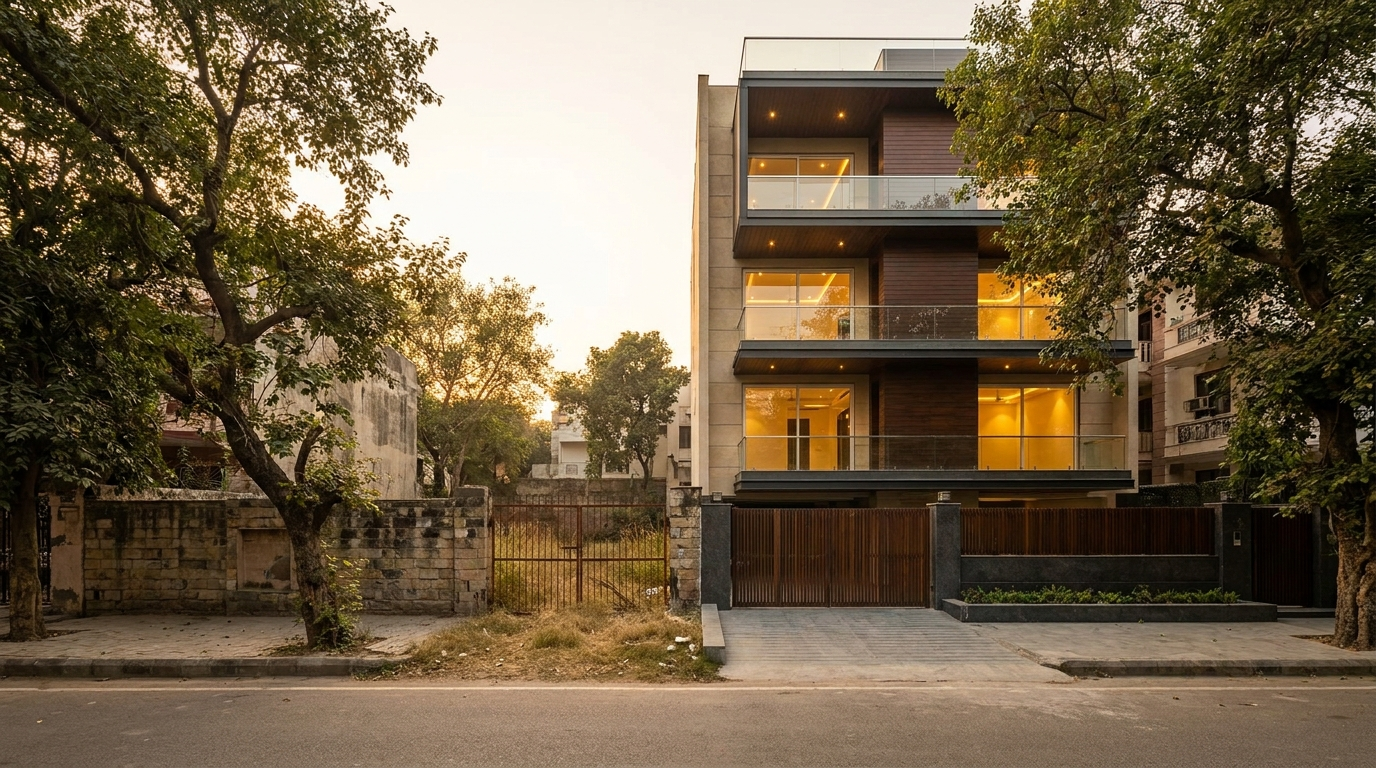















Plot vs builder floor — an empty residential plot beside a new four-storey builder floor building in South Delhi
SouthDelhiFloors · The Money Page

Plot vs Builder Floor in South Delhi

One buys the whole land and the right to build; the other buys a finished home with a fraction of it. The real comparison — money, land share, control, timeline and tax — worked on the 300-yard plot this market actually trades.

By the SouthDelhiFloors Research Desk
Updated July 2026
9 min read
Plot vs builder floor — which should you buy in South Delhi?

In the plot vs builder floor decision, a plot buys 100% of the land and the full right to build stilt + 4 floors under the FAR rules, while a builder floor buys one finished home with a fractional land share — typically 22.5–25% on a four-floor building. On a 300 sq yd plot in a prime colony at ≈₹8 lakh per sq yd, the plot route costs roughly ₹24 crore for land plus ₹5–6 crore to build; a single ready floor in the same colony runs ₹7–9 crore. Buy the plot if you want the whole building, the land appreciation and the redevelopment rights; buy the floor if you want a home at a quarter of the capital, ready now, with none of the execution risk.

This is the fork every serious South Delhi buyer eventually reaches — usually after the builder floor vs apartment question has already been settled in favour of the colony. Both routes buy the same underlying asset: freehold colony land. What differs is how much of it you own, what you must do to live on it, and how the money behaves over a decade. Accordingly, here is the whole comparison in one place, with the arithmetic shown.

100%Land ownership on a plot — and the full stilt + 4 building rights
~25%Typical land share bought with one floor of a four-floor building
18–24 moRealistic build time on the plot route, after sanction
6–8%Government levies on registration — identical for both routes

Plot vs builder floor: the side-by-side

The comparison, worked on a 300 sq yd plot in a prime South Delhi colony (2026)
Factor Plot Builder floor
Capital required ≈₹24 cr land (at ₹8L/sq yd) + ₹5–6 cr construction ₹7–9 cr for one finished floor
Land owned 100% — all 300 sq yd Fractional share, typically 22.5–25%, written into the deed
Building rights Full FAR — stilt + 4 floors, basement, terrace Your floor plus the rights your deed allocates
Time to move in 18–24 months of sanction and construction Immediate on a ready floor
Execution risk Yours — contractor, cost escalation, approvals Priced into the builder’s margin; verify via the 21-point checklist
Government levies 6–8% on the land conveyance 6–8% on the floor — identical structure
GST Nil on land; 18% on contractor bills when you build Nil on ready/resale; 5% only if booked under construction
Optionality later Rebuild, collaborate, or sell floors individually Sell or rent the floor; redevelopment needs all owners
Why the plot commands the premium

South Delhi’s appreciation engine is land, not construction — buildings depreciate while colony land has compounded for decades, with prime-colony rates now running ₹6–12 lakh+ per sq yd and Greater Kailash trending toward ₹10 lakh. A plot owner holds all of that engine and the unused FAR that powers every collaboration deal. A floor owner holds a quarter of the engine — which is precisely why a floor costs a quarter of the building, and why the land share percentage in the deed is the single most underpriced line in most floor negotiations.

How to choose: four honest questions

Is the capital a constraint?

If ₹29–30 crore all-in for a whole building is comfortable, the plot conversation is open. If the budget is ₹7–12 crore, the floor route is the market’s answer — and it is a good one.

Do you want a project or a home?

A plot is a two-year project: demolition, sanction, contractor management, escalation. A ready floor is keys in hand. Be honest about which you actually want to live through.

Is this family land for a generation?

Plots suit families planning floors for children, rental floors for income, or a future rebuild. A floor suits a household that wants one excellent home without the dynasty planning.

Run both against the same colony

Price the plot per sq yd, add the construction cost, and divide by four floors; then compare with the asking price of ready floors on the same block. The gap is the builder’s margin plus your saved risk — decide if it’s worth paying.

Mohit Minocha of SouthDelhiFloors on a South Delhi terrace overlooking colony rooftops — plot versus builder floor
Land or floor: founder Mohit Minocha above the colony rooftops — what you own underneath decides what you are worth later.

A floor is a home. A plot is a home, three more homes, and the right to decide what happens next.

Mohit MinochaFounder, SouthDelhiFloors

Either way, the closing math is the same: budget the full all-in cost of 6–8% government levies plus brokerage on whichever route you take, and choose the colony first — our neighbourhood guide ranks them honestly — because in this market the postcode outperforms the product.

Key takeaways

  • Plot vs builder floor is a question of how much land you own: 100% with full stilt + 4 rights on a plot, versus a 22.5–25% land share with one floor.
  • On a 300-yarder in a prime colony: ≈₹24 crore land + ₹5–6 crore build for the whole building, against ₹7–9 crore for one ready floor.
  • Government levies are identical (6–8%); GST is nil on land and ready floors, 5% only on under-construction bookings, and 18% on your own contractor’s bills.
  • The plot carries the appreciation engine — land and unused FAR — plus collaboration optionality; the floor carries immediacy and zero execution risk.
  • Decide on capital, appetite for an 18–24 month project, and family horizon — then run both routes on the same block before signing either.

Frequently asked questions

Is a plot a better investment than a builder floor?
Per rupee, the plot concentrates more of South Delhi’s appreciation engine — land and FAR — and adds redevelopment optionality. But it demands three to four times the capital and a two-year project. A floor is the efficient way to own a quarter of the same engine, ready to live in.
What land share do I get with a builder floor?

Typically 22.5–25% on a four-floor building, sometimes with the basement or stilt adjusting the split. It must be written into the sale deed as a percentage — verify it, because redevelopment value flows through that number.

What does a plot cost in South Delhi in 2026?

Prime colonies trade in the ₹6–12 lakh+ per sq yd band depending on the colony, block, road width and plot size, with Greater Kailash trending toward ₹10 lakh. A 300 sq yd plot therefore runs roughly ₹18–36 crore across the prime belt.

Is stamp duty different on a plot?

No — the same 6–8% all-in structure (stamp duty 6%/4%/5% by buyer, 1% MCD transfer duty, 1% registration) applies on the higher of price or circle value, exactly as on a floor.

Do I pay GST when buying a plot?

No — the sale of land carries no GST. You will pay 18% GST on your contractor’s works-contract bills when you build, which is part of the construction budget, not the land price.

Can I buy a plot and avoid building myself?

Yes — a collaboration agreement lets a builder construct at his cost in exchange for floors, the standard South Delhi structure. You keep floors and land share without writing the construction cheque.

How long before I can live on a plot I buy?

Realistically 18–24 months of sanction and construction after possession — longer if the old structure, tenants or approvals complicate the start. A ready floor closes that gap to zero.

Which appreciates faster?

Over long holds, land has outrun construction — buildings depreciate while colony land compounds. Floors still appreciate well because most of a floor’s value is its land share; new floors additionally carry a spec premium that fades with age.

Is a smaller plot better than a bigger one?

Sometimes per yard: the FAR table’s 250 sq m boundary means a 250-yarder builds more area per yard than a 300-yarder. Run the FAR before comparing price per yard — our FAR guide works both examples.

Can NRIs buy plots in South Delhi?

Yes — residential plots are permitted for NRIs under FEMA (agricultural land is not). Funding, PoA and tax mechanics follow the same rules as floors, detailed in our NRI buying guide.

Torn between a plot and a floor?

Tell us the budget and the colonies on your list — we’ll run both routes on real inventory, land shares and construction math, before you commit either way.

SouthDelhiFloors is a property advisory. Verify title, FAR and duty computations with your lawyer before committing funds.

Figures reflect the South Delhi market as of July 2026 — prime-colony land at ₹6–12 lakh+ per sq yd, construction at the tiers in our construction cost guide, land shares of 22.5–25% on four-floor buildings, government levies of 6–8% on the higher of price or circle value, and FAR per Master Plan Delhi 2021. Colony- and plot-specific numbers vary; verify development norms at dda.gov.in and current rates with your advisors before transacting.

Share this:

Like this:

Like Loading…

SOUTH DELHI FLOORS

Clean Deals Only · Since 1984

Second-generation consultants for South Delhi’s finest builder floors, farmhouses and independent homes. Four decades of clean, verified transactions.

+91 99990 04511

Enquire Now

Tell us what you are looking for and a senior consultant will get back to you.

    Your Name

    Telephone Number

    Your Email (required)

    Enter Your Message

    © 2026 SouthDelhiFloors LLP · All Rights ReservedClean Deals Only · Since 1984

    Compare Properties

    Compare
    You can only compare 4 properties, any new property added will replace the first one from the comparison.
    Property in South Delhi : Buy Sell Properties, Flats, Homes, Apartments Call SouthDelhiFloors
    Contact
    close slider

      Your Name

      Telephone Number

      Your Email (required)

      Enter Your Message

      error: Content is protected !! Please Don\\\\\\\'t Try To Copy