By the SouthDelhiFloors Research Desk · Mohit Minocha, Founder, SouthDelhiFloors — advising South Delhi buyers since 1984.
Every serious buyer in South Delhi eventually stands at the same fork. On one side, an independent builder floor in a plotted colony — your own floor, your own gate, a share of the land under your feet. On the other, a luxury apartment in a gated project — security desk, clubhouse, swimming pool, someone else worrying about the lift. Both can cost ₹5 crore to ₹40 crore in this market. They are not the same purchase, and in 2026 the gap between how the two behave as assets has rarely been wider. Here is the honest comparison, with current numbers.
The short answer
If your priority is capital appreciation and you can manage your own property, buy the builder floor — you are effectively buying South Delhi land, and land is what has been rising. If your priority is convenience, amenities and lock-and-leave living, buy the apartment — you are buying a serviced lifestyle, and you will pay for the service every month. Most regrets we see in our practice come from buyers who chose one while actually wanting the other. The rest of this guide explains the trade-offs so you choose with open eyes.
What exactly is a builder floor?
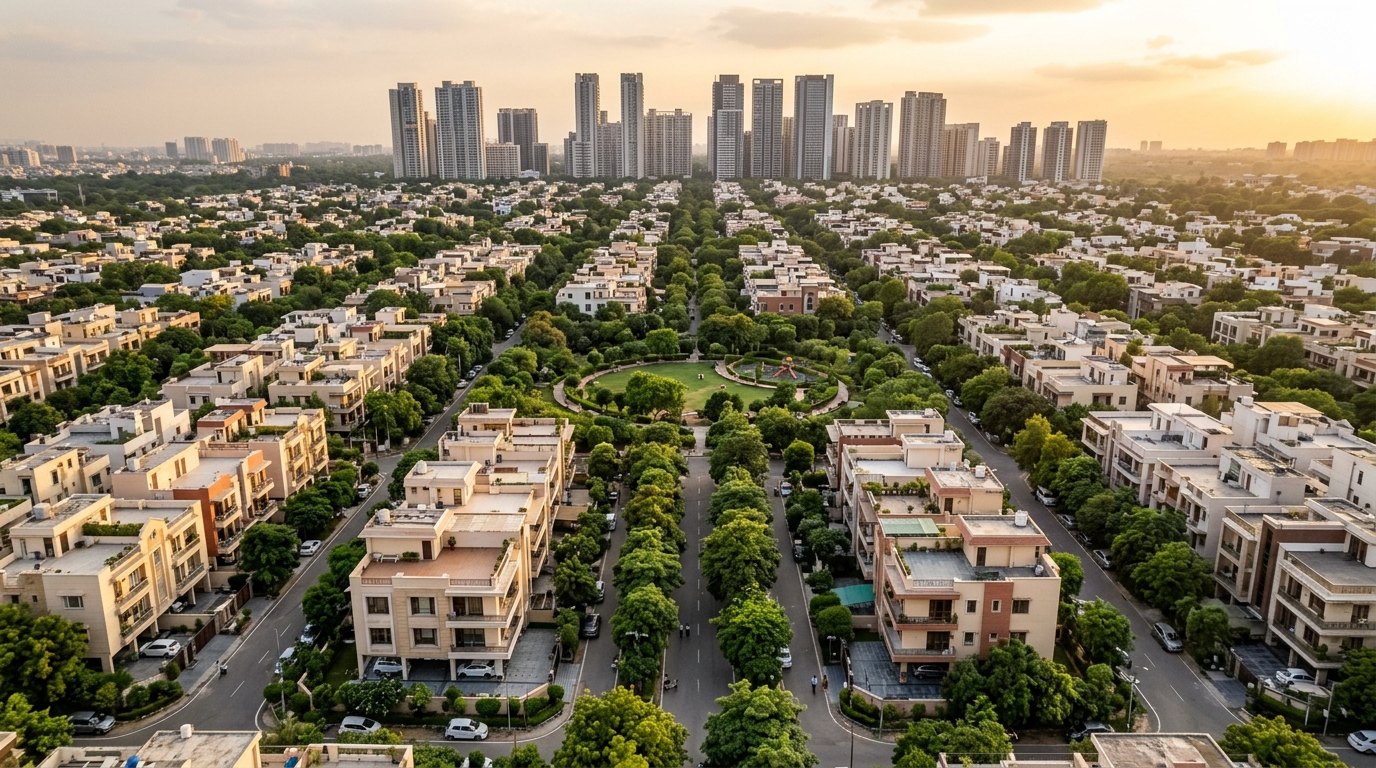
A builder floor is an independent apartment occupying one full floor of a low-rise building — typically stilt parking plus four floors — constructed on a freehold residential plot in a plotted colony such as Greater Kailash, Defence Colony or Vasant Vihar. When you buy one, your registered sale deed conveys the built-up floor plus a proportionate undivided share of the plot itself. In a new stilt-plus-four building, that share is 22.5% of the land for a first, second or third floor, and 32.5% for the basement-plus-ground unit. Many older floors, however, still convey a flat 25%. This land share is the single most important line in the comparison, because in South Delhi the land is the asset; the construction on top of it depreciates like construction anywhere. We cover the format in depth in our complete builder floor buying guide.
Delhi’s building norms make the format stable and predictable: stilt parking is mandatory on plots between 100 and 1,000 square metres, and following a 2022 Supreme Court ruling, residential buildings up to 17.5 metres with stilt no longer need a separate fire-department NOC for plan sanction. One family per floor, four families per plot — that is the density ceiling, and it is why these colonies stay quiet.
What you get with an apartment
True luxury apartment projects are rare inside South Delhi’s plotted belt, which is exactly why the few that exist command attention. The reference point is DLF Kings Court in Greater Kailash-II: a roughly 2.5-acre gated project of only around 45–57 units across low tower blocks, with apartments from about 2,400 to 7,250 sq ft, a residents-only pool, gym, clubhouse, three-tier security, power backup and piped gas. As of mid-2026, listed prices start around ₹10.5–12 crore for a 3 BHK, roughly ₹26.5 crore onwards for a 4 BHK, and about ₹45 crore for the 5 BHK villas.
What you are buying here is professional management of everything outside your front door. Travel for a month and nothing needs your attention. For NRIs, elderly buyers and anyone allergic to dealing with plumbers, that is worth real money. What you give up is the land: your undivided share in a multi-tower project is a sliver, and the building itself is the bulk of what you paid for.
Prices in 2026: what the money buys
| Parameter | Builder floor (plotted colony) | Luxury apartment (gated project) |
|---|---|---|
| Typical GK price, new construction | ₹32,000–35,000 per sq ft | ₹10.5–12 Cr entry (3 BHK, Kings Court) |
| Category-A colony (e.g. Vasant Vihar) | ₹47,000–50,000 per sq ft | Very limited comparable supply |
| Underlying land value, GK belt | Around ₹10 lakh per sq yd | Small undivided share per unit |
| What drives the price | Land share + construction quality | Brand, amenities, management |
| Supply | Continuous via plot redevelopment | A handful of projects, resale-led |
Colony matters as much as format. East of Kailash trades around ₹27,500 per sq ft, Hauz Khas Enclave around ₹36,000, Panchsheel Park roughly ₹25,000–36,500. Our Greater Kailash-1 guide and South Delhi neighbourhood guide break these down block by block.
Appreciation: where the growth actually came from
Market reports for the first quarter of 2026 recorded builder-floor prices in South Delhi’s plotted colonies rising by up to 32% year on year — with Category-B colonies such as Greater Kailash and Defence Colony (23–32%) outpacing even the Category-A addresses (14–22%). The engine is land scarcity: no new plots are being created in these colonies, redevelopment is the only supply, and every buyer of a floor is bidding for a quarter of a finite plot.
Apartments in the same postcode appreciate too — a scarce, well-managed project holds value well — but the mathematics differ. A larger share of an apartment’s price sits in the structure, and structures age. A builder floor’s structure ages identically, but the land beneath it does not, and the land is most of the value. Over a ten-year hold, that difference compounds. Historical portal data for the belt shows builder floors in localities like South Extension up roughly 46% over three years and over 90% across five.
Maintenance and running costs
| Cost head | Builder floor | Apartment |
|---|---|---|
| Monthly society charge | None formal — owners split lift, genset and common-area upkeep informally | ₹2–25 per sq ft CAM depending on amenities; luxury projects sit at the upper band |
| GST on maintenance | Not applicable | 18% where the charge exceeds ₹7,500/month |
| Who fixes what | You do — or your caretaker does | Facility management, billed to you |
| Predictability | Lumpy: quiet years, then a waterproofing bill | Smooth and monthly, but never zero |
Run the numbers on a 4,000 sq ft luxury apartment at even ₹10 per sq ft and you are at ₹40,000 a month, plus GST, before electricity — roughly ₹5 lakh a year for the life of your ownership. A builder floor owner spends less in most years and more in occasional years, and controls the timing. Neither is “cheaper” universally; they are different shapes of the same obligation.
Rental yield and tenant profile
Both formats let well in South Delhi, but to different tenants. Builder floors draw families, senior executives and long-stay corporate tenants who want space and privacy; gross yields in the luxury colonies typically run in the 2.5–4% range, with portal averages for pockets like South Extension around 5% including smaller formats. Premium apartments draw expatriates, diplomats and companies paying for security and amenities — Kings Court 4 BHKs have been listed at ₹5–7 lakh per month. If steady rental income with minimal landlord effort is the goal, the apartment’s professional management is an advantage; if long-term total return is the goal, the floor’s land appreciation usually dominates the yield difference.
Legal and regulatory position
Both purchases in South Delhi’s established colonies are freehold and convey through a registered sale deed, with identical stamp duty — 6% for men, 4% for women, 5% joint, plus 1% MCD transfer duty and 1% registration; our Delhi stamp duty guide has the worked examples. Large apartment projects fall under RERA’s project-registration net; standalone builder-floor redevelopments on single plots generally sit below RERA thresholds, which places more of the diligence burden on you — title chain, sanctioned plan, completion certificate, builder track record.
One regulatory point in Delhi’s favour in 2026: the stilt-plus-four format here operates under settled municipal norms, while Haryana’s equivalent S+4 policy for Gurugram has been under an interim High Court stay since April 2026, with litigation ongoing. Buyers comparing a GK floor against a Gurgaon floor should price that uncertainty in. NRIs can freely buy either format in South Delhi — the rules, TDS mechanics and repatriation limits are covered in our NRI buying guide.
Lifestyle: privacy versus amenities
A builder floor gives you a house’s privacy with an apartment’s convenience. An apartment gives you a hotel’s services with a community’s rules. In forty years of closing deals in these colonies, the happiest buyers are the ones who knew which of those two sentences described them before they signed.
Mohit Minocha, Founder, SouthDelhiFloors
On a floor, you choose your lift, your finishes, your terrace rights, and you never attend a society AGM. You also arrange your own security and live with three other families’ renovation schedules. In a project, the pool and gym are downstairs and the guard knows your car — but the RWA decides what colour your grille can be, and pets, parking and parties all come with bylaws.
So which should you buy?
| If you are… | Lean towards | Because |
|---|---|---|
| A long-horizon investor | Builder floor | Land share compounds; supply cannot expand |
| An NRI who visits twice a year | Apartment | Lock-and-leave with professional management |
| A family upgrading within South Delhi | Builder floor | More space per rupee, park-facing options, privacy |
| A senior couple prioritising security | Apartment | Gated access, staff, lifts, backup — handled |
| A yield-focused landlord | Either | Floor for capital growth, apartment for effortless letting |
How SouthDelhiFloors helps
We have been advising buyers across Greater Kailash, Defence Colony, Vasant Vihar and the wider South Delhi belt since 1984 — clean deals only. Whether the right answer for you is a park-facing floor in GK-1 or a serviced apartment with the lift and the pool, we will tell you plainly which one fits your money and your life, and then find it. Ready to decide? WhatsApp us at +91 99990 04511 or write to contact@southdelhifloors.com.
Key takeaways
- A builder floor conveys a proportionate share of freehold land — the asset behind South Delhi’s reported up-to-32% price rise in Q1 2026.
- An apartment buys convenience: security, amenities and lock-and-leave living, paid for through monthly CAM of ₹2–25 per sq ft plus 18% GST above ₹7,500.
- In Greater Kailash, new floors trade around ₹32,000–35,000 per sq ft; DLF Kings Court apartments start near ₹10.5–12 crore for a 3 BHK.
- Stamp duty is identical either way — 6%/4%/5% plus 1% MCD transfer duty and 1% registration — so the choice is about the asset, not the transaction cost.
- Choose the floor for land, privacy and appreciation; choose the apartment for amenities, management and effortless ownership.
Frequently asked questions
What is the main difference between a builder floor and an apartment?
Ownership structure. A builder floor gives you one full floor of a low-rise building plus a proportionate undivided share of the freehold plot — usually 22.5% for a first, second or third floor in a new stilt-plus-four building, and 32.5% for the basement-plus-ground unit, though many older floors still convey a flat 25%. An apartment gives you a unit in a larger project with a much smaller land share, plus access to shared amenities managed by the society or developer.
Which appreciates faster in South Delhi?
Builder floors have led the current cycle: market reports recorded rises of up to 32% year on year in Q1 2026 in the plotted colonies, driven by land scarcity. Well-located apartments appreciate too, but a larger share of their value sits in the depreciating structure rather than the land.
Do builder floor owners actually own the land?
Yes — the registered sale deed conveys an undivided proportionate share of the plot along with the floor. You cannot fence off your quarter, but you own it, and it is what redevelopment value and long-term appreciation are built on.
Are builder floors more expensive than apartments?
Per square foot in the same colony, a new luxury floor often costs as much as or more than an apartment because of the embedded land value — around ₹32,000–35,000 per sq ft for new GK floors. Entry tickets can be lower in apartments simply because smaller units exist; at comparable sizes, the floor’s land share is what you are paying extra for.
What are the monthly maintenance costs in each?
Apartments charge formal CAM — anywhere from ₹2 to ₹25 per sq ft per month depending on amenities, with 18% GST applying above ₹7,500 per month. Builder floors have no formal society charge; the three or four owners share lift, generator and common-area costs informally and each maintains their own floor.
Is a builder floor safe without society security?
South Delhi’s plotted colonies run RWA-managed gates, guards and CCTV at the colony level, and most luxury floors add video door phones and private guards. It is a different model from a gated project’s three-tier security, and buyers who want handed-to-you security usually prefer the apartment.
Which is better for rental income?
Apartments let faster to expatriate and corporate tenants and are easier to manage remotely — Kings Court 4 BHKs list at ₹5–7 lakh per month. Builder floors attract long-stay families and executives; gross yields are broadly similar at 2.5–4% in the luxury segment, so total return usually tilts to the floor via land appreciation.
Does RERA cover builder floors?
Large apartment projects require RERA registration. A typical single-plot builder-floor redevelopment falls below RERA’s size thresholds, so the protection net is thinner — which makes independent title verification, sanctioned-plan checks and builder due diligence essential before you pay.
Can NRIs buy both formats?
Yes. NRIs and OCIs can freely buy residential builder floors and apartments in South Delhi through banking channels; only agricultural land and farmhouses are off-limits. Funding routes, TDS and repatriation rules are detailed in our NRI buying guide.
Which should a first-time luxury buyer choose?
Decide what you are optimising for. If it is the asset — land, appreciation, space, privacy — buy the builder floor and budget for self-management. If it is the lifestyle — amenities, security, zero upkeep — buy the apartment and accept the monthly cost. Talk it through with an advisor who will show you both before you commit.