GRAP construction ban Delhi — a stilt-plus-four builder floor under construction in South Delhi, idle scaffolding and covered materials in winter evening haze
SouthDelhiFloors · The Construction Desk

GRAP Construction Ban Delhi (2026): Why 18-Month Builder Floor Timelines Became 24 Months

The GRAP construction ban in Delhi now comes every winter. For four winters running, Stage III or higher has stopped structural work on South Delhi plots for roughly three to six weeks, in several separate shutdowns, and a new Delhi government direction now adds a fixed ban on top. Here is what GRAP stops, what it allows, what each winter cost, and how to draft a builder-floor contract now that 24 months has become the norm.

By the SouthDelhiFloors Research Desk
Updated October 2026
12 min read
How does the GRAP construction ban in Delhi affect builder floor timelines?

GRAP, the Graded Response Action Plan run by the Commission for Air Quality Management (CAQM), bans dust-generating construction and demolition across the NCR once Stage III is invoked, at an actual or forecast Delhi AQI of 401–450. Excavation, structural work, welding, tiling and material loading stop. Plumbing, electrical, carpentry and interior work have been allowed. By our count from CAQM dates, Stage III or higher lasted roughly 24 to 44 days each winter from 2022-23 to 2025-26, in three to six spells from late October to early February. For 2026-27 Delhi has also notified a complete construction ban from 10 December to 20 January. That is why South Delhi contracts that used to promise 18 months now commonly promise 24 months.

We have brokered South Delhi builder floors since 1984, and no regulation has moved delivery dates as much as GRAP. It barely touches finishing; it hits the structure: excavation, the basement and the slab-a-month rhythm of a stilt-plus-four building. Below are the rules as of October 2026, the dates, and contract language that deals with winter honestly.

~24–44 daysCalendar days under GRAP Stage III or higher each winter, 2022-23 to 2025-26 (our estimate from CAQM dates)
3–6Separate construction stoppages per winter, each followed by a restart
42 daysComplete construction ban notified by Delhi for 10 Dec 2026 – 20 Jan 2027
18 → 24 monthsThe delivery clause South Delhi builders now commonly offer (desk observation)

What GRAP is, and which stages trigger the construction ban in Delhi

GRAP is an emergency schedule of anti-pollution measures for Delhi-NCR, run by the CAQM’s sub-committee on GRAP. It has four stages keyed to Delhi’s average AQI, and when a higher stage is invoked, every lower stage keeps running. The schedule is revised often. In December 2024 and again on 21 November 2025 the CAQM moved some measures to an earlier stage (in 2025, 50% office attendance moved from Stage IV to Stage III). On 28 September 2026 it approved a revision with 48 actions (25 in Stage I, 8 in II, 10 in III, 5 in IV), merging repeated dust-control measures into Stage I and extending portal-based dust monitoring to eligible sites beyond municipal limits.

GRAP stages and what each means for a private builder-floor site in South Delhi (as of October 2026)
Stage Delhi AQI Effect on a private residential plot
Stage I — Poor 201–300 Work continues under dust norms. Sites of 500 sq m or more not registered on the dust portal may not work.
Stage II — Very Poor 301–400 Work continues; inspections intensify.
Stage III — Severe 401–450 Dust-generating construction and demolition banned across the NCR. Only listed public projects are exempt; a private builder floor is not.
Stage IV — Severe+ Above 450 Stage III, plus linear public projects stop and goods-truck entry is restricted.

Two points matter more than the bands. The CAQM can act pre-emptively: it ordered Stage IV on 13 December 2025 at a 7 pm AQI of 448, and on 17 January 2026 at 428. And stages change “with immediate effect,” so contractors usually find out the same evening.

What the Stage III construction ban stops, and what is still permitted

The Stage III construction clause has been broadly stable since the 2022 schedule. Outside the exempt list, it bans earthwork, boring and drilling; structural work including fabrication and welding; demolition; loading, unloading and moving of materials; batching plants; open-trench utility work; cutting and fixing of tiles, stone and flooring; grinding; piling; waterproofing; and painting, polishing and varnishing.

Listed public projects (railways, metro, airports, hospitals and similar) are exempt. On all projects, the schedule has allowed non-dust-generating work such as plumbing, interior decoration, electrical works and carpentry (painting, polishing and varnishing excluded). Check the current CAQM schedule before relying on this.

On a stilt-plus-four floor, the banned list covers the whole critical path of the structure phase: demolition, basement excavation, slab casting, blockwork, stone and tile. A site already in finishing loses comparatively little.

“Working behind covers” is no longer a quiet option

Chief Minister Rekha Gupta said some construction “continued behind covers” under GRAP last winter, and that sites will now be watched through Dust Portal 2.0 and AI-enabled cameras. In September 2026 the CAQM noted that over 1,800 violating units had received closure orders. A closed site generally needs the Commission’s permission to restart, so pouring a slab during Stage III risks the whole season.

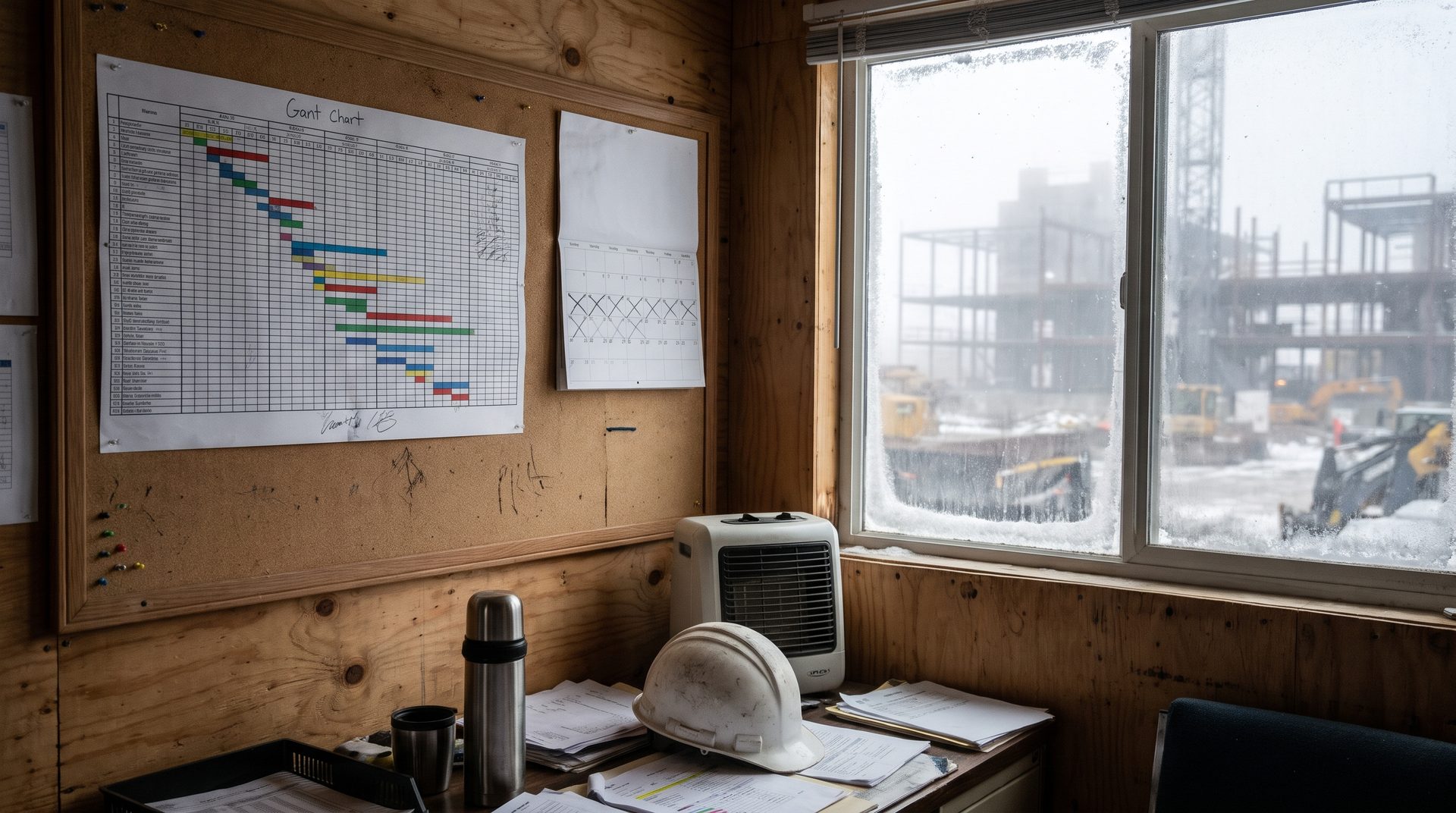
GRAP construction ban dates, 2022-23 to 2025-26: how many days each winter cost

We rebuilt each winter from CAQM orders, PIB releases and news reports. Day counts are our approximate estimates: calendar days from invocation to revocation of each Stage III-or-higher spell.

GRAP Stage III and Stage IV spells in Delhi-NCR by winter (invocation → revocation) and approximate construction days lost
Winter Stage III spells (construction ban) Stage IV within those spells Approx. days under Stage III+ (est.)
2022-23 29 Oct – 14 Nov 2022; 4 – 7 Dec 2022; 30 Dec 2022 – 4 Jan 2023 3 – 6 Nov 2022 ~24 days in 3 spells, an undercount (a further Stage III from about 6–7 Jan 2023 is excluded; we could not confirm its end date)
2023-24 2 – 28 Nov 2023; 22 Dec 2023 – 1 Jan 2024; 14 – 18 Jan 2024 5 – 18 Nov 2023 ~40 days in 3 spells
2024-25 14 Nov – 5 Dec 2024; 16 – 27 Dec 2024; 3 – 5 Jan 2025; 9 – 12 Jan 2025; 15 – 17 Jan 2025; 29 Jan – 3 Feb 2025 17/18 Nov – 5 Dec 2024 (ordered 17 Nov, effective 18 Nov; kept in place under Supreme Court supervision); 16 – 24 Dec 2024; 15 – 16 Jan 2025 ~44 days in 6 spells
2025-26 11 – 26 Nov 2025; 13 Dec 2025 – 2 Jan 2026; 16 – 22 Jan 2026 13 – 24 Dec 2025; 17 – 20 Jan 2026 ~41 days in 3 spells

The window is consistent: the first ban arrives between 29 October and 14 November, and the last is lifted by 3 February. The bans are also fragmented. 2024-25 had six stoppages, each meaning labour sent away and a pour restarted; a Delhi trade body told the CAQM in 2023 that a restart takes three to four days (its claim). With restarts included, a structure-stage site loses five to eight working weeks per winter in our desk’s experience, and a demolish-and-rebuild usually crosses two winters.

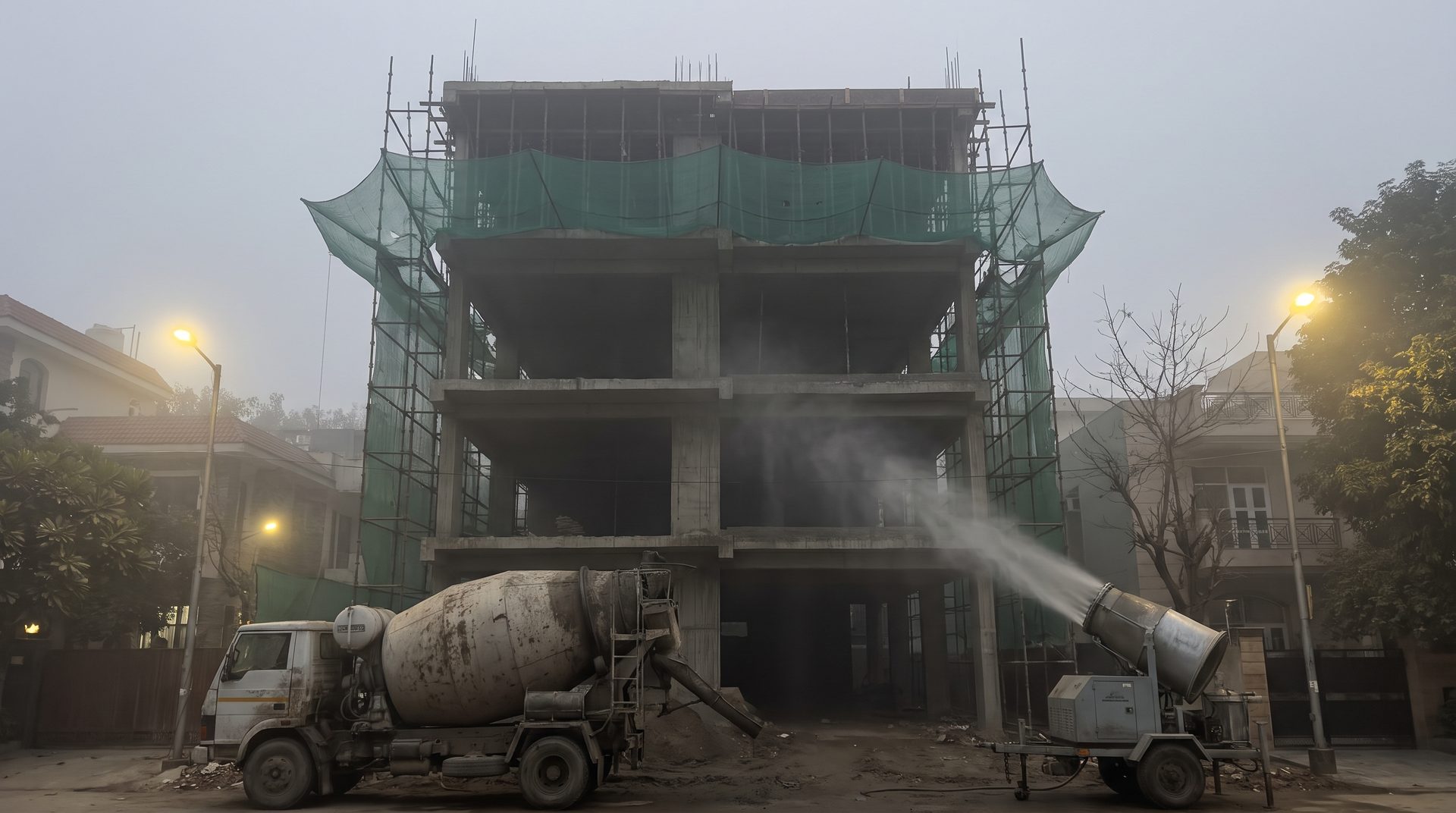
GRAP construction ban Delhi winter schedule — a South Delhi builder floor site paused mid-structure, materials covered in green netting, smog over the street
A structure-stage site in winter: under GRAP Stage III the shuttering stays up, the materials stay covered, and the slab schedule stops.

Winter 2026-27: GRAP plus Delhi’s new fixed construction ban

On 21 October 2026 the CAQM invoked Stage I across the NCR after Delhi’s AQI hit 244. What is new is a standing direction from the Delhi government’s Department of Environment, dated 23 June 2026, issued under Section 5 of the Environment (Protection) Act, 1986 and published in the Delhi Gazette on 1 July 2026. As reported, it applies automatically every winter, whatever the AQI:

1 November – 31 January: no dust-generating demolition or outdoor civil construction

On a private plot this stops demolition and outdoor structural work for 92 days. Essential public infrastructure is exempt.

10 December – 20 January: complete ban on construction and demolition

A 42-day shutdown, with exceptions for essential government and emergency works. Trucks carrying sand, aggregate, bricks, cement or debris are barred from entering Delhi.

GRAP still sits on top

Stricter GRAP measures prevail. Several reports say finishing, plumbing and electrical work inside a site may continue if dust norms are followed; confirm the gazette text, especially for 10 December–20 January.

The practical rule: a plot not demolished by the end of October will probably not be demolished before February, which is why our building plan sanction guide says to have the sanction by late summer.

The rules that apply all year: dust portal, anti-smog guns, workers’ pay

Every site must follow basic dust norms year-round. The equipment rules mostly sit above South Delhi plot sizes:

  • Dust portal registration is mandatory at a plot area of 500 sq m (about 598 sq yd) or more, and an unregistered site of that size may not work even under Stage I. Most floors stand on 200–500 sq yd and fall below it; a 600–800 sq yd plot in Vasant Vihar or Anand Niketan does not.
  • Anti-smog guns start at 5,000 sq m of built-up area under CAQM Direction No. 69 of 2 November 2022, and mist systems at a plot area above 1,000 sq m under Delhi’s 2026 direction. A typical stilt-plus-four block is well under both.
  • Workers’ pay during bans. In M.C. Mehta v Union of India, the Supreme Court has since November 2021 directed NCR states to pay construction workers from the labour cess fund during GRAP closures. On 28 February 2025 it held they must pay even without a specific direction. In December 2025 Delhi announced ₹10,000 per registered and verified worker for the 2025-26 closures. Many workers on small sites are not registered, one reason crews leave rather than wait.

The Court has declined to go further either way. On 17 November 2025 it rejected year-round GRAP curbs because of the damage to livelihoods. On 17 September 2025 it asked the CAQM to consider alternatives to a blanket winter construction ban. On 28 February 2025 it declined to order that non-polluting work continue under Stages III and IV, saying the GRAP schedule governs.

Why 18 months became 24 months: GRAP is only part of the winter

In our desk’s experience, an 18-month clause, demolition to possession, used to be standard for a stilt-plus-four building. Over the last three to four winters that stopped being realistic. GRAP is the visible cause; two other effects add to it:

The festival exodus

Many workers go home for Diwali and Chhath, in late October or November, as the first GRAP ban arrives. A crew that hears the site is shut may not return until the new year.

Logistics and cost

Stages III and IV restrict older diesel goods vehicles, and the 2026 direction bars material trucks from 10 December to 20 January. Idle weeks still carry shuttering hire and overheads. Our construction cost guide covers the line items.

A worked example (desk estimates; every site differs): a 400 sq yd GK-1 plot, sanctioned in September, on a build planned at 18 months with no winter. October demolition runs into the 1 November restriction. The basement falls in the first winter, where we would expect to lose six to ten weeks. The second winter catches finishing, which loses perhaps two to four weeks. Add a cushion for the completion certificate and 24 months is not padding; it is 18 months plus two winters.

Mohit Minocha, founder of SouthDelhiFloors, on the GRAP construction ban in Delhi and 24-month builder floor delivery clauses
Founder Mohit Minocha: the delay is predictable, so price it into the contract.
“

For the last three or four years GRAP has been a calendar event, not an emergency. It comes around November and goes in January, and sometimes it comes back in February. Earlier, every collaboration and booking agreement we saw said 18 months. Today the standard clause is at least 24 months, written with GRAP in mind. A builder who still promises 18 is either starting in February or not telling you the truth.

Mohit MinochaFounder, SouthDelhiFloors

Force majeure and the GRAP construction ban: drafting a 24-month clause

Most agreements still carry a generic force majeure clause, which invites a dispute every winter. Courts read force majeure narrowly: in Energy Watchdog v CERC (2017) the Supreme Court held that performance becoming costlier is not force majeure and the parties bear risks they accepted. A scheduled annual ban is highly foreseeable, yet a buyer who signed a vague clause will still struggle to deny any extension. Forums also want proof. In Naresh Garg and Sons v CHD Developers (2023), the NCDRC rejected a pollution-ban defence partly because the developer produced no material on the nature or duration of the ban. So name GRAP in the contract and fix in advance how it is counted:

What a GRAP-aware delivery clause should say (collaboration and buyer agreements)
Clause What to write Why
Base period 24 months from a defined start: vacant possession of the plot or the sanction date, whichever is later Ends the argument over the start date
GRAP / restriction days Day-for-day extension only for days on which a CAQM, Delhi government or court order prohibits structural work at the site Turns “winter” into countable days
Restart allowance A fixed number of days added per stoppage, if agreed, rather than an open-ended claim Prices re-mobilisation honestly
Cap A ceiling on total restriction-day extensions, beyond which delay compensation runs Stops 24 months quietly becoming 36
Notice Written notice of each stoppage and restart, with a monthly log Creates the evidence forums ask for
Delay compensation A monthly sum after the extended date; in a collaboration, the landowner’s rent continues throughout A reason to finish, not argue
Outer date A long-stop date after which the buyer may exit with refund and interest, or the landowner may terminate A remedy that exists before it is needed

For a landowner the rent clause matters most: if rent stops at month 18 and the building is at month 22, the landowner pays for GRAP. See our collaboration agreement guide and the collaboration FAQ.

A note on RERA

Do not assume RERA covers you. Whether a colony builder-floor project is registrable depends on its size and how it is sold; many are not registered, and then your contract is your main protection. Our guide to booking an under-construction builder floor explains where RERA applies.

Booking under construction: what to ask the builder about GRAP

If you are booking off-plan this season, ask:

  • What stage will the structure be at on 1 November? If “excavation,” expect the first winter to cost around two months (desk estimate).
  • Does the possession date allow for GRAP? It should read 24 months plus defined restriction days, not “subject to force majeure.”
  • Are payments linked to stages or dates? Insist on stage-linked payments, or you pay through a winter when nothing is built.
  • What about GST? Instalments paid before the completion certificate carry GST. See our GST guide.
  • How did the builder’s last winter go? Our Indus Homes GK-1 site review shows what we check.

See also our buying checklist.

Key takeaways on the GRAP construction ban in Delhi

  • GRAP Stage III (AQI 401–450) bans dust-generating construction and demolition across the NCR; private builder floors are not exempt.
  • By our estimate from CAQM dates, Stage III or higher lasted about 24, 40, 44 and 41 days in the four winters from 2022-23 to 2025-26, in three to six spells between late October and early February.
  • For 2026-27, Delhi’s standing direction adds a 1 November–31 January bar on dust-generating outdoor work and a complete ban from 10 December to 20 January.
  • In our desk’s observation, two winters per project, plus festival labour shortages and logistics, explain why 18-month clauses became 24 months.
  • Draft for it: define the start date, count restriction days from orders, cap the extension, keep landowner rent running and set an outer date.

Frequently asked questions

When does the GRAP construction ban apply in Delhi?
Under GRAP Stage III (Delhi AQI 401–450, actual or forecast) and Stage IV (above 450). In the last four winters the first ban came between 29 October and 14 November and the last was lifted by 3 February.
What construction work is allowed during GRAP Stage III?
Non-dust-generating work such as plumbing, electrical work, carpentry and interiors has been permitted. Excavation, demolition, structural work, welding, tile and stone cutting, waterproofing, painting and material loading are banned on private projects.
How many days does GRAP stop construction each winter?
By our estimate from CAQM dates, about 24 days in 2022-23, 40 in 2023-24, 44 in 2024-25 and 41 in 2025-26. With restarts, a structure-stage site typically loses five to eight working weeks (desk observation).
Is there a fixed construction ban in Delhi in winter 2026-27?
Yes. A Delhi direction dated 23 June 2026 bars dust-generating demolition and outdoor civil construction from 1 November to 31 January, with a complete construction and demolition ban from 10 December 2026 to 20 January 2027. Stricter GRAP measures prevail.
Is GRAP a valid force majeure reason for a builder to delay possession?
Only as far as the contract allows and the builder can prove the days lost. GRAP is now annual and foreseeable, so a good agreement names it, extends day-for-day for documented order days, caps the total and sets delay compensation beyond it.
Why do South Delhi builders now quote 24 months instead of 18?
In our desk’s observation, a stilt-plus-four rebuild usually spans two winters, each bringing GRAP stoppages, labour shortages and logistics problems, and now the fixed December–January ban. Together these add several months to an 18-month build.
Does my small plot need dust-portal registration or an anti-smog gun?
Usually not. Portal registration applies from a plot area of 500 sq m (about 598 sq yd) and anti-smog guns from 5,000 sq m built-up. Most South Delhi floors are on 200–500 sq yd plots. Basic dust norms apply to every site.
Who pays construction workers when GRAP stops work?
The state, from the construction welfare cess fund, under the Supreme Court’s directions in M.C. Mehta v Union of India, even without a specific order. For the 2025-26 closures Delhi announced ₹10,000 per registered, verified worker.

Signing a collaboration or booking a floor before winter?

We review delivery clauses for landowners and buyers and negotiate GRAP-day extensions, caps and rent that hold up. Tell us the plot or the project.

SouthDelhiFloors is a property advisory, not a law firm. Have collaboration and booking agreements reviewed by a lawyer before signing.

Sources: CAQM GRAP orders and PIB releases on Stage III/IV invocation and revocation, 2022–2026 (e.g. 3 Feb 2025, 22 Jan 2026); the CAQM revision of 28 September 2026; the GNCTD winter direction of 23 June 2026 (as reported by Business Standard); DPCC dust portal FAQs; Supreme Court orders in M.C. Mehta v Union of India (LiveLaw). Day counts are our estimates; timeline and contract points are desk observations as of October 2026. Check the current CAQM order before planning work.

Share this:

Like this:

Like Loading…

SOUTH DELHI FLOORS

Clean Deals Only · Since 1984

Second-generation consultants for South Delhi’s finest builder floors, farmhouses and independent homes. Four decades of clean, verified transactions.

+91 99990 04511

Enquire Now

Tell us what you are looking for and a senior consultant will get back to you.

    Your Name

    Telephone Number

    Your Email (required)

    Enter Your Message

    © 2026 SouthDelhiFloors LLP · All Rights ReservedClean Deals Only · Since 1984

    Compare Properties

    Compare
    You can only compare 4 properties, any new property added will replace the first one from the comparison.
    Property in South Delhi : Buy Sell Properties, Flats, Homes, Apartments Call SouthDelhiFloors
    Contact
    close slider

      Your Name

      Telephone Number

      Your Email (required)

      Enter Your Message