Home insurance for builder floor in Delhi — a stilt-plus-four South Delhi builder floor at dusk with an insurance policy folder and house keys on a table in the foreground
SouthDelhiFloors · The Ownership Desk

Home Insurance for a Builder Floor in Delhi: Structure vs Contents, the Shared Building, and the Earthquake Question

Home insurance for a builder floor is cheap and often bought wrong — insured at the ₹10 crore sale price instead of the rebuild cost, with nobody covering the stilt, lift or roof the owners share. Here is how to get it right, and what your bank can and cannot demand.

By the SouthDelhiFloors Research Desk
Updated October 2026
11 min read
How should you buy home insurance for a builder floor in Delhi?

Home insurance for a builder floor insures the cost of rebuilding your floor and replacing your belongings — not the market price, because land is not insured. Most insurers sell it as Bharat Griha Raksha (BGR), the standard home policy IRDAI asked general insurers to offer from 1 April 2021. The building sum insured is carpet area × a declared construction rate; on multi-year policies it rises by 10% a year (up to 100%), and a policy can run up to 10 years. Fire, earthquake, flood, storm, riot, terrorism and burst pipes are in the base cover; jewellery is an add-on. Insure building and contents together and contents get automatic cover of 20% of the building sum insured, capped at ₹10 lakh. On a stilt-plus-four building your share of the rebuild is roughly one quarter of the construction cost — and the common structure needs a decision among all the owners, because nobody insures it by default.

In our experience (a SouthDelhiFloors desk observation), many buyers have no home policy a year after possession, and many who do hold a bank-arranged policy on a sum insured nobody checked. This guide covers what home insurance for a builder floor pays for, the sum-insured arithmetic, and the problem unique to our housing type: one building, four owners, no society to insure the shell. See also our possession FAQs.

20%Automatic contents cover as a share of building sum insured (cap ₹10 lakh)
10% a yearBuilt-in escalation of the building sum insured
10 yearsMaximum tenure of a Bharat Griha Raksha policy
Zone IVDelhi’s seismic zone under IS 1893 (Part 1): 2016

What home insurance for a builder floor actually covers: Bharat Griha Raksha in 2026

Bharat Griha Raksha is a standardised product, sold by each insurer under its own name and UIN, so you can compare premiums like for like. We read a public-sector insurer’s prospectus and a private insurer’s wording; add-ons and limits vary, so read your own schedule.

Bharat Griha Raksha: the core terms that matter to a South Delhi floor owner (October 2026)
Term What the standard wording says What it means on your floor
Building sum insured Cost of construction: carpet area × a construction rate you declare and the insurer accepts, plus additional structures Land and market premium are excluded; a ₹10 crore floor is insured for its rebuild cost
Escalation Multi-year policies: +10% a year, up to 100% of the starting figure, no extra premium. Annual policies: 10% a year accrued daily Some protection against construction inflation; still re-check the rate at renewal
Under-insurance The “average” clause does not apply: a low declared sum does not proportionately cut a claim Payout is still capped at the sum insured, so a low declaration hurts on a total loss
Perils covered Fire, lightning, explosion; earthquake and other convulsions of nature; storm, cyclone, flood; subsidence and landslide; impact damage; riot, strike, malicious damage; terrorism; bursting or overflow of tanks and pipes; theft within 7 days of an insured event Earthquake is base cover, not an add-on. So is water damage from a burst pipe upstairs
General contents If both covers are bought, automatic cover of 20% of the building sum insured, capped at ₹10 lakh; more needs a declaration and extra premium On a South Delhi floor the ₹10 lakh cap almost always binds — declare your real contents
Valuables Optional, on agreed value: jewellery, silver, art, antiques. No valuation certificate needed up to ₹5 lakh total with no item above ₹1 lakh Jewellery is not covered without this. Bullion and unset stones are excluded
Rent / alternative accommodation Rent while the home is unfit to live in after an insured event; the private wording we reviewed caps it at three years, same-city accommodation Loss of rent for a landlord; a stop-gap floor for an owner-occupier
Built-in expenses Architect, surveyor and engineer fees up to 5% of the claim; debris removal up to 2% Higher limits are add-ons; worth it on a structural claim
Tenure One to ten years A long policy locks in escalation and saves renewals

What it does not cover

Beyond the usual exclusions (deliberate damage, war, wear and tear, consequential loss), three catch floor owners. Appliance breakdown is excluded for the machine itself, though a fire it starts is covered. Everyday burglary is not base cover — theft counts only within seven days of an insured event — so a break-in while you travel needs a burglary add-on. And alterations raising carpet area by more than 10% must be endorsed; an unendorsed terrace room is a classic claim fight.

The sum insured for home insurance for a builder floor: rebuild cost, not ₹10 crore

The most common error we see is insuring the purchase price. Most of what you paid is your undivided share of the land and the colony premium — neither burns, floods or falls down. Insure what it would cost to rebuild your floor, and your share of the building, to the same specification.

Our guide to construction cost for a builder floor in Delhi works through a 300 sq yd stilt-plus-four building: about 9,500–10,500 sq ft of construction including stilt, basement and balconies, and roughly ₹5–6 crore for the building at a luxury specification, before GST, sanction fees and interiors. That is the starting point.

Illustration only: sum insured for one floor in a 300 sq yd stilt + 4 building in GK-2 (four owners, equal shares)
Line Working Figure
Rebuild cost of the whole building From our construction-cost guide, luxury specification ₹5–6 crore
Your share (one floor of four) One quarter, assuming equal floors and equal shares in common parts ₹1.25–1.5 crore
Midpoint used for this example ₹5.5 crore ÷ 4 ₹1.375 crore
Automatic contents cover 20% of ₹1.375 crore = ₹27.5 lakh, but capped ₹10 lakh
Declared contents (add separately) Furniture, ACs, appliances, kitchen, at replacement value Your inventory
Valuables (add-on) Jewellery, art, silver, on agreed value Your inventory
Land and market premium Not insurable ₹0

Three adjustments move the number. Specification: Italian marble, VRV air-conditioning, home automation and a designer kitchen are fixtures, part of the building cover, so a heavily fitted floor justifies a higher declared rate. Unequal floors: if you own the ground floor with the basement, or the top floor with terrace rights, your share is not a neat quarter — see our guide to terrace, stilt and basement rights. Carpet-area mechanics: because the wording multiplies carpet area by a declared rate, the rate must carry your share of stilt, staircase, lift and foundation. Tell the insurer in writing how you derived it, and keep the working with the policy.

Desk rule of thumb

Insure the rebuild, declare the contents, schedule the jewellery. For a luxury floor in a stilt-plus-four building, the building cover should usually sit near one quarter of the building’s construction cost, adjusted for specification — a SouthDelhiFloors illustration, not a quote; the insurer’s surveyor may accept a different rate.

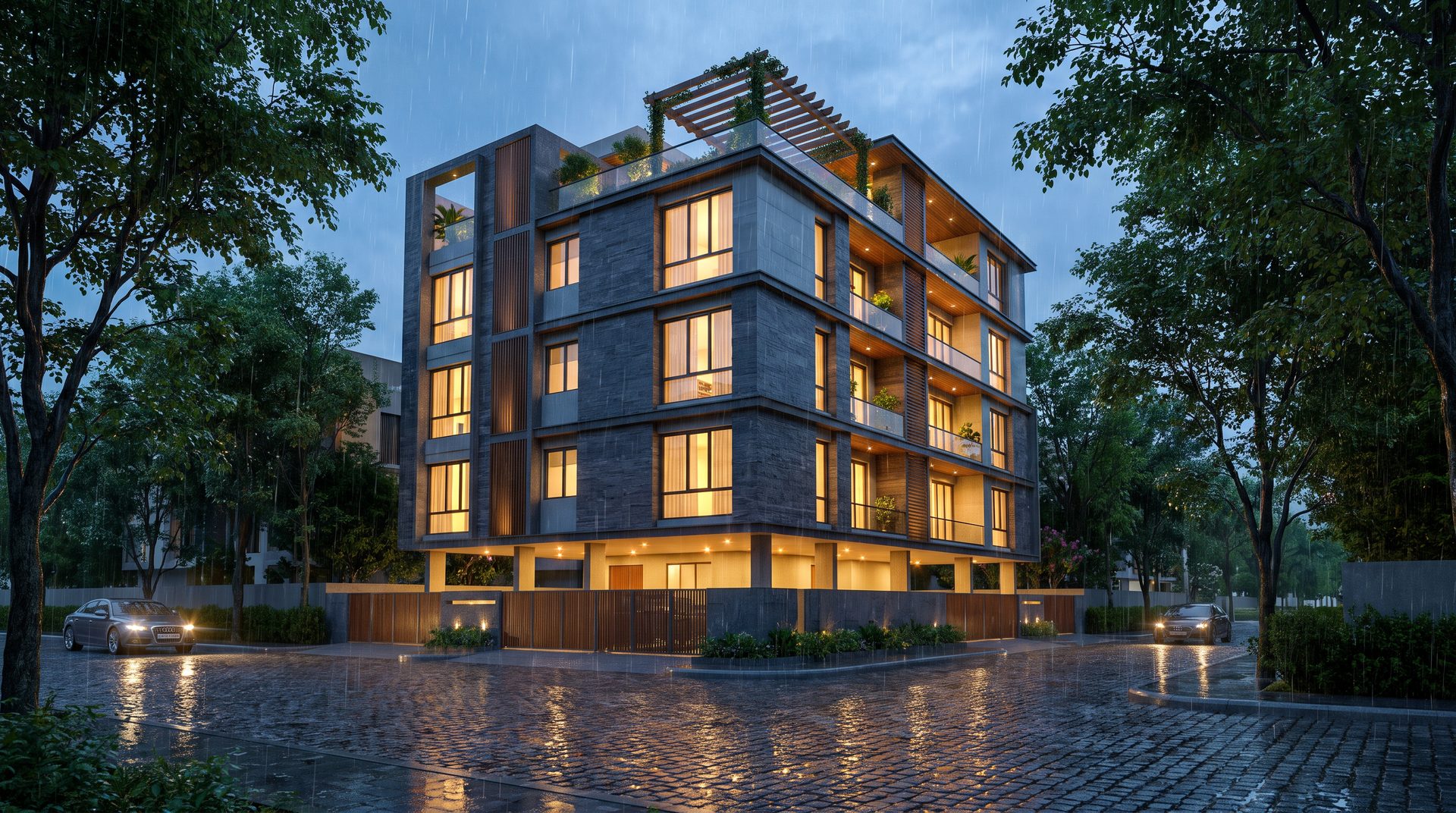
The co-owned building: who insures the stilt, the lift and the roof?

No standard wording addresses this. A builder floor has no registered society to insure the building — just three to five owners, each with a floor plus an undivided share in the land and common parts: foundation, columns, stilt, staircase, lift, tank, boundary wall and, depending on the deed, the roof. The BGR wording we reviewed covers the building used as your dwelling plus additional structures on the site, and says nothing about a share of common areas.

Owners handle it three ways:

Each owner insures their floor and their share of the shell

The most common arrangement: each owner declares a rate that includes their share of the common structure. It works only if every owner does it; one uninsured floor leaves a hole in the rebuild money.

One policy for the whole building, all owners named

The cleanest answer when owners get along: the building insured as one risk, every owner and mortgagee bank named, shares recorded. BGR is written for individuals and co-operative housing societies, so an insurer may instead offer its regular home or fire policy for an unregistered group. Ask first.

A builder or association policy during the defect period

Some developers insure the structure until handover. Get a copy and check its expiry; it protects the developer’s interest, not your contents or rent.

Whatever you choose, write it down: a one-page letter among the owners on who insures what, sums insured, renewal dates and applying any structural payout to reinstatement. The wording does not name lifts, so confirm in writing which policy carries the lift. Add it to our builder floor buying checklist.

Home insurance policy document, house keys and a floor plan on a table inside a newly handed-over South Delhi builder floor
The policy, the keys and the plan belong in the same file: the plan’s carpet area is what the building sum insured is computed on.

Delhi’s earthquake risk and home insurance for a builder floor

Delhi is in Seismic Zone IV — “fairly high seismicity”, in the Ministry of Earth Sciences’ words — under the Bureau of Indian Standards’ earthquake code, IS 1893 (Part 1). BIS notified a revised 2025 code in November 2025, with a new map adding a Zone VI for the Himalayan belt, but withdrew it in early March 2026 (its standards portal now lists IS 1893 (Part 1): 2025 as withdrawn); news reports say the 2016 edition applies again. A “new map” still shared on WhatsApp describes a standard that is not operative. The insurance position below does not depend on the zone.

Three practical points. Earthquake is base BGR cover; some older fire policies made it optional, so check a pre-BGR policy. The sum insured matters most here, the peril most likely to cause a total loss. And the co-ownership gap bites hardest: a damaged stilt column is everyone’s problem. Insurance is no substitute for structure — ask for the engineer’s certificate, as our guide to South Delhi builder floors recommends.

Mohit Minocha, founder of SouthDelhiFloors, on home insurance for a builder floor and the shared building
Founder Mohit Minocha on home insurance for a builder floor: the floor is yours, the columns are everyone’s.
“

Owners insure the ₹10 crore they paid and forget the column under the stilt. Insure what it costs to rebuild, and make sure the other three floors have done the same.

Mohit MinochaFounder, SouthDelhiFloors

Home loan insurance: what the bank can ask for, and where you can buy it

Lenders routinely require the mortgaged property to be insured, with the bank as loss payee, because the building is their security. That is legitimate. What a lender may not do is force you to its partner insurer. RBI’s existing rules already bar NBFCs from forcing customers to a particular insurance company, with parallel provisions for banks. RBI’s amendment directions on the sale of financial products, issued on 15 June 2026 and covering banks, NBFCs and housing finance companies, go further from 1 January 2027: compulsory bundling of a third-party product with a loan is prohibited; where a product is required as a risk mitigant, you must be free to buy it from any provider; each product needs separate consent; and a premium cannot be funded from the loan without explicit consent.

So you can buy home insurance for a builder floor from any insurer and give the bank the policy with its interest endorsed. If the loan file already holds a single-premium property policy, read its schedule — many cover the loan amount, not the rebuild cost. See our guides to the home loan for a builder floor and home loan FAQs.

Landlord, tenant, and the tax on the premium

Who insures what in a let floor

The building and the landlord’s fixtures (modular kitchen, wardrobes, wall-mounted ACs) are the owner’s to insure; the tenant insures their own furniture, electronics and jewellery with a contents-only policy. BGR’s rent cover pays the landlord loss of rent if an insured event makes the floor unfit to live in. Write the split into the lease — see our guide to rent agreement registration in Delhi.

Tax: no separate deduction either way

There is no income-tax deduction for a home insurance premium on a self-occupied floor; the Act’s insurance deductions are for life and health cover. For a let-out floor, the deductions from house-property income are the 30% standard deduction on annual value and home-loan interest — Section 24 of the Income-tax Act, 1961, now Section 22 of the Income-tax Act, 2025. The 30% is a flat allowance in place of actual expenses such as repairs and insurance, so the premium cannot be claimed on top. See our guide to tax on rental income.

How to claim on home insurance for a builder floor

Make it safe, then notify immediately

Stop the water, switch off the supply, secure the floor. Inform the insurer at once, and file a police report for theft, riot or malicious damage. The standard wording asks for the claim form within 30 days of first noticing the loss.

Photograph before you clear anything

Timestamped wide shots and close-ups of every damaged room and item. Do not discard damaged goods or start permanent repairs until the surveyor has seen them or the insurer agrees in writing.

Meet the surveyor with your file ready

Policy, sale deed, sanctioned plan with carpet area, contents inventory and invoices, valuation certificates, and the co-owners’ letter if common parts are involved. IRDAI’s 2024 master circular says no claim is to be rejected for want of documents.

Agree the loss, then repair

Get the assessment in writing, check that professional fees and debris removal are included, and keep repair invoices. Where the bank is loss payee, the payout may need its consent.

Reinstate the sum insured and endorse changes

After a claim, confirm the sum insured is reinstated. Endorse later additions — a terrace room, a second kitchen — before the next loss.

Three ways floor owners lose claims

Insuring the wrong number — a policy naming the market price pays no more than the rebuild, and one naming the loan amount may pay far less. Undeclared contents and jewellery — the automatic ₹10 lakh contents cap is soon exhausted on a South Delhi floor, and jewellery is never covered by default. Unendorsed alterations — a carpet-area increase of more than 10% the insurer was never told about.

Key takeaways on home insurance for a builder floor

  • Insure the rebuild cost, not the sale price: land is not insured. In a stilt-plus-four building your share is roughly one quarter of the construction cost, adjusted for specification.
  • Bharat Griha Raksha covers fire, earthquake, flood, storm, riot, terrorism and burst pipes, escalates the building cover 10% a year on multi-year terms and runs up to 10 years.
  • Automatic contents cover is 20% of the building sum insured, capped at ₹10 lakh; declare the rest and add valuables cover for jewellery. Burglary and appliance breakdown need add-ons.
  • Nobody insures the stilt, lift, staircase and roof by default: agree in writing who covers them.
  • Delhi is Seismic Zone IV under IS 1893 (Part 1): 2016; BIS withdrew the 2025 revision in March 2026.
  • Your lender can require insurance but not a particular insurer; from 1 January 2027 RBI bars compulsory bundling. No tax deduction for the premium on a self-occupied floor; on a let floor it sits inside the 30% standard deduction.

Frequently asked questions

What sum insured should I take for home insurance for a builder floor?
The rebuild cost of your floor and your share of the building, not the price you paid. On a 300 sq yd stilt-plus-four South Delhi building costing about ₹5–6 crore to build, one floor’s share is roughly ₹1.25–1.5 crore. Land is not insured.
Does Bharat Griha Raksha cover earthquake?

Yes. Earthquake and other convulsions of nature are in the base Bharat Griha Raksha cover, with fire, flood, storm, riot, terrorism and burst pipes. No separate add-on is needed.

Is my jewellery covered by home insurance?

Not by default. Jewellery, silver, art and antiques need the optional valuables cover, on agreed value. No valuation certificate is needed up to ₹5 lakh total with no item above ₹1 lakh. Bullion and unset stones are excluded.

Who insures the common structure of a builder floor building?

No one, unless the owners arrange it: each owner declares a rate that includes their share of the common structure, or all owners insure the whole building on one policy with everyone named. Record it in writing.

What is Delhi’s seismic zone in 2026?

Zone IV under IS 1893 (Part 1): 2016. BIS notified a revised 2025 code with a new zonation map in November 2025 but withdrew it in March 2026; the 2016 standard applies again.

Can my bank force me to buy home insurance from its insurer?

It can require the property to be insured, but not from a particular insurer. RBI directions issued on 15 June 2026, effective 1 January 2027, bar compulsory bundling and require separate consent for each product. Buy from any insurer and endorse the bank’s interest.

Is the home insurance premium tax deductible?

Not for a self-occupied home. For a let-out floor, the flat 30% standard deduction on annual value (Section 24 of the 1961 Act, now Section 22 of the Income-tax Act, 2025) replaces actual expenses such as insurance, so the premium is not deducted separately.

Should a tenant buy home insurance?

Yes, for their own contents, with a contents-only policy. The building and landlord’s fixtures are the owner’s to insure. Record the split in the rent agreement.

Just bought, or about to take possession of, a South Delhi floor?

We help owners put the possession file in order — the sum insured on rebuild cost, the co-owners’ letter and the bank’s endorsement — so home insurance for a builder floor pays when it has to.

SouthDelhiFloors is a property advisory, not an insurance intermediary. We do not sell or recommend specific policies; buy from an IRDAI-registered insurer or intermediary and read the policy wording.

Sources: Bharat Griha Raksha terms from The New India Assurance BGR prospectus and a private insurer’s BGR wording; limits vary by insurer. Zone IV: Ministry of Earth Sciences; IS 1893 (Part 1): 2025 withdrawal: BIS standards portal and ETV Bharat. RBI: press release, 15 June 2026. Tax: Section 22, Income-tax Act, 2025. The rebuild-cost example is a SouthDelhiFloors illustration, not an insurer’s valuation; co-ownership and uptake comments are desk observations as of October 2026. General information, not insurance, tax or legal advice.

Share this:

Like this:

Like Loading…

SOUTH DELHI FLOORS

Clean Deals Only · Since 1984

Second-generation consultants for South Delhi’s finest builder floors, farmhouses and independent homes. Four decades of clean, verified transactions.

+91 99990 04511

Enquire Now

Tell us what you are looking for and a senior consultant will get back to you.

    Your Name

    Telephone Number

    Your Email (required)

    Enter Your Message

    © 2026 SouthDelhiFloors LLP · All Rights ReservedClean Deals Only · Since 1984

    Compare Properties

    Compare
    You can only compare 4 properties, any new property added will replace the first one from the comparison.
    Property in South Delhi : Buy Sell Properties, Flats, Homes, Apartments Call SouthDelhiFloors
    Contact
    close slider

      Your Name

      Telephone Number

      Your Email (required)

      Enter Your Message