
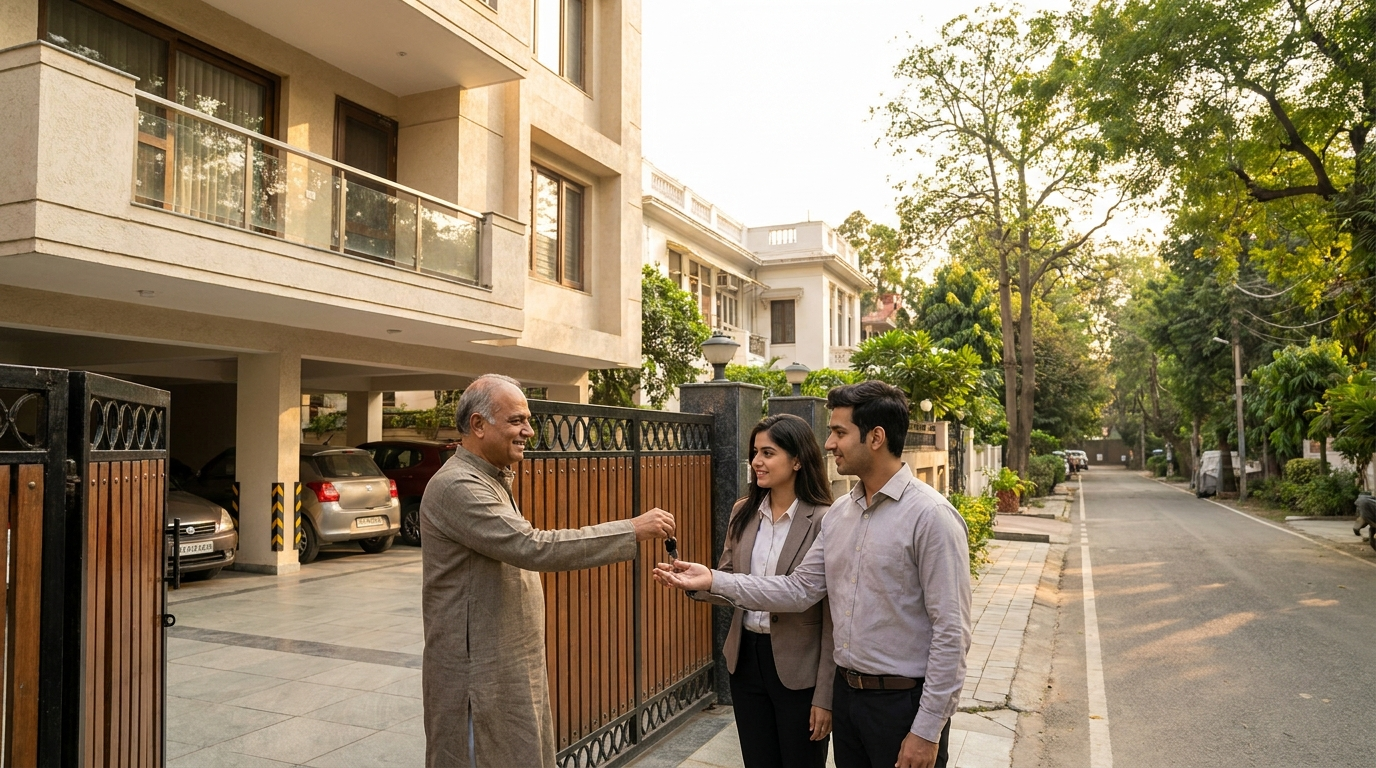














Rent agreement registration in Delhi — a landlord handing keys to tenants at a South Delhi builder floor
SouthDelhiFloors · Landlord’s Desk

Renting Out Your Floor: Rent Agreement Registration in Delhi

The 11-month convention explained honestly, the stamp duty and registration math for longer leases, mandatory police verification, the tenant’s TDS — and how landlords of premium South Delhi floors keep the whole thing clean.

By the SouthDelhiFloors Research Desk Updated July 2026 11 min read
Is rent agreement registration in Delhi compulsory?

Only for tenancies of 12 months or longer — which is precisely why the 11-month agreement is Delhi’s convention: below one year, an agreement on a modest e-stamp (commonly ₹100) needs no registration to be valid. For leases of 1 to 5 years, rent agreement registration in Delhi is compulsory, with stamp duty at 2% of the average annual rent (3% for 5–10 years) plus a ₹1,100 registration fee, executed before the sub-registrar with biometrics. Whatever the term, two things are non-negotiable for a Delhi landlord: police verification of the tenant and, where monthly rent exceeds ₹50,000, the tenant’s 2% TDS on the rent.

South Delhi’s builder floors are among India’s best rental assets — ₹1–5 lakh a month, corporate and diplomatic tenants, negligible vacancy in the good colonies. The paperwork, however, is where landlords get casual, and casualness has a price: unregistered long leases that courts won’t fully honour, skipped police verification that becomes the landlord’s legal problem, and TDS mismatches at return time. Here is the complete, current playbook for letting a floor properly.

11 moThe convention — below 12 months, registration isn’t mandatory
2%Stamp duty on average annual rent for registered 1–5 year leases (+₹1,100 fee)
2%TDS the tenant deducts where rent exceeds ₹50,000/month
30%Standard deduction on rental income in the landlord’s tax return

Rent agreement registration in Delhi: the rules by tenure

Delhi rent agreement — stamp duty and registration by lease term (2026)
Lease termStamp dutyRegistrationUsed for
Up to 11 monthsNominal e-stamp (commonly ₹100)Not mandatoryThe standard Delhi residential tenancy, renewed by fresh agreement
1–5 years2% of average annual rentMandatory — sub-registrar, biometrics, ₹1,100 feeCorporate leases, embassy tenancies, tenants investing in fit-outs
5–10 years3% of average annual rentMandatoryLong commercial-style lets; rare for homes

Two clarifications the internet muddles. First, the 11-month agreement is not a loophole — the Registration Act simply exempts leases under one year from compulsory registration; the agreement remains fully valid and stampable. Its weakness is evidentiary breadth, not legality. Secondly, Delhi is still governed by the Delhi Rent Control Act, 1958 — the Model Tenancy Act has not been adopted here — but DRC’s tenant protections attach to old, low-rent tenancies (statutory rents up to ₹3,500/month); a premium South Delhi floor at ₹2 lakh a month sits entirely outside that regime, governed by contract and the TPA. What actually protects the landlord is the written agreement itself: term, rent, escalation (11-month renewals customarily reprice; multi-year leases build in 10–15% escalations), notice, lock-in, deposit terms and an inventory annexure.

Worked example — a 3-year lease of a GK-2 floor

Rent ₹2,00,000/month with 10% annual escalation: year rents of ₹24L, ₹26.4L and ₹29.04L average to ₹26.48 lakh. Stamp duty at 2% = ₹52,960, plus ₹1,100 registration — typically split between the parties by agreement. Against three years of locked-in, court-enforceable income of nearly ₹80 lakh, the duty is roughly two weeks of rent — cheap certainty for both sides, and the reason serious corporate tenancies always register.

The landlord’s compliance file: verification, TDS and tax

Beyond the agreement, three obligations complete the file. Police verification: Delhi requires landlords to have tenants verified with Delhi Police — done online through the Delhi Police citizen-services portal or at the local station with the tenant’s ID and photographs; skipping it is an offence that lands on the landlord, and it is also simply how you know who is living in your property. The tenant’s TDS: where rent exceeds ₹50,000 a month, an individual tenant must deduct 2% TDS (Section 194-IB — reduced from 5% in October 2024), deposited once for the year via Form 26QC with Form 16C to the landlord, no TAN needed; where the landlord is an NRI, Section 195 applies instead and the tenant deducts at the landlord’s slab-linked rate (~31%+) on every payment regardless of amount — NRI landlords should surface this before the agreement is priced, as our NRI guide covers. The landlord’s return: rental income is taxed after municipal taxes and a flat 30% standard deduction, with home-loan interest deductible against it within limits — and the property tax entry ties back to your MCD file, where rented use carries a higher occupancy factor. Market customs complete the picture: 2–3 months’ deposit, and brokerage of one month’s rent (30 days) from each side plus 18% GST, as our commission guide details.

Registering a lease, step by step

Draft the agreement completely

Parties, property schedule, term, rent and escalation, deposit and its refund mechanics, lock-in, notice, maintenance split, permitted use, and an inventory annexure signed on both sides.

Buy the e-stamp for the computed duty

2% of the average annual rent for 1–5 year terms, through Delhi’s e-stamping system in either party’s name as agreed.

Book the sub-registrar appointment

Online for the sub-registrar office of the property’s jurisdiction — the same portal flow as a sale registration.

Appear with witnesses and complete biometrics

Landlord, tenant and two witnesses with original ID; photographs and thumbprints are captured, the ₹1,100 fee is paid, and the registered agreement follows.

Close the compliance loop

Police verification filed, TDS arrangement confirmed in writing where rent crosses ₹50,000, deposit banked, and rent received only through banking channels — the paper trail that makes every future step easy.

The clause landlords forget until it hurts

Lock-in and notice are not the same thing. Notice lets either side exit with 1–3 months’ warning; lock-in makes the tenant liable for rent for a minimum period even if they leave. A corporate tenant who fits out your floor will demand a lock-in on you too. Draft both expressly, state what the deposit may be applied against, and never let the deposit quietly become “the last months’ rent” — that habit converts your damage cover into nothing.

A tenancy is a lending of your biggest asset. Paper it like one.
Mohit MinochaFounder, SouthDelhiFloors

Key takeaways

  • Registration is compulsory only at 12 months or longer — the 11-month agreement on a nominal e-stamp is lawful convention, not a loophole; longer leases pay 2% of average annual rent plus ₹1,100.
  • Premium South Delhi tenancies sit outside Delhi Rent Control’s protections — the contract is your law, so draft term, escalation, deposit, lock-in and notice completely.
  • Police verification of the tenant is mandatory and the landlord’s obligation — file it before handover.
  • Rent above ₹50,000/month means the tenant deducts 2% TDS (Form 26QC); an NRI landlord flips this to Section 195 at ~31%+ on every payment.
  • The landlord’s return gets a 30% standard deduction; customs run at 2–3 months’ deposit and one month’s brokerage per side + 18% GST.

Frequently asked questions

Why are rent agreements in Delhi made for 11 months?

Because leases under one year are exempt from compulsory registration, an 11-month agreement is valid on a nominal e-stamp without a sub-registrar visit. It renews by fresh agreement — convenient for standard tenancies, though longer registered leases give both sides stronger, broader evidence.

What is the stamp duty for rent agreement registration in Delhi?

2% of the average annual rent for leases of 1–5 years and 3% for 5–10 years, plus a flat ₹1,100 registration fee. For 11-month agreements, a nominal e-stamp (commonly ₹100) suffices.

Is an unregistered one-year-plus lease valid?

It’s a problem: a lease of a year or more made without registration cannot be received as evidence of its terms, leaving the tenancy treated at law far more loosely than what you signed. If the term is 12 months or longer, register — the duty is small against the enforceability it buys.

Is police verification of tenants really compulsory in Delhi?

Yes — it is the landlord’s legal obligation, discharged online through the Delhi Police portal or at the local station with the tenant’s ID and photos. Beyond the law, it is basic diligence on who occupies your property.

Who pays the TDS on rent above ₹50,000?

The tenant deducts 2% under Section 194-IB — once for the year, from the last month’s rent, via Form 26QC with Form 16C to the landlord; no TAN needed. It’s the landlord’s own tax, credited against their return.

What if the landlord is an NRI?

Section 195 replaces 194-IB: the tenant deducts at the NRI landlord’s applicable rate (roughly 31%+ with cess) on every payment, with no ₹50,000 threshold, unless the landlord obtains a lower-deduction certificate. Settle this before signing — it changes the tenant’s cash flow materially.

How is my rental income taxed?

Gross annual rent minus municipal taxes paid, minus a flat 30% standard deduction; home-loan interest is deductible within the prevailing limits. GST does not apply to renting a residential dwelling for residence to an individual.

How much security deposit is standard in Delhi?

Two to three months’ rent for premium residential tenancies — refundable, and best held against a signed inventory with the deed stating exactly what it may be applied to.

Does Delhi Rent Control protect my tenant against eviction?

The 1958 Act’s protections attach to old, low-rent tenancies; a market-rent South Delhi letting is governed by the contract and general law. Your protection is a complete agreement — term, notice, lock-in — and rent received through banking channels.

What brokerage applies when I let my floor?

One month’s rent (30 days) from each side, plus 18% GST on the fee — payable on execution of the agreement. Renewal terms should be agreed with the broker upfront.

Letting a South Delhi floor? We bring the tenant and the paperwork

Vetted tenants, market-right rent, complete agreements, verification and TDS mechanics handled — the tenancy done properly from day one.

SouthDelhiFloors is a property advisory. Have agreements vetted by your lawyer and CA.

Stamp duty (2%/3% of average annual rent, ₹1,100 registration), the 11-month registration exemption, Delhi Police verification requirements and TDS positions (194-IB at 2% since October 2024; Section 195 for NRI landlords) reflect the law in force in July 2026, including the Income-tax Act, 2025 framework effective 1 April 2026. Delhi has not adopted the Model Tenancy Act. Verify current figures on the Delhi revenue and e-stamping portals and take professional advice for your tenancy.

Share this:

Like this:

Like Loading…

SOUTH DELHI FLOORS

Clean Deals Only · Since 1984

Second-generation consultants for South Delhi’s finest builder floors, farmhouses and independent homes. Four decades of clean, verified transactions.

+91 99990 04511

Enquire Now

Tell us what you are looking for and a senior consultant will get back to you.

    Your Name

    Telephone Number

    Your Email (required)

    Enter Your Message

    © 2026 SouthDelhiFloors LLP · All Rights ReservedClean Deals Only · Since 1984

    Compare Properties

    Compare
    You can only compare 4 properties, any new property added will replace the first one from the comparison.
    Property in South Delhi : Buy Sell Properties, Flats, Homes, Apartments Call SouthDelhiFloors
    Contact
    close slider

      Your Name

      Telephone Number

      Your Email (required)

      Enter Your Message

      error: Content is protected !! Please Don\\\\\\\'t Try To Copy