
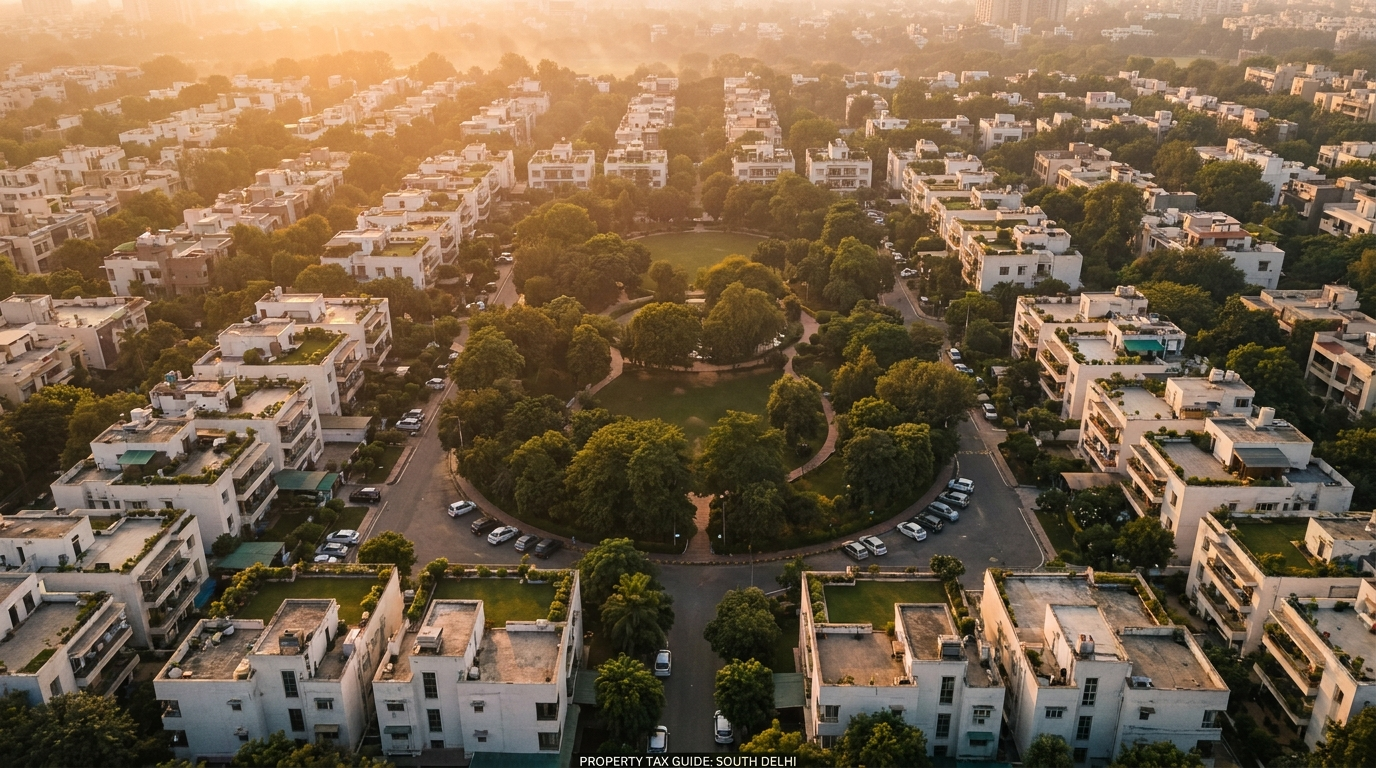















MCD property tax in Delhi — aerial view of a South Delhi residential colony whose homes fall in category A and B
SouthDelhiFloors · Owner’s Desk

MCD Property Tax in Delhi: The Complete Guide

How the Unit Area System actually computes your bill, the A–H category rates, every rebate you can claim, how to pay online with your UPIC — and why the nil-dues certificate matters more than any receipt when you sell.

By the SouthDelhiFloors Research Desk Updated July 2026 11 min read
How is MCD property tax calculated in Delhi?

Delhi uses the Unit Area System: your colony’s category (A to H) fixes a unit area value per square metre; that value is multiplied by your covered area and by factors for the building’s age, use, structure and occupancy to produce the Annual Value; the tax is then a percentage of that Annual Value — 12% for residential property in categories A and B (most of South Delhi), 11% for C–E and 7% for F–H. Because the unit values are modest, the resulting bill on even a large South Delhi floor is usually a few thousand to a few tens of thousands of rupees a year — small money, but with outsized consequences if left unpaid.

Property tax is the least glamorous number in South Delhi real estate and the one that quietly blocks the most deals. Unpaid MCD dues travel with the property, surface in every buyer’s diligence, and stall registries. This guide gives you the full 2026 picture — the formula, the category rates, a worked example for a GK floor, every rebate, the online payment walk-through, and the seller’s angle we see from the deal table.

12%Residential tax rate for category A & B colonies — most of South Delhi
₹630Unit area value per sq m for category A (B: ₹500)
30%Rebate for senior citizens, women and ex-servicemen (conditions apply)
1%/moInterest charged on late payment

MCD property tax rates in Delhi: categories, values and the formula

Every colony in Delhi sits in a category from A to H — the same classification that drives circle rates, as our circle rate guide explains. For property tax, the category fixes both the unit area value and the rate:

MCD unit area values and residential tax rates by category (2026)
CategoryUnit area value (per sq m)Residential rateSouth Delhi examples
A₹63012%Vasant Vihar, Anand Niketan, Shanti Niketan, Friends Colony
B₹50012%Greater Kailash, Defence Colony, Panchsheel Park, Hauz Khas, Gulmohar Park
C₹40011%CR Park, East of Kailash, Saket, Malviya Nagar, Alaknanda
D₹32011%Jangpura, Karol Bagh
E₹27011%
F–H₹230 / ₹200 / ₹1007%Progressively simpler localities

The formula: Annual Value = unit area value × covered area (sq m) × age factor × use factor × structure factor × occupancy factor, and tax = Annual Value × the category rate. The factors reward older buildings (age factor runs from 1.0 for post-2000 construction down to 0.5 for pre-1960), rented use raises the occupancy factor, and commercial use raises the use factor sharply — commercial property is taxed at 20% of Annual Value in the upper categories.

Worked example — a GK-1 builder floor

A self-occupied, post-2000 floor in Greater Kailash-1 (category B) with 2,500 sq ft ≈ 232 sq m covered area: Annual Value = 500 × 232 × 1.0 × 1.0 × 1.0 × 1.0 = ₹1,16,000. Tax at 12% = ₹13,920 a year — before any early-payment rebate. On a floor worth ₹10 crore, the annual property tax is roughly 0.014% of the asset’s value. Delhi taxes the government’s unit values, not the market’s; that is why the bill on a crore-class home is dinner-for-four money — and why there is never a good reason to let it fall due.

Rebates, deadlines and the amnesty scheme

MCD’s headline incentive is the lump-sum rebate for paying the full year early — traditionally 15% for payment within the first quarter (by 30 June); for the current cycle MCD has notified a 10% rebate with the deadline extended to 31 July 2026, so check the live figure on the portal before paying. On top of that, a 30% rebate applies for senior citizens, women owners, persons with disabilities and ex-servicemen — on one self-occupied residential property, up to 200 sq m of covered area, and proportionate to the eligible owner’s share where ownership is joint. DDA and CGHS flats up to 100 sq m get 10%, and group-housing flats paying by 30 June get 20%. Delay costs 1% interest per month. For owners carrying old arrears, MCD’s SUNIYO amnesty scheme (2025–26) waived interest and penalties on historical dues for those who cleared the principal — a pattern MCD has repeated before and may again; if you hold legacy dues, watch for the next window.

Paying online, step by step

Log in at mcdonline.nic.in

Register with your mobile number; your property is identified by its UPIC (Unique Property Identification Code). No UPIC yet? Generate one on the portal first — you will need it when you sell, too.

Verify the property details

Category, covered area, use and occupancy drive the computation — check them before paying, because errors compound year after year.

Select the financial year and compute

The portal’s calculator applies the formula and shows any rebate you qualify for.

Pay and download the receipt

Card, net banking or UPI. Save the PDF receipt against the UPIC — it joins the property’s permanent file.

The seller’s angle: receipts are not enough

When a floor sells, the buyer’s lawyer will not accept a shoebox of receipts as proof that nothing is outstanding — they ask for MCD’s nil-dues confirmation against the UPIC as of a current date. Arrange it before the agreement is signed, not at the registry. Property tax standing also feeds the mutation record that follows every sale, and it appears as a line item in our buying checklist for exactly this reason. Sellers preparing a floor for market should treat the tax file as part of the title file — our seller’s guide shows where it fits in the sequence.

The cheapest tax in Delhi property stalls the most expensive deals. Pay it in April and forget it.
Mohit MinochaFounder, SouthDelhiFloors

Key takeaways

  • Delhi taxes property on the Unit Area System: category unit value × covered area × age/use/structure/occupancy factors, times the rate — 12% residential for categories A and B, where nearly all of South Delhi sits.
  • Bills are small relative to values — a 2,500 sq ft GK floor computes to roughly ₹14,000 a year before rebates — because unit values, not market prices, drive the math.
  • Pay the full year early for the lump-sum rebate (10–15% depending on the year’s notification; 31 July 2026 for the current cycle) and claim the 30% category rebates if eligible; delay costs 1% a month.
  • Everything runs on the UPIC at mcdonline.nic.in — generate one if your property lacks it.
  • For a sale, get MCD’s nil-dues confirmation before signing — receipts alone don’t satisfy a buyer’s lawyer, and dues travel with the property.

Frequently asked questions

What is the property tax rate for South Delhi colonies?

Almost all premium South Delhi colonies fall in categories A or B, where residential property is taxed at 12% of Annual Value — computed on unit area values of ₹630 and ₹500 per sq m respectively, not on market prices.

How do I find my property’s category?

The category follows your colony — Vasant Vihar and Anand Niketan are A; Greater Kailash, Defence Colony and Panchsheel Park are B; Saket and CR Park are C. The MCD portal shows the classification against your UPIC; verify the specific colony rather than assuming from a neighbour.

What is a UPIC and why do I need one?

The Unique Property Identification Code is MCD’s identifier for your property — every payment, record and nil-dues certificate hangs off it. If your property predates the system, generate a UPIC on mcdonline.nic.in before your next payment or sale.

What rebates can I claim on Delhi property tax?

The early lump-sum rebate for paying the full year in one go (10–15% depending on the year’s notification); 30% for senior citizens, women, persons with disabilities and ex-servicemen on one self-occupied home up to 200 sq m; 10% for DDA/CGHS flats up to 100 sq m; 20% for group-housing flats paying by 30 June.

What happens if I don’t pay property tax?

Interest accrues at 1% per month, dues accumulate against the property (not just the owner), and the arrears surface in every sale’s diligence — often as a last-minute price deduction. MCD also runs recovery proceedings for chronic defaulters.

Do tenants or landlords pay the property tax?

The owner is liable to MCD. Rented properties also carry a higher occupancy factor than self-occupied ones, so letting a floor raises the bill somewhat — a detail landlords should build into yield math.

Is property tax linked to circle rates?

No — they share the A–H category framework but are separate systems. Circle rates set minimum registration values for stamp duty; property tax runs on the unit-area formula. A low circle rate does not lower your tax, and vice versa.

How is an old building taxed differently?

Through the age factor: post-2000 construction carries 1.0, scaling down to 0.5 for pre-1960 buildings. A rebuilt floor resets to the newest band — one of the small recurring costs of redevelopment worth knowing before a collaboration.

Was there an amnesty for old dues?

Yes — MCD’s SUNIYO scheme (2025–26) waived interest and penalties on legacy dues for owners who paid the principal, with deadlines extended into 2026. MCD has run such schemes periodically; owners with old arrears should watch for the next window rather than paying penalties at full freight.

What proof of payment does a property sale need?

MCD’s nil-dues confirmation against the UPIC as of a current date — buyers’ lawyers treat receipts for individual years as incomplete evidence. Obtain it before the agreement to sell is signed.

Buying or selling? Get the dues checked with the title

We verify MCD standing, UPIC records and the full paper file on every deal we broker — before token money moves. Clean deals only.

SouthDelhiFloors is a property advisory. Confirm your exact computation on the official MCD portal.

Rates, unit area values, factors and rebate schemes reflect MCD’s Unit Area System as in force in July 2026, including the rebate deadline of 31 July 2026 notified for the current cycle and the SUNIYO amnesty windows of 2025–26. Compute and pay only through the official portal at mcdonline.nic.in; notifications change and the portal’s calculator is authoritative for your property.

Share this:

Like this:

Like Loading…

SOUTH DELHI FLOORS

Clean Deals Only · Since 1984

Second-generation consultants for South Delhi’s finest builder floors, farmhouses and independent homes. Four decades of clean, verified transactions.

+91 99990 04511

Enquire Now

Tell us what you are looking for and a senior consultant will get back to you.

    Your Name

    Telephone Number

    Your Email (required)

    Enter Your Message

    © 2026 SouthDelhiFloors LLP · All Rights ReservedClean Deals Only · Since 1984

    Compare Properties

    Compare
    You can only compare 4 properties, any new property added will replace the first one from the comparison.
    Property in South Delhi : Buy Sell Properties, Flats, Homes, Apartments Call SouthDelhiFloors
    Contact
    close slider

      Your Name

      Telephone Number

      Your Email (required)

      Enter Your Message

      error: Content is protected !! Please Don\\\\\\\'t Try To Copy