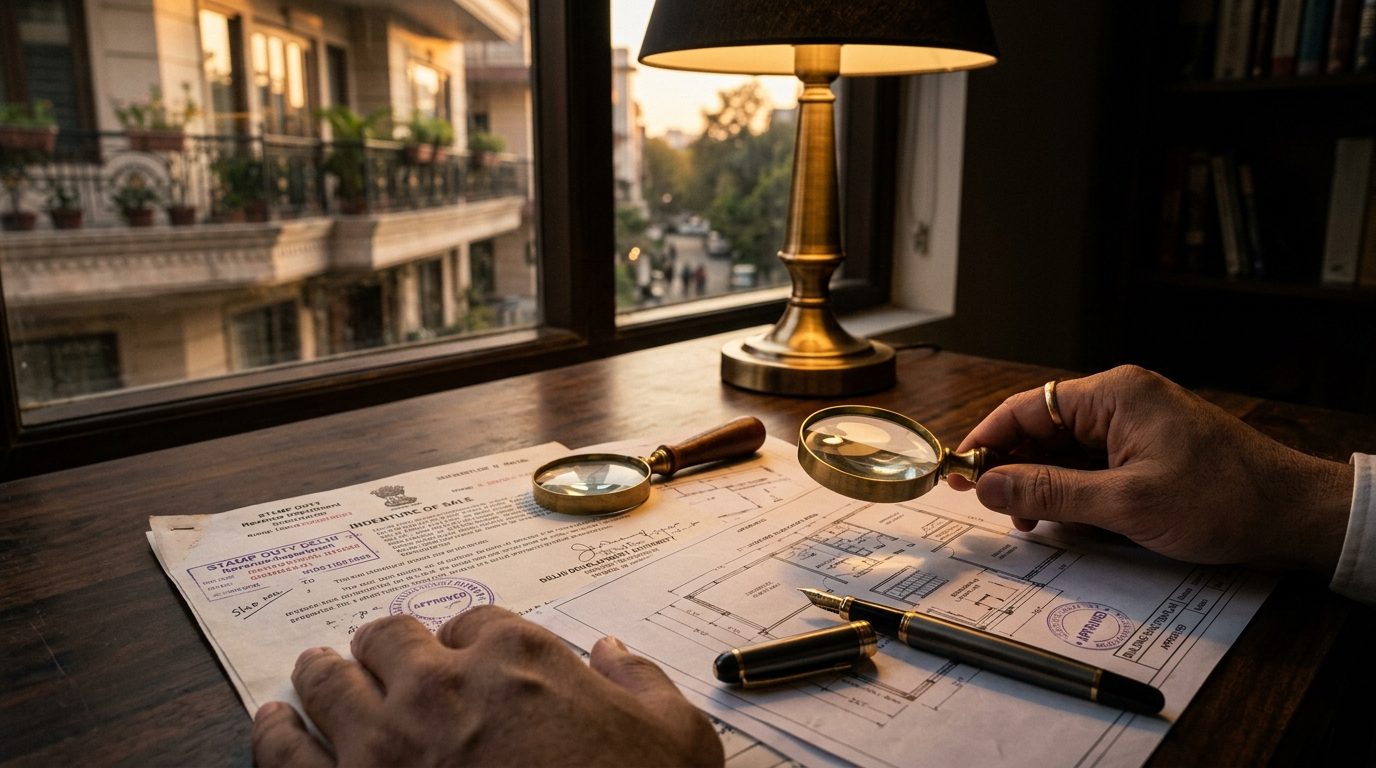
Property registration process in Delhi — stamped sale deed and building plan being reviewed before the sub-registrar appointment
SouthDelhiFloors · Transaction Desk

Property Registration Process in Delhi

The step-by-step 2026 guide to registering a sale deed — e-stamping, the DORIS portal, booking any of Delhi’s 22 sub-registrar offices under Anywhere Registration, the documents to carry, and what must happen after the registry.

By the SouthDelhiFloors Research Desk Updated July 2026 12 min read
What is the property registration process in Delhi?

The property registration process in Delhi has three stages: first, you pay stamp duty online through e-stamping and pay the 1% registration fee; next, you book an online appointment at any sub-registrar office (SRO) in Delhi under the Anywhere Registration policy; finally, buyer, seller and two witnesses appear at the SRO, where photographs and biometrics are taken and the sale deed is registered. With papers in order, the SRO visit itself takes under an hour, and the registered deed is typically returned the same day or within a few days.

Registration is not a formality. Under the Registration Act, 1908, a sale of immovable property is only legally complete when the sale deed is registered — an unregistered deed does not transfer ownership, no matter how much money has changed hands. In a market like South Delhi, where a single floor can cost more than a whole building elsewhere, the registry is the moment your crores become a legal title.

Fortunately, Delhi has quietly become one of the easier states to register in. Payments moved online years ago, and the Anywhere Registration policy now lets you pick whichever of the city’s sub-registrar offices suits you, instead of queueing at the one office tied to your colony. This guide walks through the entire property registration process in Delhi, from the duty calculation to the day after the registry.

4–6%Stamp duty (female / male buyer) on the higher of deal or circle value
+2%MCD transfer duty (1%) plus registration fee (1%)
22Sub-registrar offices — use any one under Anywhere Registration
~1 hrTypical time at the SRO with complete papers

Before the registry: what the property registration process in Delhi assumes you have done

By the time you reach the sub-registrar, the real work should already be finished. Above all, the title must be verified — the full chain of prior deeds, the freehold status, and the sanctioned building plan. Our builder floor buying checklist covers those checks in detail, and if you are financing the purchase, the bank’s legal team will run its own search as part of your builder-floor home loan.

Secondly, the numbers must be settled. Stamp duty in Delhi is charged on the higher of your deal price or the circle-rate value of the property — a distinction that matters enormously in South Delhi, where market prices run far above circle rates. We explain that gap in our guide to circle rate vs market rate in Delhi, and the full duty arithmetic in the stamp duty and registration charges guide.

Finally, the tax step: on any purchase of ₹50 lakh or more, the buyer must deduct 1% TDS from the seller’s payment and deposit it with the Income Tax Department via Form 26QB before or at the time of payment. Buying from an NRI seller? The TDS rules change completely — read the NRI guide to buying and selling in South Delhi before you pay a rupee.

The property registration process in Delhi, step by step

Here is the sequence exactly as it runs for a South Delhi builder-floor purchase in 2026. The same flow applies to plots, flats and commercial premises, with only the duty rates changing.

Get the sale deed drafted

A lawyer or deed writer prepares the sale deed: parties, full property description, land share, consideration, and the chain of title recited. Every schedule and measurement in this document becomes your permanent legal record — proof it before anything is printed.

Calculate duty on the higher of deal price or circle value

Male buyers pay 6% stamp duty, female buyers 4%, and joint (with a woman) 5%. On top of that sit the 1% MCD transfer duty and the 1% registration fee — a total of 6% to 8% of the value.

Deposit the buyer’s TDS

For consideration of ₹50 lakh or above, file Form 26QB and deposit 1% TDS on the sale value. Carry the challan/Form 16B trail — banks and careful sellers will ask for it at closing.

Pay stamp duty and registration fee online

Delhi uses e-stamping through the Stock Holding Corporation of India (SHCIL). Pay the stamp duty and the 1% registration fee online and obtain the e-stamp certificate that gets bound into the deed.

Book an SRO appointment on the DORIS portal

Book an online appointment through Delhi’s registration portal. Under Anywhere Registration, every sub-registrar in Delhi acts as a joint sub-registrar for the whole city — so choose the office and slot that suit you, not the one your colony historically fell under.

Appear at the sub-registrar with witnesses

Buyer, seller and two witnesses attend with originals. The SRO verifies identities, takes photographs and biometric thumb impressions, and the parties sign the deed before the sub-registrar.

Collect the registered deed

Once registered, the deed is scanned into the government record and returned bearing its registration number. Store the original safely — and store certified copies separately.

Complete mutation after registration

Registration proves ownership; mutation updates the municipal tax record into your name. For deeds registered since 2019 the sub-registrar pushes the data to the MCD automatically, but verify it happened — our guide to mutation of property in Delhi shows exactly how.

The document file to carry

Original sale deed (unsigned, for execution) with e-stamp · complete prior chain of title deeds · Aadhaar and PAN of buyer, seller and witnesses · two passport photos of each party · TDS challan (Form 26QB) · registration fee receipt · latest property-tax receipt · NOC or loan-closure letter if the seller had a mortgage. Missing any one of these is the most common reason an appointment is wasted.

What the registry costs on a South Delhi floor

Because duty is charged on the higher of the two values, and South Delhi deals close well above circle rates, the government charges are calculated on your actual price in almost every case. Here is the complete cost stack on a typical purchase.

Government charges on a ₹10 crore builder-floor purchase in Delhi (2026)
ChargeMale buyerJoint (with a woman)Female buyer
Stamp duty6% — ₹60,00,0005% — ₹50,00,0004% — ₹40,00,000
MCD transfer duty1% — ₹10,00,0001% — ₹10,00,0001% — ₹10,00,000
Registration fee1% — ₹10,00,0001% — ₹10,00,0001% — ₹10,00,000
Total on registry₹80,00,000 (8%)₹70,00,000 (7%)₹60,00,000 (6%)

Consequently, registering in a woman’s name — alone or jointly — saves ₹10–20 lakh on a ₹10 crore deal, entirely legally. The worked examples in our stamp duty guide go deeper into how families structure this.

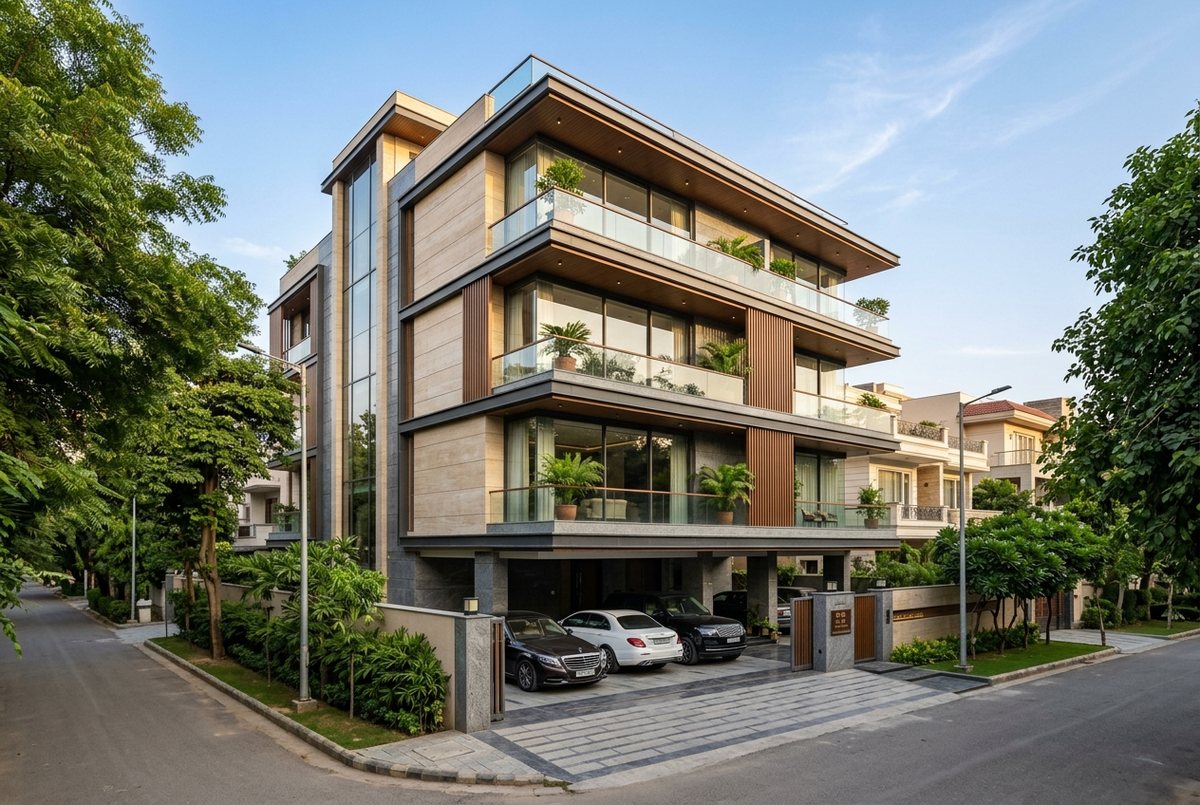
Property registration process in Delhi completed — a newly registered luxury builder floor in a South Delhi colony
The registry is the moment the floor legally becomes yours — everything before it is preparation.
A registry with clean papers takes an hour. A registry with one missing paper takes a month.
Mohit MinochaFounder, SouthDelhiFloors

After the registry: the three follow-ups buyers forget

First, complete the mutation so the MCD’s property-tax ledger shows your name — without it, bills and notices keep going to the seller. Second, if the property is on leasehold land, plan the conversion to freehold; South Delhi’s premium colonies are overwhelmingly freehold, but pockets remain. Third, update utilities and the RWA record, and file the registered deed with your bank if there is a loan. Only then is the transaction genuinely closed.

Key takeaways

  • The property registration process in Delhi runs in three stages: pay duty online, book any SRO under Anywhere Registration, then appear with witnesses for biometrics and signing.
  • Budget 6–8% of the value in government charges: 4/5/6% stamp duty by buyer profile, plus 1% MCD transfer duty and 1% registration fee.
  • Duty is charged on the higher of the deal price or circle value — in South Delhi, that means your actual price.
  • Deduct and deposit 1% TDS via Form 26QB on any purchase of ₹50 lakh or more before the registry.
  • Registration is not the finish line — mutation at the MCD completes the record.

Frequently asked questions

What is the property registration process in Delhi in 2026?

Pay stamp duty and the 1% registration fee online through e-stamping, book an appointment at any sub-registrar office via Delhi’s registration portal, then appear with the seller and two witnesses for biometric verification and signing. The registered deed is returned with its registration number, after which mutation at the MCD updates the tax record.

Can I register my property at any sub-registrar office in Delhi?

Yes. Under the Anywhere Registration policy, all of Delhi’s sub-registrar offices function as joint sub-registrars with city-wide jurisdiction, so you can book whichever office and slot suit you rather than the office tied to the property’s locality.

What documents are required for property registration in Delhi?

The executed sale deed with e-stamp, the prior chain of title deeds, Aadhaar and PAN of all parties and witnesses, passport photographs, the TDS challan (Form 26QB) for deals of ₹50 lakh or more, the registration fee receipt, the latest property-tax receipt, and a loan-closure NOC if the seller had a mortgage.

How much does property registration cost in Delhi?

Stamp duty is 6% for male buyers, 4% for female buyers and 5% for joint registration with a woman, plus a 1% MCD transfer duty and a 1% registration fee. The total is therefore 6% to 8% of the higher of the transaction value or circle-rate value.

Is stamp duty paid on the circle rate or the actual price?

On whichever is higher. In South Delhi, market prices are usually well above circle rates, so duty is computed on the actual deal price. Declaring less than the circle value triggers tax consequences for both sides.

How long does the registration take at the sub-registrar office?

With complete papers and a booked slot, the appearance, biometrics and signing typically take under an hour. The registered deed is generally returned the same day or within a few working days.

Is an unregistered sale deed valid in Delhi?

No. Under the Registration Act, 1908, the sale of immovable property is legally complete only on registration. An unregistered deed does not transfer ownership and is not admissible as proof of title, regardless of payment or possession.

Who pays the TDS at the time of purchase?

The buyer. On consideration of ₹50 lakh or more, the buyer deducts 1% from the payment to a resident seller and deposits it via Form 26QB. If the seller is an NRI, a much higher TDS regime applies and the buyer bears the compliance burden.

What happens after the sale deed is registered?

Complete the mutation so the MCD’s records and property-tax ledger show your name, update utilities and the RWA, and lodge the original deed safely — with your lender if the purchase was financed. For deeds registered since 2019, the sub-registrar pushes data to the MCD automatically, but you should verify the mutation went through.

Do both buyer and seller have to be physically present?

Yes, both parties (or their registered power-of-attorney holders, in limited legitimate cases) and two witnesses must appear before the sub-registrar for photographs, biometrics and execution. NRIs commonly execute through a properly registered and adjudicated PoA.

Registering a South Delhi floor? Let us run the file.

We prepare the deed, the duty workings, the TDS trail and the SRO appointment — and we stand with you at the registry. Clean deals only, fully documented.

SouthDelhiFloors is a property advisory. We are not a law firm; deed drafting is executed through empanelled counsel.

Process, portals and rates described are current for Delhi as of July 2026 and can change by notification. Official references: the Delhi Online Registration Information System (doris.delhigovt.nic.in) and SHCIL e-stamping (shcilestamp.com). Verify the prevailing procedure and charges at the time of your transaction.

Share this:

Like this:

Like Loading…

SOUTH DELHI FLOORS

Clean Deals Only · Since 1984

Second-generation consultants for South Delhi’s finest builder floors, farmhouses and independent homes. Four decades of clean, verified transactions.

+91 99990 04511

Enquire Now

Tell us what you are looking for and a senior consultant will get back to you.

    Your Name

    Telephone Number

    Your Email (required)

    Enter Your Message

    © 2026 SouthDelhiFloors LLP · All Rights ReservedClean Deals Only · Since 1984

    Compare Properties

    Compare
    You can only compare 4 properties, any new property added will replace the first one from the comparison.
    Property in South Delhi : Buy Sell Properties, Flats, Homes, Apartments Call SouthDelhiFloors
    Contact
    close slider

      Your Name

      Telephone Number

      Your Email (required)

      Enter Your Message

      error: Content is protected !! Please Don\\\\\\\'t Try To Copy