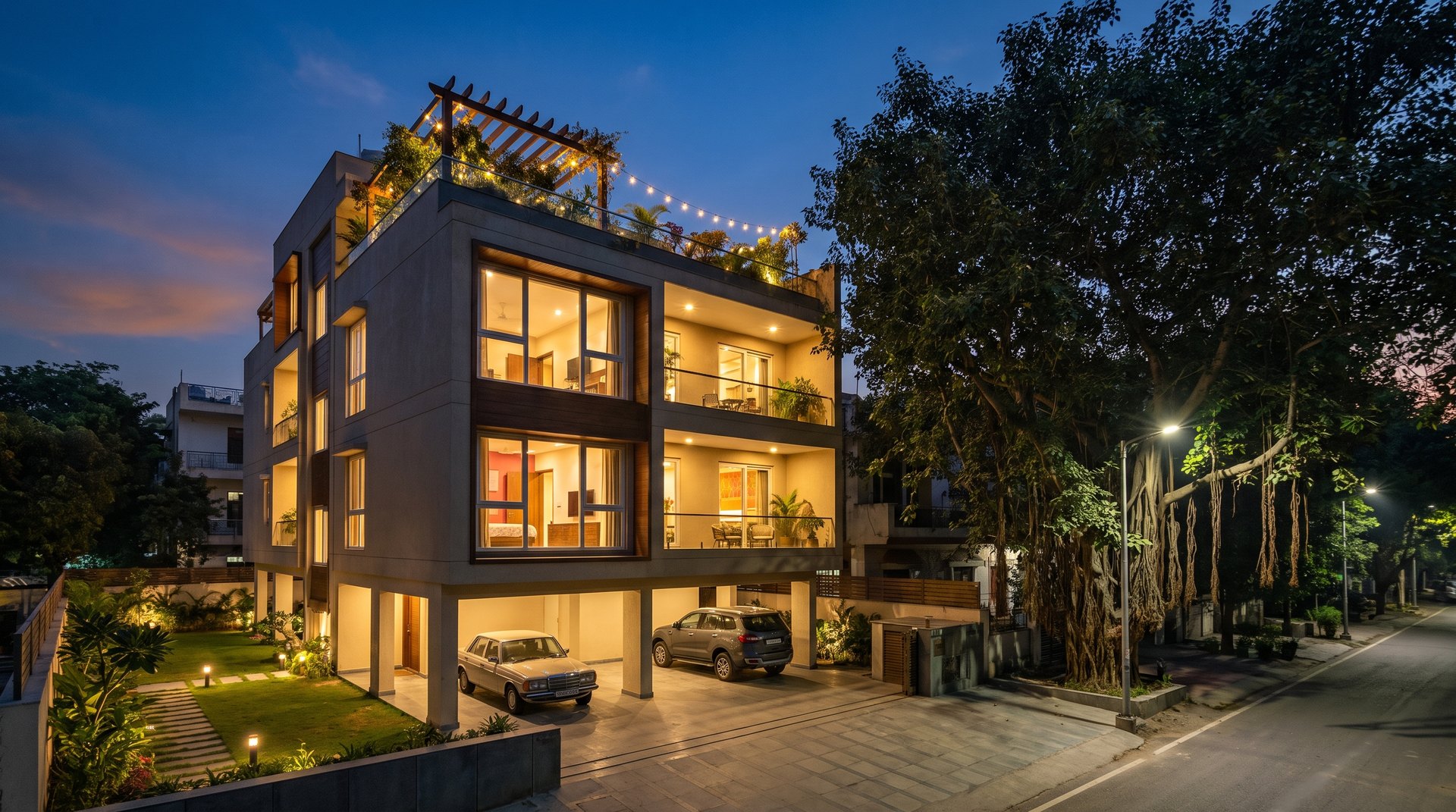
Best Floor in a Builder Floor: Ground, First, Second or Top With Terrace? The South Delhi Verdict
Every stilt-plus-four building in South Delhi sells four homes on one plot, and they are not priced alike. The ground floor comes with a lawn and usually the basement; the top floor comes with the terrace and a 10–20% premium; the two floors in between come with the best value per square foot. Here is how the market actually prices each level, what each one costs to live in, and which floor suits which buyer.
By the SouthDelhiFloors Research Desk Updated September 2026 10 min read
Which is the best floor in a builder floor?
There is no best floor — there is a best floor for a buyer. South Delhi prices the four levels of a stilt + 4 building in three tiers. The ground floor, sold with the private lawn and usually the basement (a 32.5% land-share unit), and the top floor, sold with exclusive terrace rights at a 10–20% premium, are the feature floors. The first and second floors are the value floors: same plan, same finish, same 22.5% land share, lowest price per square foot. Families with elderly parents, pets or a garden habit should buy the ground floor and check the basement’s sanctioned use. Buyers who entertain, or want a second home with sky, should buy the top floor and budget for the terrace. Almost everyone else — and every rental investor — is better served by a second or third floor with a lift, which is where the best price, the best light and the widest tenant pool meet.
We sell all four floors of the same building, often to four unrelated families, and the pricing pattern below is drawn from that experience rather than from a listing portal. It is a pattern, not a formula: a north-facing plot on a park changes the numbers, so does a basement that is actually habitable, so does a lift that is actually maintained. But the pattern is consistent enough across South Delhi’s builder-floor colonies that a buyer who knows it walks into a negotiation with the right expectations.
22.5%Standard land share per floor in a new stilt + 4 South Delhi building
32.5%Land share usually carried by the basement-plus-ground unit
10–20%Typical premium the top floor commands for exclusive terrace rights
17.5 mHeight cap that makes stilt + 4 the standard South Delhi building
How South Delhi prices the best floor in a builder floor
A 300 sq yd plot rebuilt to stilt + 4 produces four full floors of roughly the same built-up area, each with its own deed, its own parking slots and a fractional share of the land beneath — the mechanics are in our guide to terrace, parking and basement rights. The builder prices them off a base and adjusts for what each floor exclusively gets. Using a ₹9 crore first floor as the base, the pattern we see in Greater Kailash, Defence Colony, Panchsheel and the surrounding colonies looks like this:
Illustrative pricing pattern across one stilt + 4 building, first floor = 100 (SouthDelhiFloors desk view, 2026)
Floor
What it exclusively gets
Index
On a ₹9 crore base
Who usually buys it
Basement + ground
Private lawn, basement, direct stilt access, 32.5% land share
105–115
₹9.5–10.4 crore
Multi-generational families, doctors and professionals wanting a lower-level office, dog owners
First
Nothing extra — the base unit
100
₹9 crore
Value buyers, first-time colony buyers, rental investors
Second
Marginally better light and air; furthest from both street and roof
100–103
₹9–9.3 crore
Young families, corporate tenants — the quiet winner
Third
Best light below the roof; entirely lift-dependent
102–105
₹9.2–9.5 crore
Buyers who want the top-floor light without the terrace bill
Fourth (top)
Exclusive terrace rights, sky, privacy; 22.5% land share unless the deed says more
110–120
₹9.9–10.8 crore
Entertainers, NRIs and second-home buyers, terrace-garden households
Two readings of that table matter more than the numbers. First, the spread between the cheapest and dearest floor in the same building is routinely 15–20%, for identical square footage and finish — you are paying for a lawn or a roof, not a bigger home. Second, the value floors carry the same land share as the top floor, so when the building is eventually rebuilt or a collaboration is signed, the first-floor owner and the top-floor owner sit at the table as equals. The premium you pay today for the terrace does not buy you a larger stake in the land tomorrow.
Ground floor: the lawn, the basement and the questions to ask
In a colony the ground floor is the one that behaves most like the bungalow it replaced. You get the front lawn, a private entrance off the stilt, no dependence on a lift, and usually the basement — which is why it carries the larger 32.5% land share and a price at or above the top floor. For a household with elderly parents, small children or a dog, it is the obvious choice, and it is the floor that keeps its buyer pool in a downturn because families never stop needing it.
The trade-offs are real. It is the darkest floor in most plans, the noisiest (cars in the stilt, the gate, the street), the dustiest, and the one that needs the most security thought. The basement is the biggest variable: building bye-laws restrict basement use, sanctioned plans typically show storage and services rather than bedrooms, and a “duplex” marketed as three extra bedrooms below ground may be a regularisation problem you are buying with the floor. Ask for the sanctioned plan, check what the basement is approved for, and look hard at damp-proofing and the sump pump — a South Delhi monsoon finds every unfinished basement. Price the basement as what it is on paper, not what the brochure calls it.
First and second floors: the value tier, and why the second floor wins
The middle floors are where per-square-foot value is best, and the second floor is, in our experience, the best floor in a builder floor for most owner-occupiers. It is far enough from the street to be quiet and clean, far enough from the roof to be cool, gets better light than the first floor, and carries none of the top floor’s waterproofing and heat liabilities. It rents easily to the corporate and expatriate tenants who dominate the South Delhi lease market, because those tenants want a lift, light and privacy rather than a lawn to maintain. For a buyer running the rent-versus-buy arithmetic on a 2–3% yield, paying 15% less for the same floor plan is the single largest lever available.
The first floor is the base unit and the one to negotiate hardest on. Its only real disadvantages are the view of the stilt roof from its windows and proximity to the ground-floor family’s comings and goings. In a building without a lift — still common in pre-2015 stock — the first floor becomes the premium floor by default, because nobody wants to carry groceries to the third.
Founder Mohit Minocha on the best floor in a builder floor: it is decided by who lives there, not by the brochure.
“
Buyers ask me which floor is best. I ask who will climb the stairs when the lift is down, and who will sit on that terrace in May.
Mohit MinochaFounder, SouthDelhiFloors
Top floor with terrace: what the premium buys and what it costs
The fourth floor sells sky. Exclusive terrace rights turn a 2,500 sq ft home into one with 2,000 sq ft of open-air living, and in a city that entertains outdoors from October to March that is worth the 10–20% premium to the right household. It is the most private floor, the brightest, and the one buyers photograph. It is also the floor with the highest running costs: it takes the summer roof heat first, needs insulation or a planted terrace to be comfortable in May and June, depends entirely on the lift and its power backup, and lives with the overhead tank, the pumps and every waterproofing decision the builder made. Water pressure from a gravity tank is weakest here, so a booster pump is standard.
Three things to establish before paying the premium. First, that the terrace is actually yours: rights flow from the deed and the collaboration agreement, not from custom, and a deed that is silent gives you nothing — the point our terrace rights guide makes at length. Second, what sits on the roof by right of the other floors: tanks, solar panels, the lift machine room, a common staircase head, which can reduce “your” terrace by a third. Third, in an older stilt + 3 building, who holds the roof rights decides who benefits if a fourth floor is ever built under the FAR rules — that is a different, and larger, premium, and it should be priced as such.
The rental view is the opposite of the owner’s view
Owners pay most for the ground and top floors; tenants mostly do not. Corporate and expatriate leases in South Delhi cluster on the second and third floors with a lift, and the rent premium for a terrace or a lawn is thin next to the capital premium the owner paid for it. A rental investor should therefore buy the floor with the lowest price and the widest tenant pool, which is almost never the feature floor. The tax on that rent is worked in our rental income guide.
The best floor in a builder floor, by buyer: our verdict
Matching the floor to the buyer — the SouthDelhiFloors recommendation (2026)
If you are…
Buy
Because
Watch
A family with elderly parents, young children or pets
Ground floor
No lift dependence, a lawn, easy access; holds its value with families
Basement’s sanctioned use, damp, security, noise from the stilt
A first-time colony buyer stretching the budget
First or second floor
Same plan and land share, 10–20% cheaper than the feature floors
Lift quality and backup; who lives above and below
A rental investor
Second or third floor with a lift
Lowest capital cost against the widest corporate tenant pool
Do not pay a feature premium the rent will never return
An entertainer, an NRI or a second-home buyer
Top floor with exclusive terrace
Privacy, light, open-air living worth the premium to you
Terrace rights in the deed, roof heat, waterproofing, what the roof must share
A professional needing a home office or clinic space
Ground floor with basement
Separate access, lower-level rooms, parking convenience
Permitted use under the plan before you plan a practice there
Whichever level you decide is the best floor in a builder floor for you, the checks are the same as for any floor and are laid out in our 21-point buying checklist: sanctioned plan against what was built, title and land share, dues, and the collaboration agreement that created the floors. The floor-specific additions are the sanctioned use of the basement, the deed language on the terrace, the parking slots allotted to each level, and — for anything above the first floor — the lift’s make, maintenance contract and power backup. In an under-construction building, add the questions in our booking guide, because the floor you are promised on a plan is only as real as the sanction behind it.
Floor count is a legal fact before it is a feature
Many older South Delhi buildings carry an unsanctioned fourth floor or a basement extended beyond its approval. A “top floor” that is not on the sanctioned plan is not a premium; it is exposure. Match the floor you are buying to the plan on file before you match it to your budget.
Key takeaways on the best floor in a builder floor
South Delhi prices a stilt + 4 building in three tiers: ground with lawn and basement and top with terrace at a premium, and the first and second floors as the value tier — often 15–20% apart for identical square footage.
The top floor’s 10–20% premium buys exclusive terrace rights only if the deed grants them; it does not buy a larger land share, which stays at 22.5% per floor (32.5% for the basement-plus-ground unit).
The second floor is the best floor in a builder floor for most buyers: quiet, cool, lit, rentable, and priced at or near the base.
Rental investors should buy the cheapest floor with a lift; owner-occupiers should buy the floor that fits the household, and price the basement and terrace as the plan defines them.
Floor-specific checks: basement’s sanctioned use, terrace deed language, roof-top installations, lift and backup, and whether the top floor is on the sanctioned plan at all.
Frequently asked questions
Which is the best floor in a builder floor in South Delhi?
The floor that fits the buyer. Ground floors suit families needing a lawn and no lift dependence; top floors suit buyers who value a private terrace; the second and third floors give the best value per square foot and the widest tenant pool. For most owner-occupiers and nearly all rental investors, a second or third floor with a lift is the most rational purchase.
Is the ground floor the best floor in a builder floor for investment?
It holds value well with families and usually carries the basement and a larger 32.5% land share, but it is priced 5–15% above the middle floors and rents at a thin premium. As an investment it is sound on resale and weak on yield; as a family home it is often the right answer.
Why is the top floor of a builder floor more expensive?
Because it is typically sold with exclusive terrace rights, which add open-air living space, privacy and light. That premium runs 10–20% in South Delhi. The top floor also carries the highest running costs — roof heat, waterproofing, lift dependence and weakest water pressure.
Does the top floor automatically own the terrace?
No. Terrace rights come from the sale deed and the collaboration agreement, not from custom. A deed that is silent grants nothing, and the roof must still host common tanks, pumps and the lift machine room. Read the deed before paying the premium.
Which floor gets the highest rent in South Delhi?
Corporate and expatriate tenants cluster on second and third floors with a lift; ground and top floors rent at only a small premium to those. Since the owner pays a much larger capital premium for the feature floors, the middle floors deliver the best rental yield.
Do middle floors appreciate less than the ground or top floor?
Not in land terms. Every floor carries the same land share — usually 22.5% — so all four owners gain equally when the plot appreciates or the building is rebuilt. The feature premium is largely fixed at purchase and does not compound.
Can I live in the basement of a builder floor?
Only as the sanctioned plan and building bye-laws allow. Basements are typically approved for storage, services and limited uses; converting one into bedrooms invites regularisation and resale problems. Check the approved use before you pay for a “duplex”.
Is a lift mandatory in a stilt + 4 builder floor?
Most new stilt + 4 buildings are built with a lift, and buyers of the third and top floors should treat it as essential: verify the make, the maintenance contract and the power backup, and factor the monthly running cost into common charges.
Ground, middle or top? Let us price the building for you
The best floor in a builder floor depends on the building. We sell whole buildings floor by floor, so we know what each level should cost against the others in your colony. Tell us the block and the plan, and we’ll tell you which floor to buy and what to pay for it.
SouthDelhiFloors is a property advisory. Pricing patterns are desk observations for 2026 and vary by plot, block and build; verify plans and deeds before committing funds.
Pricing patterns, premiums and floor preferences are SouthDelhiFloors desk observations for the South Delhi builder-floor market as of September 2026 and are illustrative, not quotes; they vary by colony, plot orientation, plan, build quality and market conditions. Land-share figures reflect prevailing practice in new stilt + 4 buildings. Building norms follow the development-control regulations in force; verify sanctioned plans and permitted uses at dda.gov.in and with MCD before purchase, and take legal advice on deeds.