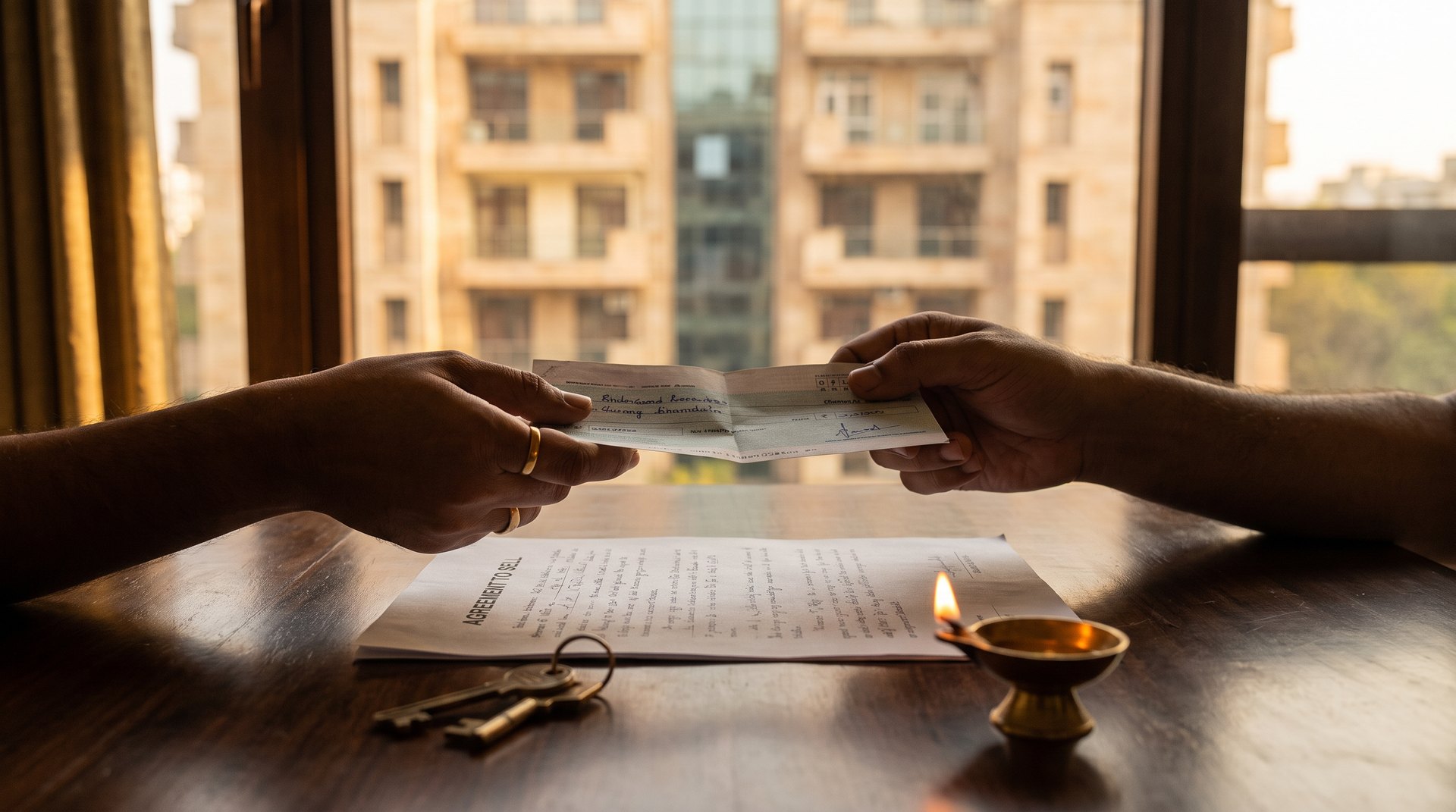
Token money in a property deal — a cheque handed across an agreement to sell with house keys beside it, a South Delhi builder floor in the evening light outside
SouthDelhiFloors · The Deal Desk

Token Money in a Property Deal: How Much, the Bayana Receipt, Refunds, Forfeiture and the Tax on It

Token money in a property deal is the first money that moves and the money most often fought over. In South Delhi it is a bank transfer of a few lakh against a bayana receipt, followed by 10% at the agreement to sell, then the balance at registry. Here is how much is normal, what the receipt must say, when it is refunded and when it is forfeited, what the “double bayana” custom is worth in law, and how the tax department treats a token that is kept.

By the SouthDelhiFloors Research Desk
Updated September 2026
10 min read
How does token money in a property deal work in Delhi?

Token money — bayana in Delhi usage, earnest money in the contract — is the sum a buyer pays to take a property off the market and bind both sides while the agreement is drafted and the title is checked. On a South Delhi floor it is typically 1–2% of the price, paid by bank transfer within a day or two of the handshake, against a signed receipt that names the property, the price, the time to complete and what happens if either side walks. It is followed by an agreement to sell with about 10% paid, and by the balance at registry, usually within 30 to 90 days. Three rules decide what it is worth. A buyer who backs out forfeits a reasonable token; a seller who backs out refunds it and, by Delhi custom and often by contract, pays the same again as compensation, failing which the buyer can sue for the floor itself. It cannot be paid in cash once it reaches ₹20,000. And a token the seller keeps is taxable income in the seller’s hands the year it is forfeited.

We take a token on almost every transaction we close, and we have refunded, forfeited and litigated enough of them to know that the receipt is where deals are won or lost. This guide is the version of the conversation we have with both sides before the transfer is made: how much to pay, what the paper must say, the four ways a token comes back or does not, and the tax and cash rules that changed the mechanics in the last decade. The document that follows the token — the agreement to sell — is covered in our guide to sale deeds, agreements and GPAs; this one is about the money that comes before it.

1–2%Typical token on a South Delhi floor — ₹10–20 lakh on ₹10 crore
10%Cumulative payment usually made at the agreement to sell
₹20,000Ceiling on any cash advance for property — the token goes through the bank
30–90 daysUsual window from token to registry, longer with a home loan

How much token money in a property deal is normal, and how the money moves

There is no statutory amount. The token is negotiated, and the right figure is the one that makes walking away expensive for the buyer without making forfeiture a windfall for the seller. In our experience that is 1–2% on a large South Delhi floor and rarely more than 5% on anything. The larger number — the 10% at the agreement to sell — is the market’s convention for earnest money proper, and it is the figure a court is most comfortable treating as a genuine pre-estimate rather than a penalty.

The payment sequence on a ₹10 crore South Delhi builder floor (2026 practice)
Stage Typical amount Paper Discipline
Day 0–2: token 1–2% — ₹10–20 lakh Bayana / token receipt signed by seller and buyer, two witnesses Bank transfer only; TDS of 1% deducted and deposited if the deal crosses ₹50 lakh
Day 7–15: agreement to sell 10% cumulative — ₹1 crore less the token Agreement to sell on nominal Delhi stamp, price, schedule, completion date, default clauses Seller hands over the document file; diligence window opens
Day 15–75: diligence and finance Title chain, sanctioned plan, dues, collaboration agreement, loan sanction The 21 checks in our buying checklist; any defect surfaces here, not at the registry
Day 30–90: registry Balance 90% Sale deed stamped at 8% (man) / 5% (woman) / 6% (joint) plus 1% registration, registered RTGS or banker’s cheque before the sub-registrar; possession and keys against the balance

Two mechanics changed the token in the last decade. First, cash: under Section 269SS (now Section 185 of the Income-tax Act, 2025) no one may accept an advance of ₹20,000 or more in cash in relation to immovable property, and under Section 269T a cash token cannot be refunded in cash either — both breaches carry a penalty equal to the amount, as our guide to cash in property deals sets out. The bayana in an envelope is a museum piece. Second, TDS: the buyer’s 1% under Section 194-IA is deductible at the time of each payment, including the advance, whenever the total price is ₹50 lakh or more — the mechanics are in our TDS guide. If a deal collapses after TDS has been deposited on the token, the seller claims the credit in their return; it is not lost, only delayed.

The bayana receipt: what it must say

The receipt for token money in a property deal is a contract, and in a dispute it is usually the only one. A one-line “received ₹10 lakh as token for E-block floor” leaves every consequence to argument. A good receipt runs to a page and settles seven things:

The parties and the property

Full names and PANs of seller and buyer, the property by address and floor, and the seller’s confirmation of ownership and authority to sell — including that all co-owners consent, which matters on inherited floors.

The price and the schedule

The total consideration, the token received and how, the amount and date of the next payment, and the outside date for the sale deed. Vague timelines are how tokens end up in court.

What the token is

State that it is earnest money adjustable against the price. Without that recital a buyer can argue it was a mere advance and recover it on default, and a seller can argue it was a non-refundable fee.

The buyer’s exit and its price

If the buyer fails to complete by the outside date, the token stands forfeited. Keep the sum reasonable: courts uphold forfeiture of genuine earnest money, but cut down amounts that operate as a penalty under Section 74 of the Contract Act.

The seller’s exit and its price

If the seller fails or refuses to complete, the token is refunded with the agreed compensation. Delhi custom is dugna bayana — return double — and it is enforceable as liquidated damages when written down and reasonable, and worth little when it is only assumed.

The conditions that unwind it without fault

A title defect, a missing sanction, an undisclosed encumbrance, or — if negotiated — a loan refusal: each should trigger a full refund within a stated number of days, with no forfeiture and no compensation. This clause is the buyer’s most valuable sentence.

Signatures, witnesses and the bank reference

Both parties sign, two witnesses attest, and the receipt records the UTR of the transfer. The bank narration should say what the money is; a token described as a “loan” on a statement invites a different set of tax questions.

Mohit Minocha, founder of SouthDelhiFloors, on token money in a property deal — what the bayana receipt must say
Founder Mohit Minocha on token money in a property deal: the receipt, not the amount, decides who keeps it.

A token is a promise with a price on it. Write the price of breaking it on the receipt, for both sides, and most of the disputes I have seen never happen.

Mohit MinochaFounder, SouthDelhiFloors

When token money in a property deal is refunded, and when it is not

What happens to the token in the five ways a deal ends (Delhi practice and law, 2026)
What happens The token The law behind it
The deal completes Adjusted against the price at the agreement or the registry The receipt’s recital that it is earnest money adjustable against consideration
The buyer withdraws or fails to pay on time Forfeited, if the receipt says so and the amount is reasonable Section 74, Contract Act: genuine earnest money may be forfeited; a penalty-sized sum is scaled down to actual loss
The seller withdraws, or sells to someone else Refunded in full plus the agreed compensation — customarily an equal amount Liquidated damages if written; otherwise damages on proof. The buyer may instead sue for specific performance, which the Specific Relief Act, as amended in 2018, now makes the rule rather than the exception
A title or sanction defect surfaces Refunded in full, no forfeiture The receipt’s conditions clause; a seller who cannot give clean title cannot keep earnest money
The buyer’s loan is refused Refunded only if a financing condition was negotiated into the receipt; otherwise forfeitable Contract terms — there is no implied loan condition, which is why our home loan guide says get the sanction-in-principle before the token

The second and third rows are where Delhi custom and the Contract Act meet. Custom says the buyer loses the token and the seller pays double; the Act says forfeiture and compensation must be reasonable, and courts have enforced both when the sums were genuine estimates of loss and trimmed both when they were not. A 10% earnest is routinely upheld; a 30% “token” forfeited on a week’s delay is routinely cut down. The practical rule is to keep the token proportionate and the consequences symmetrical — and to remember that the buyer’s strongest remedy against a seller who reneges is no longer the refund but the suit for the floor itself, brought within three years.

Three ways a token goes wrong before the receipt is even tested

Paying a broker instead of the seller — the token belongs in the owner’s account, never an intermediary’s, and the receipt is signed by the owner. Paying one co-owner — on inherited and jointly held floors every owner signs, or the token binds nobody. A bounced cheque — a token cheque that bounces is a criminal complaint under Section 138 of the Negotiable Instruments Act, which is why the market has moved to transfers against a UTR.

The tax on a token the seller keeps

Until 2014 a forfeited advance was not income; it simply reduced the seller’s cost of acquisition under Section 51, so the tax arrived years later as a larger capital gain. That changed with Section 56(2)(ix), carried into the Income-tax Act, 2025 as part of Section 92: any advance received in the course of negotiations for the transfer of a capital asset that is forfeited because the transfer does not go through is taxable as income from other sources, at the seller’s slab, in the year it is forfeited. The cost of the floor is no longer reduced. A seller who keeps a ₹20 lakh token therefore declares ₹20 lakh of income that year; at the 30% slab plus cess, about ₹6.24 lakh of the windfall goes to the exchequer.

The buyer’s side is the mirror image. A forfeited token is not a capital loss for the buyer, because no capital asset was transferred; it is simply money gone. Where the seller pays the buyer compensation for reneging — the “double bayana” — the compensation is a capital gain in the buyer’s hands, being the price of giving up the right to enforce the agreement. And the TDS deducted on a token is neither party’s loss: it sits against the seller’s PAN and is claimed in the seller’s return whether the deal completes or not. Sellers who want the arithmetic of the sale itself, from the token to the final 12.5%, will find it in our guide to selling a builder floor.

Key takeaways on token money in a property deal

  • Token money in a property deal is normally 1–2% of the price in South Delhi, followed by 10% at the agreement to sell and the balance at registry within 30–90 days.
  • It goes through the bank: a cash advance of ₹20,000 or more breaches Section 269SS (new 185), and a cash refund breaches Section 269T. TDS of 1% applies to the token when the deal crosses ₹50 lakh.
  • The receipt decides everything: earnest money adjustable against price, forfeiture on buyer default, refund plus agreed compensation on seller default, full refund on a title defect, and a financing condition if the buyer needs one.
  • Courts uphold forfeiture of reasonable earnest money and trim penalty-sized sums; a reneging seller faces refund with compensation or a specific performance suit for the property itself.
  • A token the seller keeps is taxable income in the year of forfeiture (old Section 56(2)(ix), new Section 92); the buyer’s loss is not a capital loss, and compensation received by a buyer is a capital gain.

Frequently asked questions

How much token money in a property deal is normal in Delhi?
There is no fixed rule. On a South Delhi builder floor the token is typically 1–2% of the price — ₹10–20 lakh on a ₹10 crore floor — paid by bank transfer within a day or two of agreeing the deal, followed by about 10% at the agreement to sell and the balance at registry.
Is token money in a property deal refundable if the buyer backs out?
Usually not. A buyer who withdraws or fails to pay on time forfeits genuine earnest money if the receipt says so. Courts uphold forfeiture of reasonable amounts under Section 74 of the Contract Act but scale down sums that operate as a penalty, which is why tokens are kept proportionate.
What happens if the seller backs out after taking token money?
The seller must refund the token and, if the receipt provides for it, pay the agreed compensation — Delhi custom is an equal amount, the ‘double bayana’. Alternatively the buyer can sue for specific performance and get the property itself; since the 2018 amendment to the Specific Relief Act that remedy is the rule, not the exception.
Can token money be paid in cash?
Not once it reaches ₹20,000. Section 269SS (new Section 185) bars accepting an advance for immovable property of ₹20,000 or more other than by account-payee cheque, draft or electronic transfer, with a penalty equal to the amount; a cash refund separately breaches Section 269T.
Is TDS deducted on token money?
Yes, if the total consideration is ₹50 lakh or more. The buyer deducts 1% under Section 194-IA on each payment, including the advance, and deposits it through Form 26QB. If the deal fails, the seller claims the TDS credit in their return.
Is forfeited token money taxable?
Yes, for the seller. Under old Section 56(2)(ix), now within Section 92 of the Income-tax Act, 2025, an advance forfeited because the transfer does not go through is taxable as income from other sources in the year of forfeiture. For the buyer it is not a capital loss.
What should a bayana receipt contain?
The parties and PANs, the property, the seller’s authority and all co-owners’ consent, the total price, the token and how it was paid, the next payment and its date, the outside date for the sale deed, a recital that the token is earnest money adjustable against price, the consequences of default on each side, the conditions for a full refund, signatures, two witnesses and the bank UTR.
Should the token be paid to the broker or the seller?
To the seller, always, into the owner’s own bank account, against a receipt signed by the owner. A token paid to an intermediary binds nobody and is hard to recover. A broker’s role is to witness and document the payment, not to hold it.

About to pay a token on a South Delhi floor?

Token money in a property deal should never become the dispute. We draft the bayana receipt both sides can live with, run the diligence inside the window, and get the deal from token to registry without the token becoming the dispute. Tell us the floor.

SouthDelhiFloors is a property advisory, not a law firm. Have the receipt and agreement reviewed by a lawyer before money moves.

Practice figures (token size, timelines, the 10% convention) are SouthDelhiFloors desk observations for the South Delhi market as of September 2026 and vary by deal. Legal positions summarised: Section 74 of the Indian Contract Act on forfeiture and liquidated damages; the Specific Relief (Amendment) Act, 2018 on specific performance; Section 138 of the Negotiable Instruments Act; Sections 269SS and 269T of the Income-tax Act (new Sections 185 and 188) on cash advances; Section 194-IA on TDS; Section 56(2)(ix) (new Section 92) on forfeited advances. Verify current provisions at incometaxindia.gov.in and take legal advice before paying or receiving a token.

Share this:

Like this:

Like Loading…

SOUTH DELHI FLOORS

Clean Deals Only · Since 1984

Second-generation consultants for South Delhi’s finest builder floors, farmhouses and independent homes. Four decades of clean, verified transactions.

+91 99990 04511

Enquire Now

Tell us what you are looking for and a senior consultant will get back to you.

    Your Name

    Telephone Number

    Your Email (required)

    Enter Your Message

    © 2026 SouthDelhiFloors LLP · All Rights ReservedClean Deals Only · Since 1984

    Compare Properties

    Compare
    You can only compare 4 properties, any new property added will replace the first one from the comparison.
    Property in South Delhi : Buy Sell Properties, Flats, Homes, Apartments Call SouthDelhiFloors
    Contact
    close slider

      Your Name

      Telephone Number

      Your Email (required)

      Enter Your Message

      error: Content is protected !! Please Don\\\\\\\'t Try To Copy