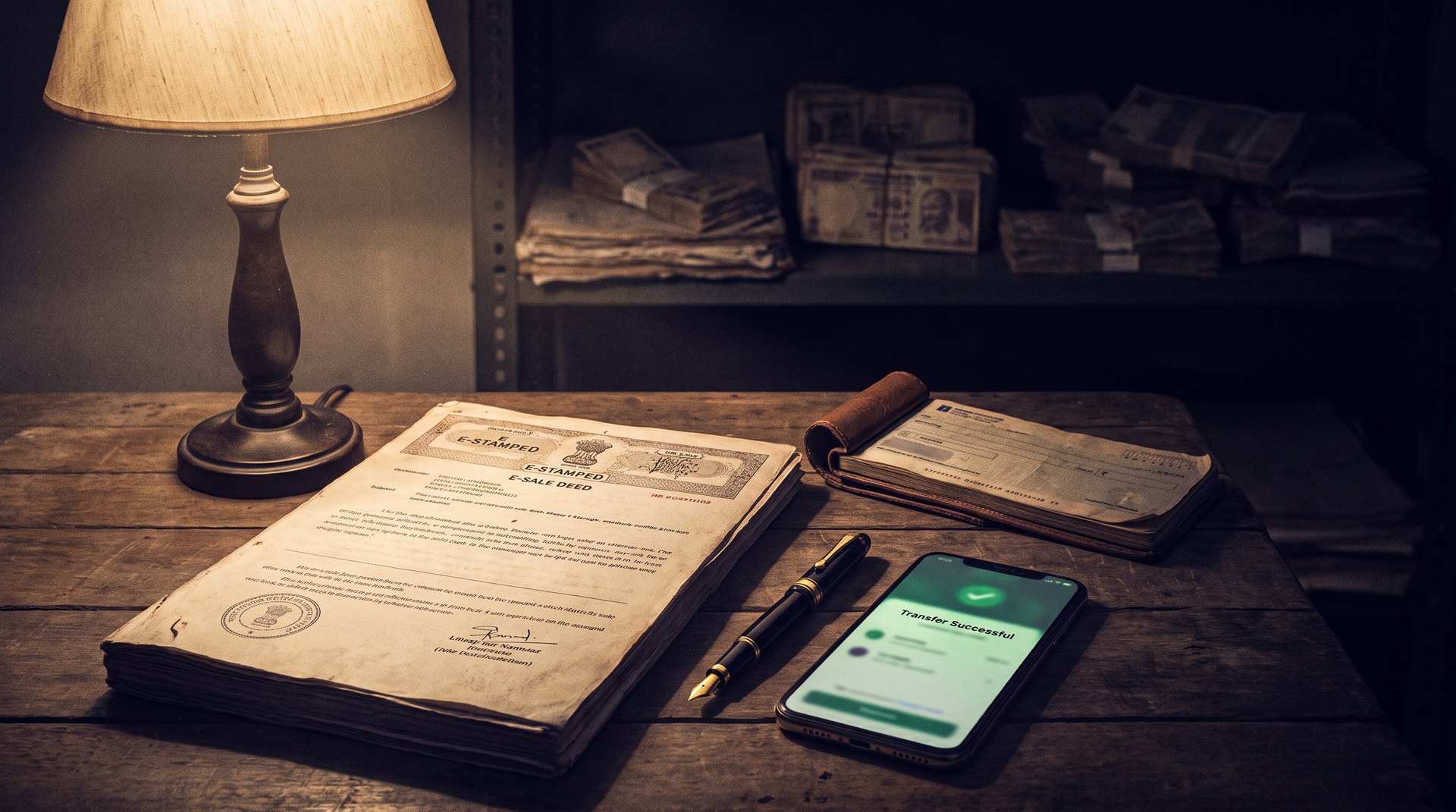
Cash payment for property purchase — a Delhi registration table with a cheque book, e-stamped deed and bank transfer on a phone, cash bundles fading in the background
SouthDelhiFloors · The Compliance Desk

Cash Payment for Property Purchase in India: The ₹20,000 Rule, the ₹2 Lakh Rule and the Penalty That Equals the Cash

Cash payment for property purchase is not restricted in India — it is effectively prohibited. A seller who accepts ₹20,000 or more in cash as an advance, or ₹2 lakh or more in cash for the deal, faces a penalty equal to every rupee received. Here are the four provisions that do it, a ₹10 crore worked example of what the “cash component” really saves and risks, how it gets caught in 2026, and how a clean South Delhi deal is actually paid.

By the SouthDelhiFloors Research Desk
Updated September 2026
11 min read
How much cash payment for property purchase is legal in India?

Almost none. Two provisions of the Income-tax Act close the door from both sides. Section 269SS (now Section 185 of the Income-tax Act, 2025) bars anyone from accepting an advance of ₹20,000 or more in cash in relation to the transfer of immovable property — whether or not the sale goes through. Section 269ST (now Section 186) bars anyone from receiving ₹2 lakh or more in cash in a single transaction, from one person in a day, or for one event — and a property sale is one transaction, so instalments do not help. The penalty in each case is 100% of the cash received, on the recipient, under Sections 271D and 271DA. Add the 1% TDS the buyer must deduct on the full price, the sub-registrar’s reporting of every deal above ₹30 lakh, and the Supreme Court’s April 2025 direction that registration offices report any cash of ₹2 lakh or more to the tax department, and the position is simple: a South Delhi property is paid for through a bank, in full, or not at all.

We are asked about the “cash component” less every year, and this guide is the answer we give when we are. It is not a lecture. It is a costing: what the cash portion of a deal is supposed to save each side, what it exposes each side to, and why, in 2026, the arithmetic has stopped working even for people who were never going to be caught. If you want the tax rules for the deal itself, they sit in our guides to TDS on purchase, capital gains and stamp duty; this one is about the part of the price that never used to reach the deed.

₹20,000Cash advance limit for any immovable-property transaction (Section 269SS)
₹2 lakhCash receipt limit per transaction, per day, per event (Section 269ST)
100%Penalty on the recipient — equal to the cash accepted (Sections 271D / 271DA)
₹30 lakhThreshold above which sub-registrars report every property deal to the tax department

The four provisions behind the cash payment for property purchase rules

The restrictions are on the person who receives the cash — the seller, usually — which is why sellers are the ones who should read this table twice. The buyer is not penalised under these sections, but is exposed under a different one, which the worked example below explains.

Cash rules that apply to a property transaction in India (2026), with the renumbered sections of the Income-tax Act, 2025
Provision What it prohibits Threshold Consequence
Section 269SS (new Section 185) Accepting a loan, deposit or a “specified sum” — any advance for the transfer of immovable property — other than by account-payee cheque, draft or electronic transfer ₹20,000 or more (aggregate with the same person) Penalty equal to the amount, under Section 271D, levied by the Joint Commissioner; relief only for proven reasonable cause
Section 269T (new Section 188) Repaying such an advance in cash — so refunding a cash token in cash is a second offence ₹20,000 or more Penalty equal to the amount, under Section 271E
Section 269ST (new Section 186) Receiving cash in aggregate from a person in a day, in a single transaction, or for one event or occasion ₹2 lakh or more Penalty equal to the amount, under Section 271DA, on the recipient
Sections 50C, 43CA and 56(2)(x) (new Sections 78, 53 and 92) Declaring a price more than 10% below the circle-rate value 10% tolerance band Seller taxed on circle value as deemed consideration; buyer taxed on the shortfall as income — the undervaluation trap in our circle rate guide

Read together, the first three provisions leave no lawful room for a cash payment for property purchase. The advance limb bites at ₹20,000, so even the customary cash token is a violation the moment it reaches that figure. The receipt limb bites at ₹2 lakh per transaction, and the Income-tax Department’s own guidance treats a sale as a single transaction however many instalments it is split into. The penalties are not a percentage of tax; they are a percentage of the cash, and that percentage is one hundred.

What the Supreme Court added in April 2025

In RBANMS Educational Institution v. B. Gunashekar, a buyer sued to protect a claimed ₹9 crore agreement on which he said he had paid ₹75 lakh in cash. The court threw the suit out and, noting that such payments openly violate Section 269ST, directed that courts must inform the tax department whenever a pleading claims cash of ₹2 lakh or more, that sub-registrars must report any document recording cash of ₹2 lakh or more, and that officers who fail to report face disciplinary action through the state’s Chief Secretary. A cash payment that reaches any piece of paper is now a self-reported offence.

The ₹10 crore worked example: what the cash component saves, and what it risks

To see what a cash payment for property purchase actually buys, take a South Delhi floor that changes hands at ₹10 crore, with the parties agreeing to register at ₹8 crore and pass ₹2 crore outside the deed. Here is what each side is supposed to gain, and what each side actually carries:

₹10 crore deal with a ₹2 crore cash component: the arithmetic on both sides (2026)
Seller Buyer
The supposed saving Long-term capital gains tax on ₹2 crore at 12.5% — about ₹25 lakh plus surcharge and cess Stamps and registration on ₹2 crore at 6–9% — ₹12–18 lakh
The statutory exposure Penalty of ₹2 crore under Section 271DA (100% of cash received); the ₹2 crore taxed as income anyway once found; prosecution risk The ₹2 crore treated as unexplained investment (old Section 69, new Section 103) unless its source is proven — taxed at 60% plus surcharge and cess, roughly 78%, with no deductions
The certain cost, even if never caught Cost of acquisition on paper is ₹8 crore, not ₹10 crore. At resale the taxable gain is ₹2 crore higher: 12.5% of that is ₹25 lakh of extra tax, on money already spent
The collateral cost Cannot deposit or use the cash without explaining it; deposits above ₹10 lakh a year are reported by the bank Home loan sanctioned only against the registered value; the cash portion is self-funded and invisible to the lender

Look at the buyer’s row. The stamp duty saved is ₹12–18 lakh; the extra capital gains tax at resale is ₹25 lakh, and that is before any penalty or investigation. The buyer who pays cash is not saving; he is borrowing against his own future sale at a bad rate and taking on unexplained-investment risk to do it. The seller’s ₹25 lakh saving is set against a ₹2 crore penalty, an eight-to-one bet on never being noticed — and the next section is about why that bet has stopped paying.

Mohit Minocha, founder of SouthDelhiFloors, on why cash payment for property purchase has disappeared from South Delhi deals
Founder Mohit Minocha on cash payment for property purchase: the cash portion is the part of a deal nobody can defend later.

The cash portion is the part of the deal no one can defend later — not the seller in a penalty notice, not the buyer at resale. We don’t do it, and the market has stopped needing it.

Mohit MinochaFounder, SouthDelhiFloors

How a cash payment for property purchase gets caught in 2026

The old assumption was that a cash component was invisible unless someone talked. Four data flows now run whether anyone talks or not.

The sub-registrar reports the deal

Every registration of immovable property worth ₹30 lakh or more is reported to the tax department in the registrar’s annual statement of financial transactions, and appears in both parties’ Annual Information Statement. The registered value, the names and the PANs are on file before the deed is delivered.

The TDS pins the price

The buyer’s 1% deduction under Section 194-IA is filed against the seller’s PAN with the consideration stated on Form 26QB. A consideration that does not match the registered value, the loan sanction or the seller’s capital-gains return is a mismatch the system flags automatically.

The bank reports the cash

Cash deposits of ₹10 lakh or more in a year in savings accounts are reported by banks; large cash withdrawals draw TDS of their own. A seller cannot bank the cash without explaining it, and a buyer cannot withdraw it without a record.

The paper turns witness

A receipt, an agreement recital, a WhatsApp message, a broker’s ledger, a suit when the deal sours — after the Supreme Court’s April 2025 direction, every court and registration office that sees a cash figure of ₹2 lakh or more is required to pass it to the tax department. The deals that are caught are usually caught by their own documents.

There is also a quieter reason the cash component has faded from South Delhi. Delhi’s circle rates were last revised in 2014 and sit well below market in the good colonies, so there was never a need to under-declare to avoid a circle-rate penalty; the duty was always payable on the real price. And the buyers of ₹10–30 crore floors today are professionals, listed-company promoters and NRIs whose money is banked by definition and whose lenders require a registered value that supports the loan. The white deal is not a moral choice any more; it is the only one that clears a bank, a CA and a registry.

What is still lawful, and how a clean deal is actually paid

Strictly, a cash payment for property purchase below ₹20,000 as a token does not breach Section 269SS, and a stray cash payment below ₹2 lakh does not breach Section 269ST. Neither is worth the ambiguity, and we advise against both: the customary token in a South Delhi deal is now a bank transfer against a receipt, and the rules on token money are cleaner when every rupee has a narration. Two side-payments deserve a warning. Brokerage is a receipt like any other, so commission of ₹2 lakh or more paid in cash puts the broker in breach; a professional brokerage invoices it with GST. And a “separate” payment for furniture or fittings is lawful only if it is genuinely for furniture, separately invoiced and paid through the bank — used to park part of the price, it is the same cash component with a different label.

How a ₹10 crore South Delhi floor is paid, cleanly, from token to registry
Stage Payment Discipline
Token Bank transfer or account-payee cheque against a signed receipt Narration on the transfer; the receipt states the property, the price and the refund terms
Agreement to sell Typically 10% of the price, less the token, through the bank Full price stated; TDS of 1% on each instalment deposited via Form 26QB within the deadline
Loan disbursement Lender pays the seller directly against the registered value A sanction letter at the true price is the buyer’s best evidence of a white deal
Balance at registry RTGS or banker’s cheque before the sub-registrar Deed recites the full consideration and the mode of every payment

The document chain that makes this work — agreement, diligence, deed — is the one described in our guide to sale deeds and agreements to sell, and the full cost stack of a white deal, every charge on one table, is in the all-in cost guide. A buyer paying the full price through the bank also gets something the cash buyer never does: a cost of acquisition that matches what was actually paid, which is worth exactly 12.5% of the difference on the day the floor is sold again.

Key takeaways on cash payment for property purchase

  • Cash payment for property purchase is effectively prohibited: ₹20,000 or more as an advance breaches Section 269SS (new 185), and ₹2 lakh or more per transaction breaches Section 269ST (new 186). Instalments do not reset the limit.
  • The penalty is 100% of the cash received, on the recipient (Sections 271D / 271DA); refunding a cash token in cash is a second breach under Section 269T.
  • In a ₹10 crore deal with ₹2 crore in cash, the seller risks a ₹2 crore penalty to save about ₹25 lakh; the buyer saves ₹12–18 lakh of duty and pays ₹25 lakh more capital gains tax at resale, plus unexplained-investment exposure at about 78%.
  • It gets caught through the registrar’s ₹30 lakh reporting, TDS mismatches, bank cash-deposit reports and, since April 2025, mandatory reporting by courts and sub-registrars of any cash figure of ₹2 lakh or more.
  • A clean deal is paid entirely through the bank: token against receipt, agreement with TDS, lender to seller, balance by RTGS at the registry.

Frequently asked questions

Is cash payment for property purchase allowed in India?
Not in any meaningful amount. A seller cannot accept ₹20,000 or more in cash as an advance for immovable property (Section 269SS, new Section 185) or ₹2 lakh or more in cash for the transaction as a whole (Section 269ST, new Section 186). Both carry a penalty equal to the cash received.
What is the penalty for accepting cash in a property deal?
100% of the amount received in cash — under Section 271D for an advance of ₹20,000 or more, and Section 271DA for receipts of ₹2 lakh or more. The penalty falls on the recipient, usually the seller, in addition to tax on the amount and possible prosecution.
Is the buyer penalised for paying cash?
Not under Sections 271D or 271DA, which target the recipient. But the buyer must explain the source of the cash; an unexplained investment (old Section 69, new Section 103) is taxed at 60% plus surcharge and cess, about 78%, and the buyer’s cost of acquisition on paper stays lower, raising capital gains tax at resale.
Does splitting the cash into smaller instalments avoid the ₹2 lakh limit?
No. Section 269ST applies per transaction as well as per day and per event, and a property sale is one transaction however it is paid. Instalments below ₹2 lakh that together relate to one sale still breach the limit.
Can token money be paid in cash?
Only below ₹20,000, and we advise against even that. Any advance for the transfer of immovable property of ₹20,000 or more must be by account-payee cheque, draft or bank transfer, and refunding a cash token in cash separately breaches Section 269T.
What did the Supreme Court say about cash in property deals in 2025?
In RBANMS Educational Institution v. B. Gunashekar (16 April 2025) the court held that a claimed ₹75 lakh cash advance violated Section 269ST and directed courts to report any pleaded cash of ₹2 lakh or more to the tax department, sub-registrars to report any such cash in a document, and states to discipline officers who fail to do so.
Why do people say cash saves stamp duty?
Under-declaring the price saves 6–9% of the undeclared amount in stamps and registration for the buyer. But the buyer’s recorded cost falls by the same amount, so capital gains tax at resale rises by 12.5% of it — more than the duty saved — before counting penalties or unexplained-investment tax.
Can I pay part of the price separately for furniture and fittings?
Only if it is genuinely for furniture, separately invoiced, reasonably priced and paid through the bank. A furniture payment used to park part of the property price is the same undeclared consideration and attracts the same rules; a cash receipt of ₹2 lakh or more for it also breaches Section 269ST.

Buying or selling in South Delhi? We only do white deals.

We do not take or arrange any cash payment for property purchase: every SouthDelhiFloors transaction is paid through the bank, invoiced with GST and registered at the real price. If that is how you want to buy or sell, we should talk.

SouthDelhiFloors is a property advisory, not a tax advisor. Confirm the tax consequences of any structure with a chartered accountant before you sign.

Provisions summarised as in force for FY 2026-27 under the Income-tax Act, 2025, with the familiar 1961 references: Sections 269SS, 269T and 269ST (new Sections 185, 188 and 186) and the corresponding penalties in Sections 271D, 271E and 271DA; Sections 50C, 43CA and 56(2)(x) with the 10% tolerance band; Section 69 and the 60% rate on unexplained investments; registrar reporting of transactions of ₹30 lakh and above and bank reporting of cash deposits under the statement-of-financial-transactions rules. Case law: RBANMS Educational Institution v. B. Gunashekar, Supreme Court, 16 April 2025. Read the text of Section 269ST at incometaxindia.gov.in, and take professional tax advice before any transaction.

Share this:

Like this:

Like Loading…

SOUTH DELHI FLOORS

Clean Deals Only · Since 1984

Second-generation consultants for South Delhi’s finest builder floors, farmhouses and independent homes. Four decades of clean, verified transactions.

+91 99990 04511

Enquire Now

Tell us what you are looking for and a senior consultant will get back to you.

    Your Name

    Telephone Number

    Your Email (required)

    Enter Your Message

    © 2026 SouthDelhiFloors LLP · All Rights ReservedClean Deals Only · Since 1984

    Compare Properties

    Compare
    You can only compare 4 properties, any new property added will replace the first one from the comparison.
    Property in South Delhi : Buy Sell Properties, Flats, Homes, Apartments Call SouthDelhiFloors
    Contact
    close slider

      Your Name

      Telephone Number

      Your Email (required)

      Enter Your Message

      error: Content is protected !! Please Don\\\\\\\'t Try To Copy