
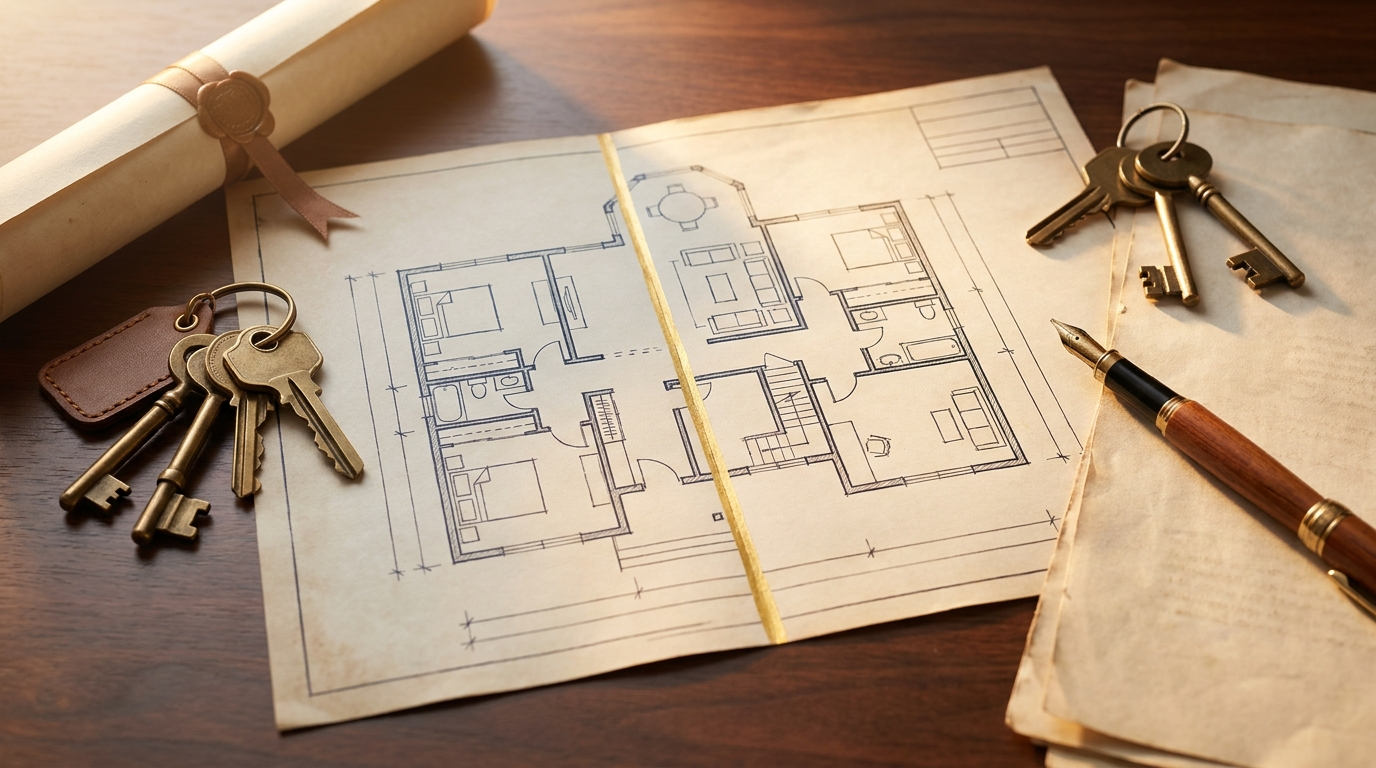















Partition deed stamp duty Delhi — a family home’s floor plan divided by a gold line with two sets of keys and deed papers
SouthDelhiFloors · Legal Desk

Partition Deed and Family Settlement in Delhi

Dividing the family building without selling it: the 2% duty that beats every conveyance, the memorandum that pays nothing at all, the capital-gains rule that surprises everyone pleasantly — and the mistakes that reopen settled peace.

By the SouthDelhiFloors Research Desk
Updated July 2026
10 min read
What is the partition deed stamp duty in Delhi?

Partition deed stamp duty in Delhi is 2% of the value of the separated share or shares, computed on the circle-rate value, plus a ~1% registration fee — and registration is compulsory. That makes partition the cheapest instrument for dividing co-owned family property: on a ₹2 crore separated share, roughly ₹6 lakh all-in against ₹12–16 lakh by gift or sale conveyance. A memorandum recording a past oral family settlement needs no stamp duty or registration at all. Moreover, a genuine partition is not a “transfer” for capital gains — no tax arises on dividing, and each member carries the original cost and holding period into their share.

Half of South Delhi’s best buildings are family-held: a plot bought by a grandfather, floors occupied by branches of the family, ownership still undivided on paper. Everything works — until a sale, a redevelopment or a succession forces the question of who owns exactly what. Partition is the legal machinery for answering it, and Delhi prices that machinery kindly. Accordingly, this guide covers the instrument, its cost, the family-settlement alternative, the tax treatment, and the process at the Sub-Registrar — the peaceful sequel to our guide on transferring property after death.

2%Stamp duty on the separated share’s circle value — the partition rate
~1%Registration fee on top — registration is compulsory
₹0Capital gains tax on a genuine partition — it is not a transfer
1976Kale v. DDC: a memorandum of past settlement needs no registration

Partition deed stamp duty in Delhi vs every other route

Dividing a ₹2 crore share of the family building — instrument by instrument (2026)
Instrument Government cost When it fits
Partition deed 2% + ~1% registration ≈ ₹6 lakh Co-owners dividing jointly held property into defined shares
Memorandum of family settlement Nil — if it only records a past oral settlement The family has already divided by word and conduct; paper follows fact
Gift deed Full conveyance stack — 6–8% all-in ≈ ₹12–16 lakh One-way transfer to a person who owns no existing share
Sale deed between family 6–8% all-in + capital gains for the seller A branch is genuinely being bought out for money
Court partition suit Court fees + years of litigation When consensus has failed — the route of last resort
The comparison explains the drafting discipline this area demands. The 2% rate belongs to an instrument of partition — co-owners dividing what they already jointly own. If the document instead moves property to someone without a pre-existing share, it is a gift or sale in partition’s clothing, and the Registrar (or worse, a later court) will price it as one. Equally, unequal divisions balanced with cash (“owelty”) are legitimate partition mechanics — but the money must be in the deed, not around it.
The memorandum rule — and its limits

Since Kale v. Deputy Director of Consolidation (1976), a family arrangement made orally and acted upon needs no registration, and a memorandum that merely records that past settlement is not an instrument of partition — so it attracts no stamp duty and no compulsory registration. The trap is the tense: a document that itself divides the property “hereby allots…” is a partition deed whatever its title says, and unstamped it is inadmissible as evidence of title. Banks and buyers also lend and pay against registered instruments, not memoranda — which is why serious families record the settlement, then register a formal partition deed at 2% before anyone needs to sell, mortgage or rebuild.

The tax position — the pleasant surprise

A genuine partition among co-owners, or of an HUF, is not a transfer for capital gains purposes: nobody “sells” anything, pre-existing joint rights are merely defined in severalty. Consequently no capital gains tax arises at partition, and — the part that matters years later — each member inherits the original cost of acquisition and the original holding period for their separated share. When a floor received in a 2026 partition of a 1985 building is sold in 2030, the gain runs from 1985 economics, taxed at the long-term rate our capital gains guide details. The same logic keeps a bona fide family settlement outside gift taxation among the parties.

Registering a partition deed in Delhi: the process

Inventory and shares

List every property and every co-owner with their undivided share — from the title chain, succession position or HUF composition. Ambiguity here is where future litigation is manufactured.

Value at circle rate

Compute each separated share’s value on the applicable circle rates — land share plus construction, per the colony’s category. This is the base for the 2% duty; one deed can partition multiple properties.

Draft the deed

Recitals of ownership, the division (floor-wise in a typical South Delhi building, with terrace, stilt and basement rights expressly allocated), any owelty payments, and mutual releases — drafted by a lawyer, not a template.

E-stamp and register

Buy the e-stamp for 2% of the separated shares’ value, book the Sub-Registrar appointment, and appear — all parties, with ID, photographs and title papers — paying the ~1% registration fee. Unregistered, the deed cannot prove title.

Mutate every share

Post-registration, each member records their separated ownership with the MCD — the mutation that aligns property tax and future sale paperwork with the new reality.

Mohit Minocha of SouthDelhiFloors in an ivory bandhgala in a heritage family study — partition deed and family settlement
Kept in the family: founder Mohit Minocha — at 2% stamp duty, a partition deed is the cheapest peace a family will ever buy.

Families don’t fight over property. They fight over undefined property. The partition deed is the peace treaty.

Mohit MinochaFounder, SouthDelhiFloors

One closing calibration: partition divides ownership; it does not upgrade it. Shares emerging from a partition still carry the building’s history — sanction status, duty-paid trail, occupancies. Where the real plan is a rebuild, partition first and collaborate after: builders negotiate with defined owners, banks lend against registered shares, and every branch of the family signs from strength rather than suspicion.

Key takeaways

  • Partition deed stamp duty in Delhi is 2% of the separated share’s circle-rate value, plus ~1% registration — roughly ₹6 lakh on a ₹2 crore share, against ₹12–16 lakh by gift or sale conveyance.
  • Registration is compulsory; an unregistered partition deed cannot prove title, support a mortgage or satisfy a buyer’s lawyer.
  • A memorandum recording a past oral family settlement pays nothing (Kale, 1976) — but a document that itself divides property is a partition deed regardless of its title.
  • A genuine partition is not a transfer: no capital gains arise, and each member carries the original cost and holding period into their share.
  • Sequence for family buildings: settle, register the partition at 2%, mutate each share — then sell, mortgage or redevelop from clean, defined ownership.

Frequently asked questions

What is the stamp duty on a partition deed in Delhi?
2% of the value of the separated share or shares, computed on circle-rate valuation, plus a registration fee of about 1%. One registered deed can cover multiple properties being divided in the same settlement.
Is registration of a partition deed compulsory?

Yes — an instrument of partition of immovable property must be registered. Unregistered, it is inadmissible to prove the division and each member’s title, which defeats the entire purpose.

Does a family settlement need stamp duty?

Not if it is a memorandum merely recording a family arrangement already concluded orally and acted upon — the Kale doctrine. If the document itself effects the division, it is chargeable and registrable as a partition deed, whatever heading it carries.

Is there capital gains tax on partition?

No — a genuine partition among co-owners or of an HUF is not a transfer, so no capital gains arise. Each member takes the original cost of acquisition and holding period into their separated share, which governs tax only on a future sale.

Can shares be unequal?

Yes — families routinely allot unequal shares, balanced by owelty (equalisation money) written into the deed. Keep the balancing inside the instrument; side payments outside it create both evidentiary and tax problems.

Partition deed or gift deed — which is cheaper?

Between existing co-owners, partition at 2% is far cheaper than gift at full conveyance rates (6–8% all-in). A gift is the right instrument only when the recipient holds no existing share — a different transaction, priced differently.

How is a typical South Delhi building partitioned?

Floor-wise: each branch takes a floor (or floors) with a defined land share, and the deed expressly allocates terrace, stilt and basement rights — the same rights architecture every builder floor deed uses, applied within the family.

What if one co-owner refuses to sign?

Consensual partition needs everyone. Failing that, any co-owner may file a partition suit; the court divides (or orders sale and division of proceeds), but over years and at real cost. The 2% deed exists precisely to make that unnecessary.

Do we need probate or a succession step first?

Ownership must be established before it can be divided — so where the property comes from a deceased owner, complete the succession/mutation steps first (our transfer-after-death guide maps them), then partition among the established heirs.

What happens after registration?

Each member mutates their separated share with the MCD, property tax records split, and every share becomes independently sellable, mortgageable and redevelopable — the clean chain a future buyer’s lawyer will thank you for.

Dividing the family building?

We map the shares, run the circle-rate valuation and 2% duty math, and coordinate the lawyers — so the settlement holds for a generation, not a news cycle.

SouthDelhiFloors is a property advisory. Deeds, adjudication and tax positions rest with your lawyer and CA.

Positions reflect Delhi’s stamp regime and settled law as of July 2026 — partition instruments chargeable at 2% of the separated share’s value on circle-rate valuation with ~1% registration and compulsory registration; memoranda of concluded oral family settlements outside stamp and registration per Kale v. Deputy Director of Consolidation (1976); genuine partitions outside “transfer” for capital gains with cost and holding-period carryover; and conveyance alternatives at the site’s standard 6–8% all-in stack. Rates and procedure change by notification; verify at doris.delhigovt.nic.in and with your lawyer before executing any instrument.

Share this:

Like this:

Like Loading…

SOUTH DELHI FLOORS

Clean Deals Only · Since 1984

Second-generation consultants for South Delhi’s finest builder floors, farmhouses and independent homes. Four decades of clean, verified transactions.

+91 99990 04511

Enquire Now

Tell us what you are looking for and a senior consultant will get back to you.

    Your Name

    Telephone Number

    Your Email (required)

    Enter Your Message

    © 2026 SouthDelhiFloors LLP · All Rights ReservedClean Deals Only · Since 1984

    Compare Properties

    Compare
    You can only compare 4 properties, any new property added will replace the first one from the comparison.
    Property in South Delhi : Buy Sell Properties, Flats, Homes, Apartments Call SouthDelhiFloors
    Contact
    close slider

      Your Name

      Telephone Number

      Your Email (required)

      Enter Your Message

      error: Content is protected !! Please Don\\\\\\\'t Try To Copy